All species › Passerines › Finches, euphonias and allies › ʻAkikiki
ʻAkikiki | Oreomystis bairdi
Kauaikruiper | ʻAkikiki de Kauaʻi
The ʻAkikiki is a small, grey-and-white honeycreeper that works its way up and down ohia trunks like a nuthatch. It occurs only on Kauaʻi and its disappearance from the wild has been the fastest of any Hawaiian bird: dozens remained in 2019, and the last known wild individual vanished in the autumn of 2025.
Voice
The contact call is a short, high weet or whit, often doubled, and usually the first sign of the bird. The breeding-season song is a descending trill of a few seconds, thinner and flatter than that of the Kauaʻi ʻAmakihi. Young birds give a stuttering series of chit notes, mostly while begging from their parents. The voice carries poorly through the wet canopy of the Alakai Plateau.
Recording: Patrick Blake — CC BY-NC-SA 4.0 · Alaka'i Wilderness Preserve, Halepa'akai Stream, Kauai, Hawaii, United States · xeno-canto
Identification
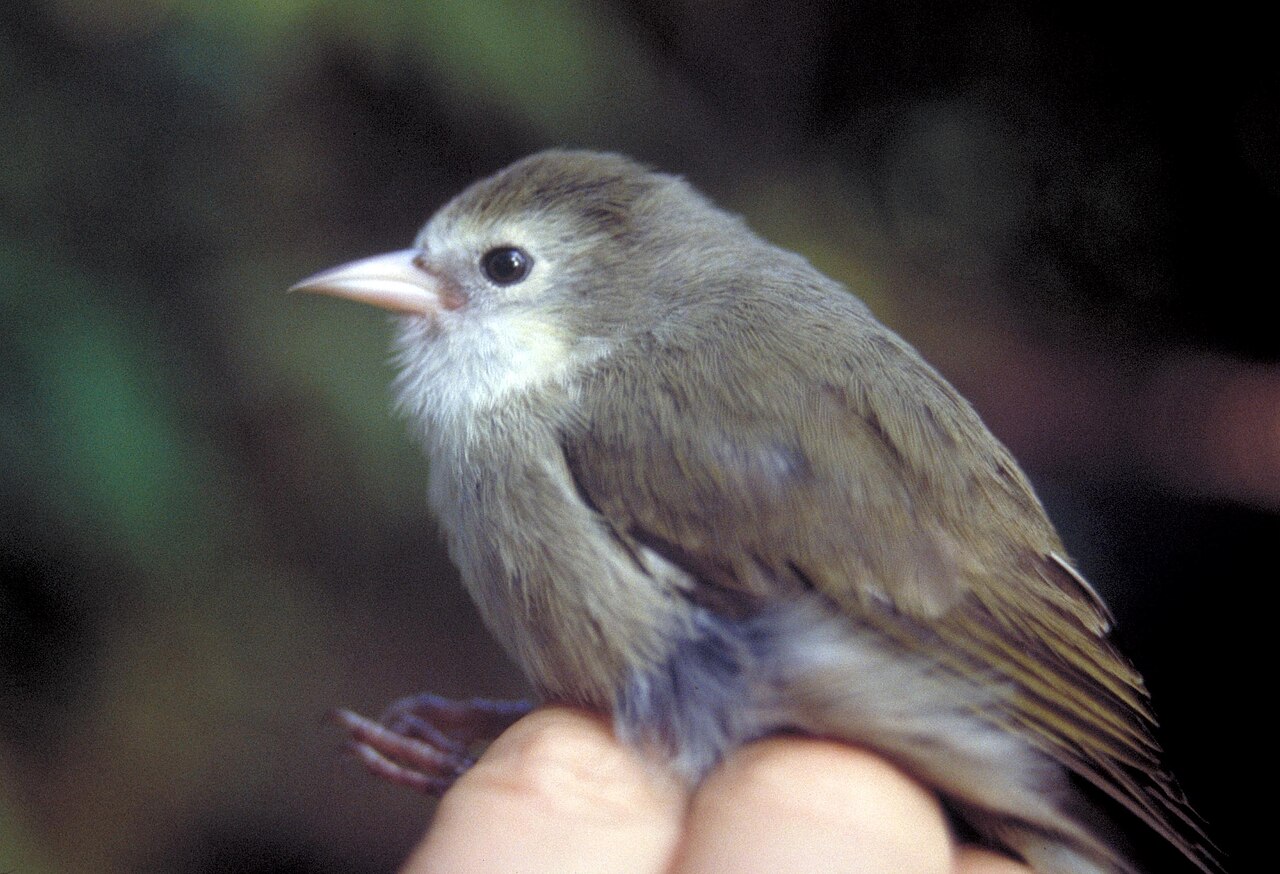
Plain grey above and white below, without streaking or wingbars. Bill and legs are pink, the bill short and slightly decurved. The tail is short, which gives the bird a stocky outline. A pale eyebrow is often present and may persist for years. Juveniles have a broad white eye-ring set like spectacles around the eye. The sexes look alike. It climbs trunks and heavy branches in short jerks, including head-downward, prising under moss and bark flakes for arthropods.
Confusion species
Kauaʻi ʻAmakihi is the usual confusion: it is yellow-green rather than grey and white, has a dark mask around the base of the bill and a distinctly more curved bill, and hangs at flowers and twigs instead of running along the trunk. ʻAnianiau is smaller and bright yellow. Kauaʻi ʻElepaio, also a grey forest bird, cocks its tail and shows a white rump and wingbars, and belongs to a different family altogether. The pink bill, short tail and trunk-climbing action settle it.
Habitat
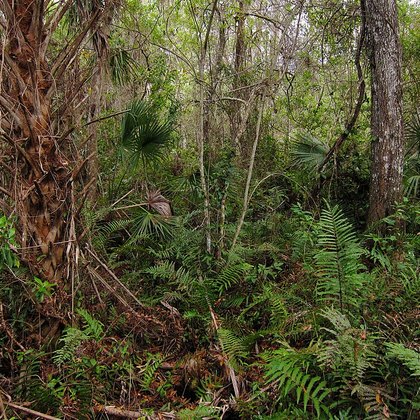
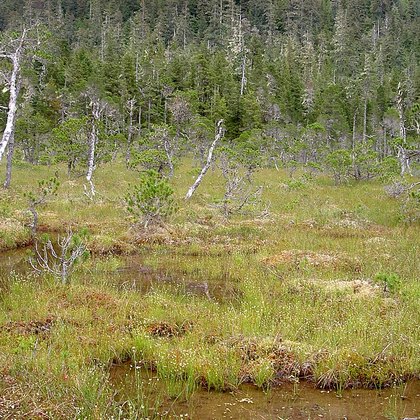
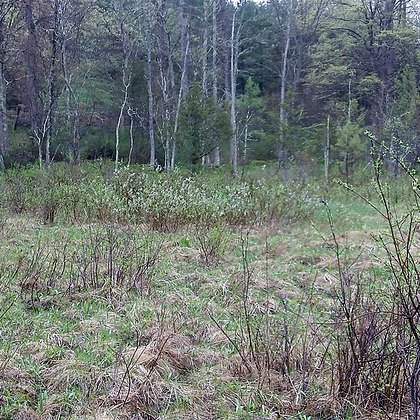
High, permanently wet ohia rainforest of the Alakai Plateau and Kokee State Park, above roughly 1000 metres, with moss- and lichen-covered trunks, tree ferns and adjoining open bog. Subfossil bones show that it formerly lived in dry forest at sea level as well. The present lower limit of the range is not a preference but a consequence: below that elevation mosquitoes breed year-round.
Where the bird is most often found, arranged by the USNVC — the vegetation classification of the United States and Canada — and CMECS for sea and coast.
Range and movements
Endemic to Kauaʻi. Around 1900 it occurred from about 300 metres upward, mainly on the south and west slopes; by the 1930s and 1940s the range had withdrawn above 900 metres and later to the central Alakai Plateau. Estimates fell from about 6,800 birds in 1968–1973 to 468 in 2012, 454 in 2018 and 45 in 2021. In July 2024 the species was declared functionally extinct in the wild; the last known wild female, Pakele, was seen on 29 August 2025. The remaining birds are held at the San Diego Zoo Wildlife Alliance breeding centres on Maui and Hawaii Island.
- Resident
Where and when to look
It is no longer to be expected in the field: no wild birds have been known since the autumn of 2025. Walkers on the Alakai Plateau now meet Kauaʻi ʻAmakihi and ʻAnianiau instead; check any grey, short-tailed bird climbing a trunk for a pink bill, and report such a sighting to the Kauaʻi Forest Bird Recovery Project.
Conservation
The species has been listed as Critically Endangered (CR) since 2000 and was placed under the US Endangered Species Act in 2010. The main cause is avian malaria carried by the southern house mosquito, introduced in 1826, which rising temperatures allow to survive ever higher in the mountains; on Kauaʻi there is no cold refuge left above the Alakai Plateau. Rat predation, forest damage by pigs and goats, and competition with the introduced Warbling White-eye add to it. The captive flock numbered about forty birds and breeds with difficulty; any release depends on mosquito suppression with sterile males over large areas.
Scientific name
Oreomystis bairdi | (Stejneger, 1887)
Stejneger described the species in 1887 as Oreomyza bairdi. That genus name proved to be preoccupied by a genus of flies, so in 1903 he replaced it with Oreomystis; because the species changed genus, author and year stand in parentheses. Oreomyza comes from Greek oros, oreos 'mountain' and myzo 'to suck', Oreomystis from the same oros with mystes 'an initiate'. The species name honours Spencer Fullerton Baird, secretary of the Smithsonian Institution. The Hawaiian name ʻAkikiki is the one used here; older literature calls the bird Kauaʻi Creeper. The specimen described came from Kauaʻi.