All species › Passerines › White-winged chough and apostlebird › White-winged Chough
White-winged Chough | Corcorax melanorhamphos
Modderkraai | Corvino negro
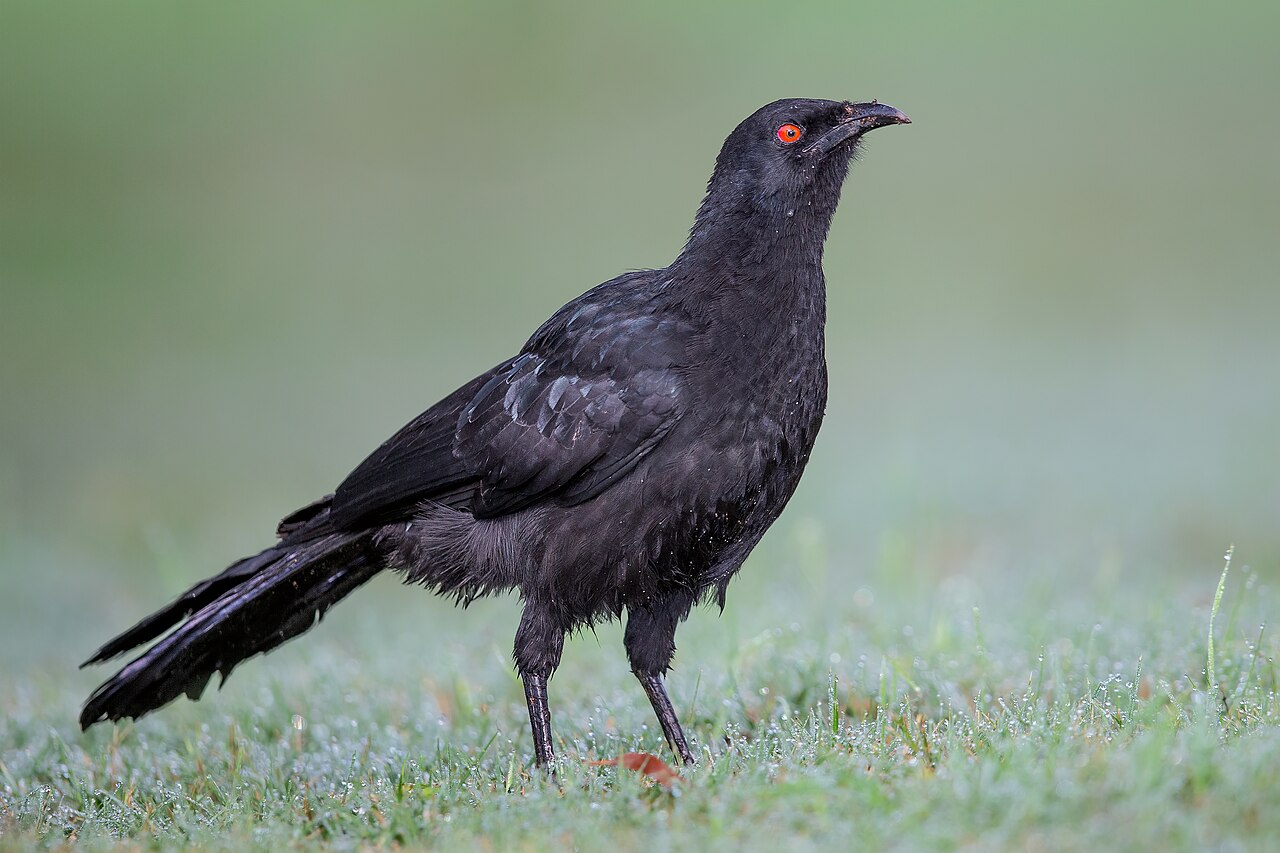
The White-winged Chough is no chough and no crow, but the larger of the two Australian mudnest-builders: a dull black bird with a blood-red eye, a slender curved bill and a white wing patch that only opens in flight. It lives in permanent families of four to twenty birds that build one mud nest together, incubate together and raise a single brood between them.
Voice
The commonest sound is a descending, mournful whistle with which family members keep track of one another through the woodland: weeoo, soft and velvety close to, thin and plaintive at range. On alarm the whole group switches at once to a harsh rattling call broken by hissing and rasping. Young birds beg with a persistent high piping that draws the rest of the family to them.
Recording: Nick Talbot — CC BY-NC-SA 4.0 · Crusoe Reservoir (near Kangaroo Flat), Greater Bendigo City, Victoria, Australia · xeno-canto
Identification
A dull black bird of just over forty centimetres, with a long tail, broad rounded wings and a slim, slightly decurved black bill. The eye is blood-red and visibly bulges when the bird is excited; young birds have a brown eye that turns red only in the fourth year. In flight a large white primary patch opens in each wing, and that mark settles everything. The flight is slow and floppy, with much gliding between tree and ground.
Confusion species
Australian Raven (Corvus coronoides) and Torresian Crow (Corvus orru) are glossy black with a white eye, carry a far heavier straight bill and show no white in the wing; nor do they work the forest floor in tight, noisy families. Pied Currawong (Strepera graculina) has a yellow eye and a white tail tip. The only relative, Apostlebird (Struthidea cinerea), is smaller, grey rather than black, and short and thick in the bill.
Habitat
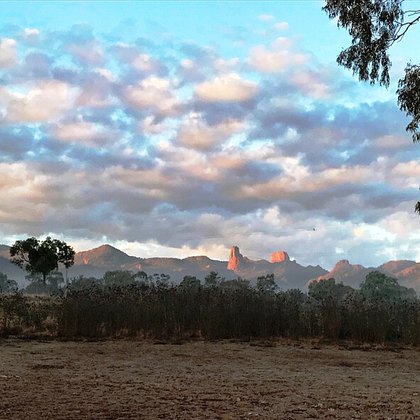
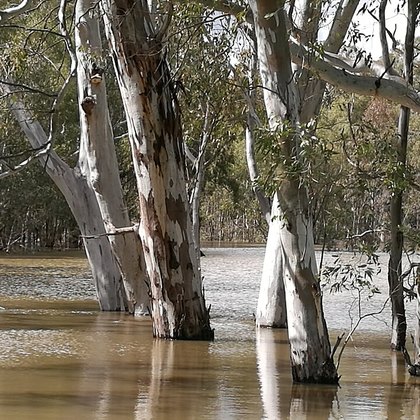
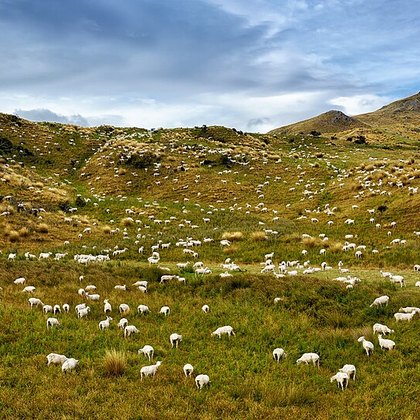
Open dry eucalypt forest and woodland with a deep layer of leaf litter, and the riverine timber along creeks where river red gum and coolibah stand. It needs two things that rarely coincide: litter damp enough to rake insects out of, and mud to build the nest from. Beyond that it walks grazed rangeland, road verges and roomy parks and country gardens with old trees.
Where the bird is most often found, arranged by main group and formation.
Range and movements
Eastern and southeastern Australia, from southern Queensland through New South Wales and Victoria to the southeastern corner of South Australia, and inland along the creek lines. It is absent from northern Queensland and from Tasmania. It does not migrate: a family holds ground that can run to a thousand hectares and stays there year after year, though in dry seasons groups shift to where the litter is still damp.
- Resident
- dark = core range, pale = thinly spread
Where and when to look
Listen first, then look at the ground: the mournful whistling betrays a family before you see it, and the party rakes through the litter with their bills like a line of weeders. Flush them and watch the moment the wings open, because the white patch is the only mark that holds up at a hundred metres. From July to December the mud nest sits open on a horizontal branch, usually less than ten metres up.
Conservation
Least Concern (LC). The species is numerous in the eastern interior and holds its own in grazed country that still carries old trees. Where the understorey and the litter go — through heavy grazing, the tidying away of fallen timber, and suburban spread — the chough goes too, because a family can only raise young if there are helpers enough, and small groups almost always fail.
Scientific name
Corcorax melanorhamphos | (Vieillot, 1817)
Vieillot described the bird in 1817 in another genus, so author and year stand in parentheses. The genus Corcorax was introduced by Lesson in 1831 and is formed on Greek korax, korakos, 'raven'. The epithet melanorhamphos is from Ancient Greek melano-, 'black', and rhamphos, 'bill'. This guide spells it melanorhamphos; GBIF carries the species under the spelling melanoramphos.