All species › Swifts › Swifts › White-throated Needletail
White-throated Needletail | Hirundapus caudacutus
Stekelstaartgierzwaluw | Vencejo mongol
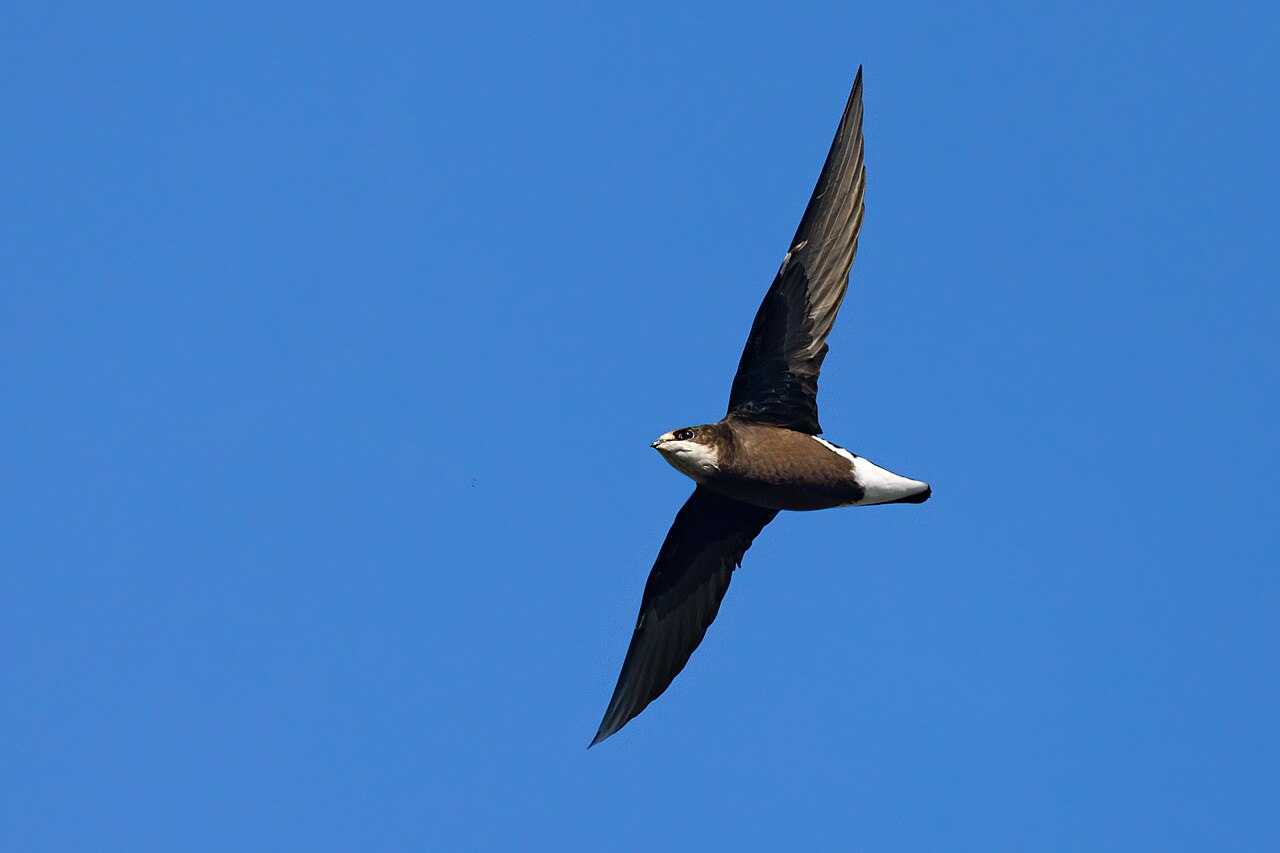
The White-throated Needletail breeds in the forests of Siberia and Japan and spends the southern summer over eastern Australia, from October to April. It is a heavy, broad-chested swift with a short square-cut tail from which the feather shafts protrude like needles, and it appears above all in the hours before a thunderstorm.
Voice
In Australia it is all but silent, and most observers see the species without ever hearing a sound from it. Where a large party hunts low there is sometimes a thin, rapid twittering that rattles across the birds and suggests insect buzz rather than bird voice. On the breeding grounds in the north it is noisier, but that country lies far outside this guide. Anyone watching a party feed over a ridge must work by eye and not by ear.
Recording: Uku Paal — CC BY-NC-SA 4.0 · 藻琴山 (near Teshikaga), Kawakami District, Hokkaido, Japan · xeno-canto
Identification
A thickset, barrel-bodied swift of twenty to twenty-two centimetres with very long scythe-shaped wings and a short, square-cut tail from which stiff needle-like shafts project. The plumage is grey-brown glossed green, with a white throat and a white horseshoe running from the undertail forward along the flanks — the decisive character, and against the light often the only one visible. A paler grey-brown saddle across the back stands out against the darker wings. The sexes are alike. The flight is fast and powerful, with long glides and hard turns, and in the air the bird reads as distinctly heavier than a swallow.
Confusion species
Fork-tailed Swift (Apus pacificus) is the only real confusion and passes through Australia in the same months: at seventeen to eighteen centimetres it is smaller and much slimmer, has a clearly forked tail and a white rump band, and lacks the white horseshoe under the tail. Swallows and martins are far smaller, fly more slowly and more flutteringly, and have a wholly different wing shape. At great height a party of needletails can also suggest feeding bats, but the pace is beyond comparison.
Habitat
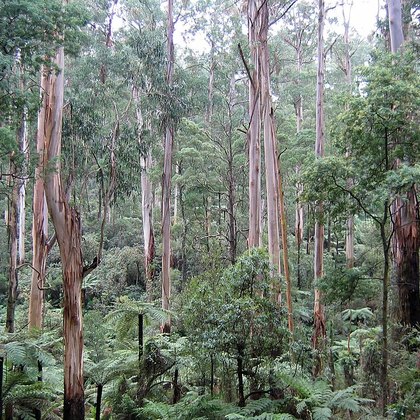
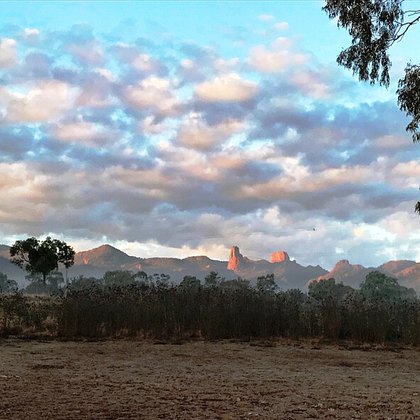
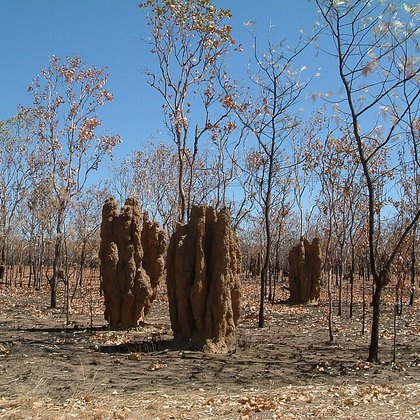
It lives in the air and uses the landscape only as something to hunt above: wet and dry eucalypt forest, savanna, farmland, ridges, sea cliffs and the sky over towns. It eats flying insects — termites, ants, beetles and flies — lifted on updraughts and on the thermals ahead of a storm front. It roosts in trees; old reports that the species never lands in Australia have not held up.
Where the bird is most often found, arranged by main group and formation.

Range and movements
It breeds from June to August in the forests of southeastern Siberia, Mongolia, the Korean Peninsula and northern Japan, and then moves south. In Australia it is present from October to April — the southern summer, the exact opposite of the season in which it breeds — chiefly along and east of the Great Dividing Range, and commoner on the coast than inland. It reaches Western Australia irregularly and in small numbers, and New Zealand only as a vagrant. The number of Australian records has fallen markedly over recent decades.
- Non-breeding visitor
- dark = core range, pale = thinly spread
Where and when to look
On a sultry afternoon between November and February watch the sky ahead of an approaching storm or cold front; that is when parties come down to hunt low and can be followed with the naked eye. Search along a ridge or above a wooded slope, where updraughts carry the insects up. On every bird wait for a moment when the undertail comes into view: the white horseshoe settles the species at once.
Conservation
Least Concern (LC) on the global list, but in Australia listed as Vulnerable both nationally and in New South Wales since April 2024, after a clear fall in records. The clearing of grassland, woodland and forest reduces the supply of aerial insects on which the species lives in the south. Collisions with wind turbines rank as a second threat, and the scale and causes of mortality are still little known.
Scientific name
Hirundapus caudacutus | (Latham, 1801)
Latham described the bird in 1801 as Hirundo caudacuta, among the swallows; because it was later moved to another genus, author and year stand in parentheses. The genus Hirundapus was introduced by Hodgson in 1836 and is built from Latin hirundo, 'swallow', and Apus, the genus of the swifts. caudacutus means 'sharp-tailed', from cauda and acutus, after the protruding shafts. The type locality is New Holland, narrowed by Mathews to New South Wales.