All species › Passerines › Honeyeaters › White-throated Honeyeater
White-throated Honeyeater | Melithreptus albogularis
Witkinhoningeter | Mielero goliblanco
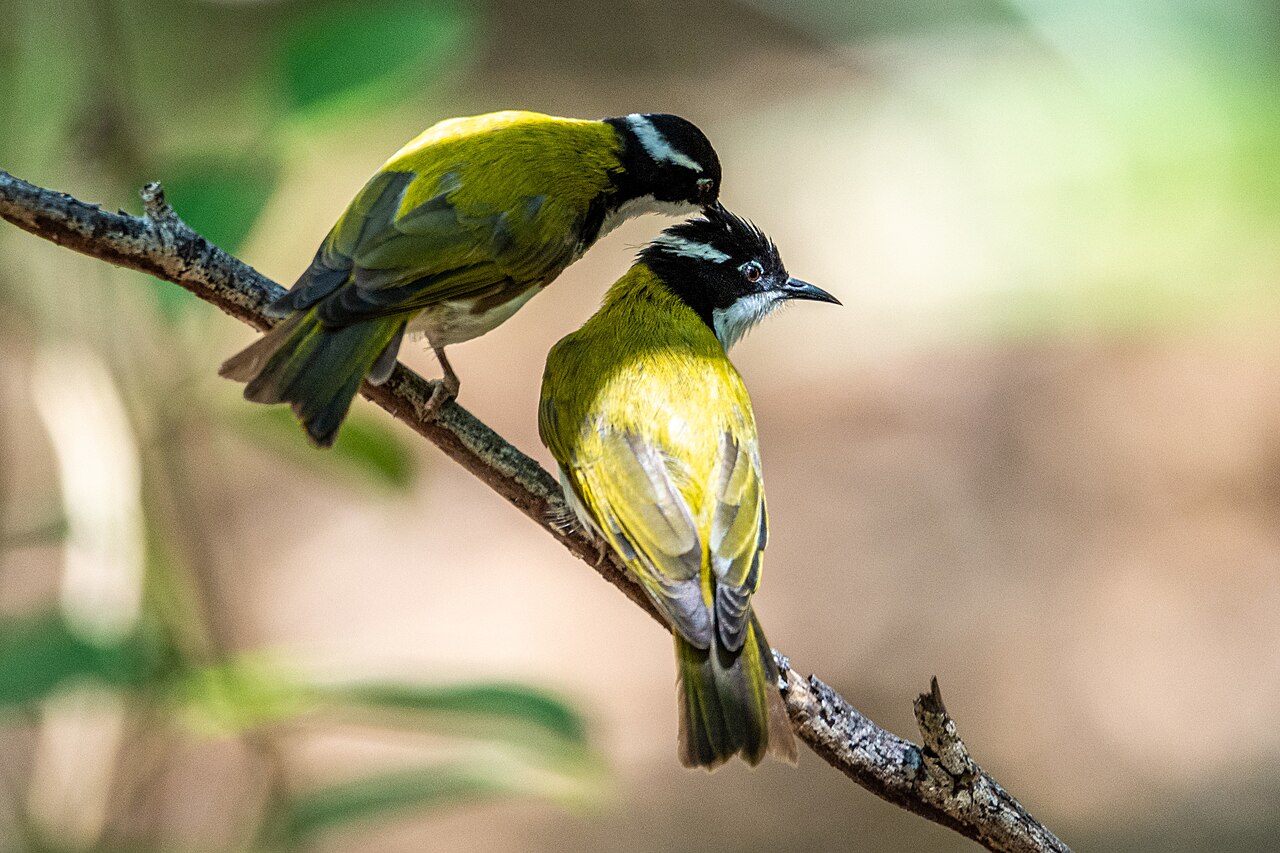
The White-throated Honeyeater is the smallest Melithreptus and the only one that genuinely inhabits the tropical north. It looks like a reduced version of the White-naped Honeyeater: black head, white nape band, olive-green back and white underparts. Two things set it apart — the bare skin above the eye is blue-white instead of red, and the white of chin and throat runs right up to the base of the bill, which is what gave the bird its name. In the savannas of northern Australia it is one of the most numerous small honeyeaters.
Voice
Simple high whistles, given singly or in short bursts and, tellingly, almost always on the same pitch. That is the most usable character the species has, because White-naped Honeyeater (Melithreptus lunatus), with which it overlaps in Queensland, gives runs at varying pitch instead. There is also a short hard chip as a contact note between members of a party, and a fast rattling chatter when the birds are disturbed.
Recording: Richard White — CC BY-NC-SA 4.0 · Fogg Dam, Monsoon Forest, Australia · xeno-canto
Identification
The smallest of the genus at eleven and a half to fourteen and a half centimetres, with a fine, pointed bill. The head is black, the upperparts olive-green to olive-grey, the underparts pure white and noticeably cleaner than in its relatives. Chin and throat are white to the base of the bill, so that the black of the head stops as a sharp cap. The white nape band is broad and long and runs well forward on each side, almost meeting the bare skin above the eye. That skin is blue-white to pale blue — a small but decisive mark in good light. Bill and legs are dark. Immatures are duller, with a brown-washed head and a yellowish-looking base to the bill.
Confusion species
White-naped Honeyeater (Melithreptus lunatus) is the main issue: it overlaps in eastern Queensland and north-eastern New South Wales and has red to orange bare skin above the eye, a narrower nape band stopping well short of the eye, a black rather than white chin, and is slightly larger and richer in colour. In the field voice is quickest: even high whistles against varied runs. Black-chinned Honeyeater (Melithreptus gularis) likewise has blue skin above the eye, but is markedly larger and heavier, with a bright blue rather than blue-white eye patch, an olive-yellow to golden back and a black wedge running from the chin down the throat — the exact reverse of this species. Brown-headed Honeyeater (Melithreptus brevirostris) has a brown head and a complete pale eye-ring. Gilbert's Honeyeater (Melithreptus chloropsis), Strong-billed Honeyeater (Melithreptus validirostris) and Black-headed Honeyeater (Melithreptus affinis) do not occur within this species' range.
Habitat
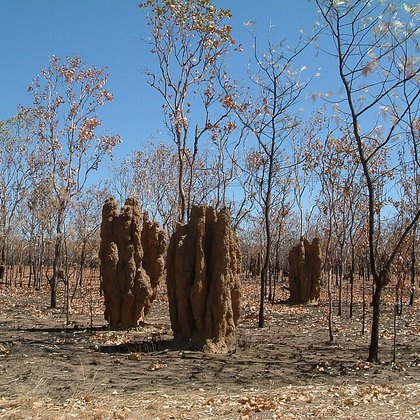
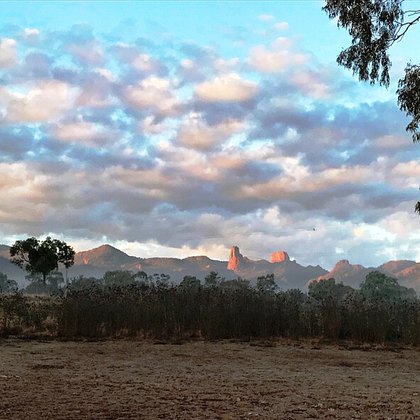
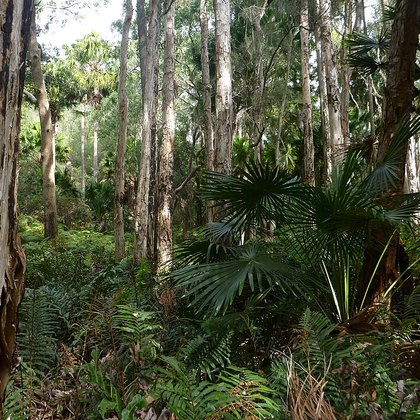
Far less particular than White-naped Honeyeater: eucalypt savanna and open woodland of the tropical north, dry eucalypt forest, wet sclerophyll forest on the east coast, melaleuca swamp forest and timbered floodplains, and beyond that gardens, parks and street plantings in cities such as Darwin, Cairns and Brisbane. It forages in the crown and out along the outer twigs, taking nectar and lerp (sugary scale secreted by psyllids, food for honeyeaters) from eucalypt and melaleuca and gleaning insects and spiders besides. It breeds from July to December; the nest is a sturdy cup of bark and grasses in a fork, usually with two eggs. Pairs hold a territory of roughly three hectares all year round.
Where the bird is most often found, arranged by main group and formation.
Range and movements
Tropical northern Australia from the Kimberley through the Northern Territory and the Gulf of Carpentaria to Cape York, and from there south along the Queensland coast into north-eastern New South Wales. Outside Australia it occurs in the savannas of southern and eastern New Guinea, so unlike most of its relatives it is not an Australian endemic. It is absent from the arid interior to the south, from the south and south-west of the continent and from Tasmania, and does not occur in New Zealand. It is essentially sedentary.
- Resident
- dark = core range, pale = thinly spread
Where and when to look
Around Brisbane this is by far the commoner of the two, while White-naped Honeyeater is scarce there — on North Stradbroke Island and Bribie Island only this species occurs. So do not agonise over small head details if you already have the voice: a series of even high whistles belongs to this bird. If you do want to see it, wait until it turns towards you and look at the chin. White up to the bill means this species; black running from the head down under the bill means White-naped.
Conservation
Least Concern (LC) and common to numerous across its northern range; of all the Melithreptus this is among the least vulnerable, because it copes with savanna and with urban greenery alike. A slightly decreasing trend has nonetheless been recorded, linked in the north mainly to altered fire regimes in the savanna and to grazing of the understorey. No targeted protection appears to be required; retaining old, flowering eucalypts and melaleucas in grazed and built-up country benefits the species most.
Scientific name
Melithreptus albogularis | Gould, 1848
Gould described the species in 1848 as Melithreptus albogularis; author and year stand without parentheses, because it has always remained in this genus. The epithet is built from Latin albus, 'white', and gula, 'throat'. The English name and the Spanish mielero goliblanco render that directly, and the Dutch witkinhoningeter points at the same feature, though at the chin. That is arguably the sharper reading: it is precisely the white below the bill that separates the bird from Black-chinned Honeyeater (Melithreptus gularis), which carries a black wedge there.