All species › Passerines › Honeyeaters › Black-headed Honeyeater
Black-headed Honeyeater | Melithreptus affinis
Zwartkophoningeter | Mielero carinegro
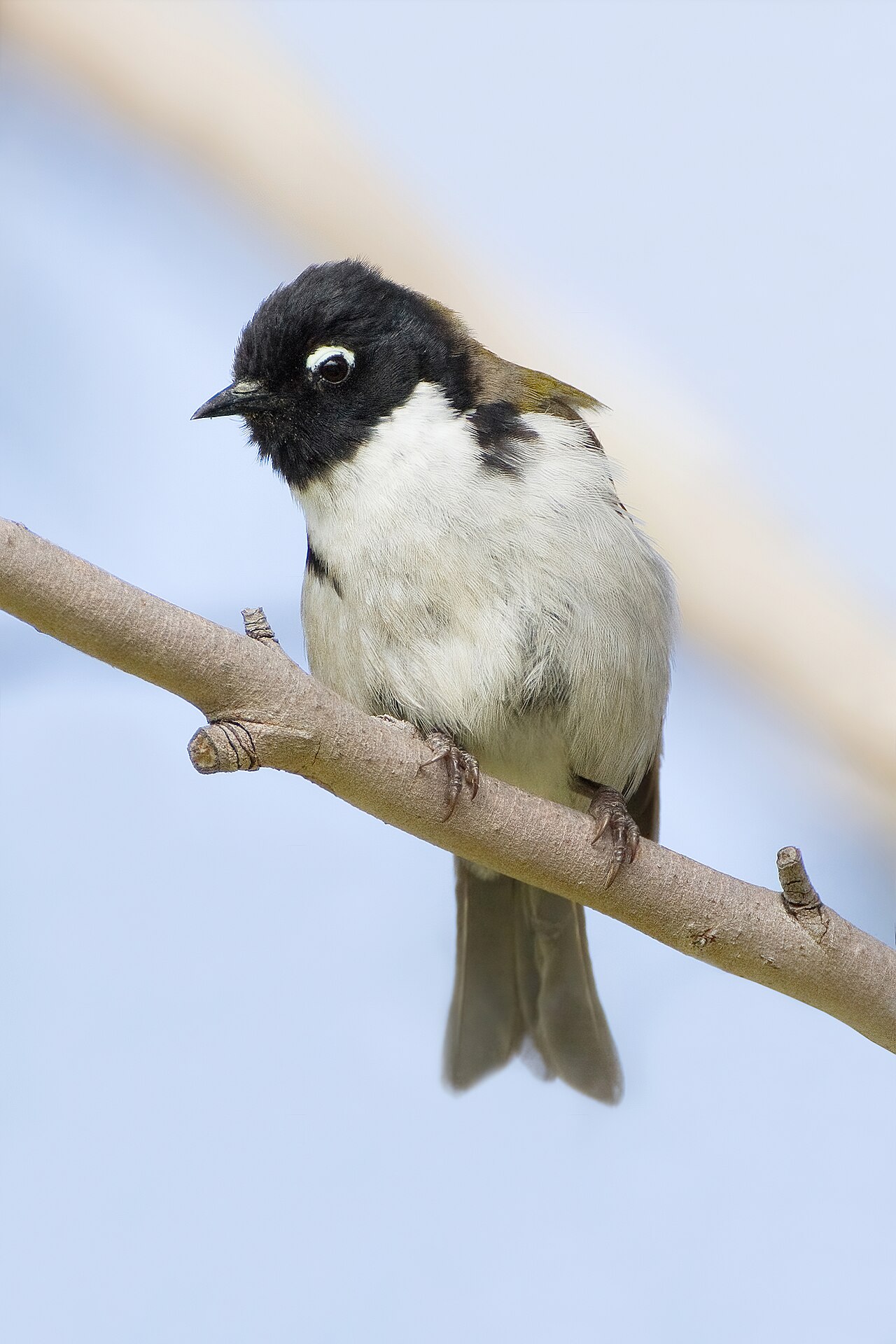
The Black-headed Honeyeater is the one Melithreptus without the band. Where all six relatives wear a white stripe across the nape, its head is wholly black from crown to throat, unbroken, with only a pale blue to white crescent of bare skin above the eye. For the rest it is olive-green above and off-white beneath. It is endemic to Tasmania and the Bass Strait islands and feeds busily and acrobatically among the leaves, often hanging upside down from a twig.
Voice
A busy, high, slightly squeaky chatter delivered in short runs as the party works through the foliage, together with a sharp thin chip as a contact note. The voice is lighter and finer than the hard, metallic chak of Strong-billed Honeyeater (Melithreptus validirostris), and it lacks the dry cracking of tearing bark that accompanies that species. A party can be quite noisy without ever reaching the penetrating tone of its larger neighbour.
Recording: Richard White — CC BY-NC-SA 4.0 · Tinderbox Reserve, Kingborough Council, Tasmania, Australia · xeno-canto
Identification
A small honeyeater of thirteen to fifteen centimetres and about fifteen grams, with a fine, pointed black bill. The decisive character is the head: wholly black, chin and throat included, and without the white nape band that every other member of the genus carries. A narrow crescent of very pale blue to white bare skin sits above the eye. Upperparts are olive-green to olive-brown, underparts off-white to cream. Immatures differ clearly: they have a brownish rather than black head and a faint yellowish wash on the throat, which can suggest Brown-headed Honeyeater — but that species does not occur in Tasmania. In flight the swift, undulating passage of pairs and parties is striking.
Confusion species
In Tasmania there is only one real rival: Strong-billed Honeyeater (Melithreptus validirostris). It is substantially larger and nearly two-thirds heavier, has a long, heavy, almost straight bill instead of a fine pointed one, and does carry a clear white nape band together with a white chin and throat. Behaviour works even better than plumage: Strong-billed climbs the trunk like a treecreeper and tears bark loose audibly, while this species feeds among the leaves in the crown and hangs upside down from twigs. The two therefore barely overlap in their working zone within the same tree. The five mainland species — White-naped (Melithreptus lunatus), White-throated (Melithreptus albogularis), Black-chinned (Melithreptus gularis), Brown-headed (Melithreptus brevirostris) and Gilbert's Honeyeater (Melithreptus chloropsis) — none of them reach Tasmania, so on the island the absence of the nape band is conclusive.
Habitat
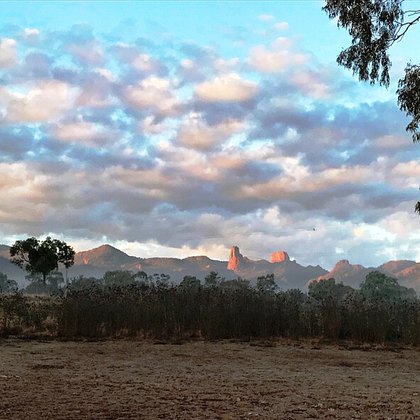
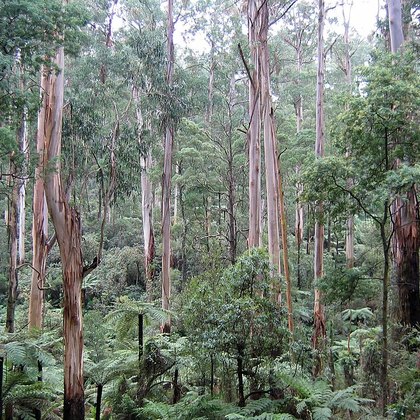
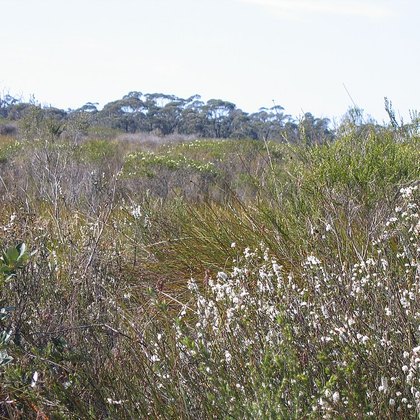
Both dry and wet sclerophyll forest, and besides that scrub, heathland and subalpine vegetation up to roughly twelve hundred metres. The centre of gravity lies in drier forest below a thousand metres, particularly where a dense shrub layer stands and where mature trees have been retained through logging. It eats mainly insects and spiders gleaned from leaves and twigs, supplemented by nectar and some fruit. Pairs stay together for the long term and sometimes nest in loose groups close to one another; the cup nest is slung from a branch, both parents incubate the usual three eggs for about sixteen days, and the young then spend a further sixteen days in the nest.
Where the bird is most often found, arranged by main group and formation.
Range and movements
Endemic to Tasmania and the islands of Bass Strait, including King Island, Flinders Island and Cape Barren Island. On the main island it is most numerous in the eastern part, with scattered populations in the north-west; in the wet, dense south-west it is scarce. Beyond this region it does not occur: neither on the Australian mainland nor in New Zealand. It is resident, with local movements in winter and gatherings into parties after the breeding season.
- Resident
- dark = core range, pale = thinly spread
Where and when to look
In Tasmania you need answer only one question: is there a white band across the nape or not? No band means this species; a band means Strong-billed Honeyeater. If the bird's posture will not help, look at what it is doing — feeding among leaves against climbing the trunk — or at the bill, fine against heavy. Good places are the drier forests of the island's east, for instance around Freycinet and the Midlands, where it moves through the crowns in noisy parties.
Conservation
Least Concern (LC) and rated secure both federally and in Tasmania; in suitable forest it is a common and conspicuous bird. The species is also less particular than its large island companion: it persists in logged forest as long as mature trees and a dense shrub layer have been left, and it uses scrub and heath as well. Where forest is converted wholly to uniform plantation or to pasture it does disappear. Large-scale bushfire is the main longer-term risk, because it removes canopy and understorey at a single stroke.
Scientific name
Melithreptus affinis | (Lesson, 1839)
Lesson described the bird in 1839 as Eidopsarus affinis; because it was later moved to Melithreptus, author and year stand in parentheses. The epithet affinis is Latin for 'related' or 'allied' and therefore says nothing about appearance, indicating instead that Lesson placed the species close to a previously described relative. The generic name Melithreptus means 'honey-fed', from Greek meli and threptos. The English name, the Spanish mielero carinegro and the Dutch zwartkophoningeter all pick the wholly black head, precisely the feature that sets the species apart from its six relatives.