All species › Passerines › Australasian robins › White-faced Robin
White-faced Robin | Eopsaltria leucops
Witteugelvliegenvanger | Petroica cariblanca
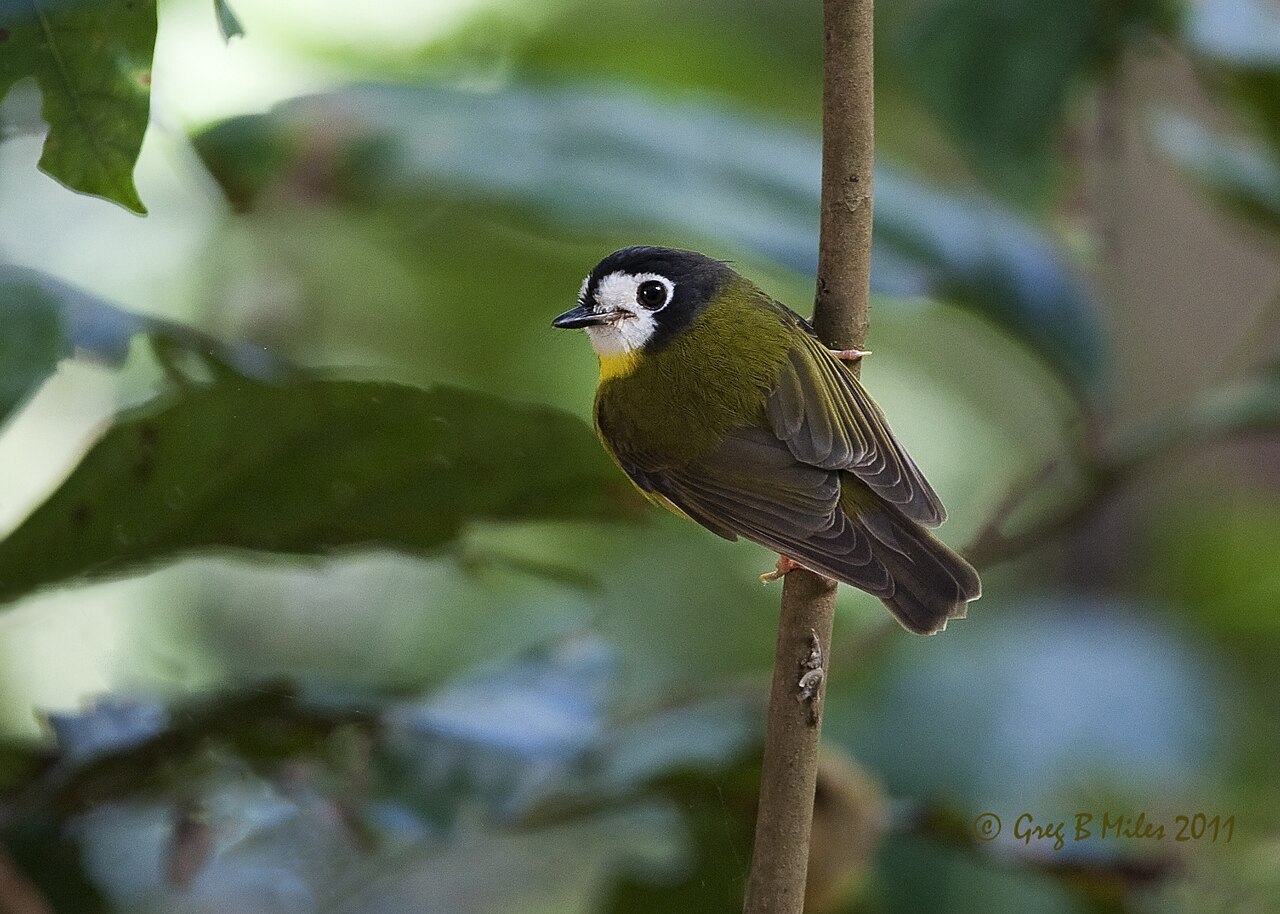
The White-faced Robin is a small, short-tailed robin of the New Guinean rainforests which in Australia occurs only in the lowland rainforests at the very top of Cape York Peninsula. The face is the whole story: a clean white mask from forehead to chin, sharply framed by a dark crown, above an olive-green back and a bright yellow belly. Once you see the mask you need look no further.
Voice
A thin, high series of four to six whistled notes falling away in pitch, with the character of a slowly descending scale, usually from the middle layer of the forest. Beyond that a soft rattling throat note and, when it is uneasy, a sharp, thin tseep. The voice is quiet and is easily lost in the general murmur of rainforest; in practice the bird is seen more often than heard.
No recording with a suitable Creative Commons licence has been found for this species yet; what to listen for is described below.
Identification
Twelve to thirteen centimetres, about fifteen grams, with a strikingly short tail and a big head. Forehead, lore, cheek and chin are clean white and together form a round mask; around it crown and nape run olive-black, which makes the white stand out further. The upperparts are olive-green, the underparts from the breast down bright yellow. The bill is short and black, the eye dark, the legs pale. The sexes are alike; young birds have a dirty white, vaguely bounded mask.
Confusion species
The white mask makes the species unique in Australia, but it shares its forest with two birds that resemble it from a distance. Yellow-legged Flyrobin (Kempiella griseoceps) lives in the same rainforest and is likewise olive above and yellow below, but it has a grey crown and no white mask, conspicuously pale yellow legs, and hunts higher in the canopy. Pale-yellow Robin (Eopsaltria capito), further south along the coast, has a pale eye-ring instead of a mask and is much duller yellow. Outside Australia, in the New Guinean part of the range, the commonest confusion is Pachycephalopsis poliosoma, which is larger, has a white eye and carries no yellow below. Gerygone species are smaller, greyer and show white tail spots.
Habitat
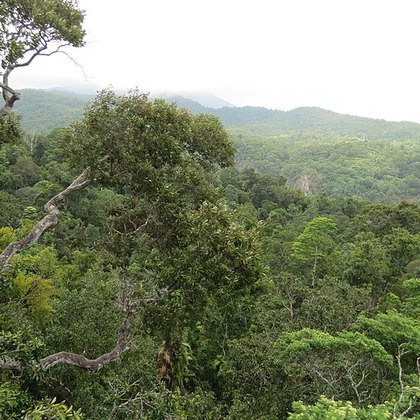
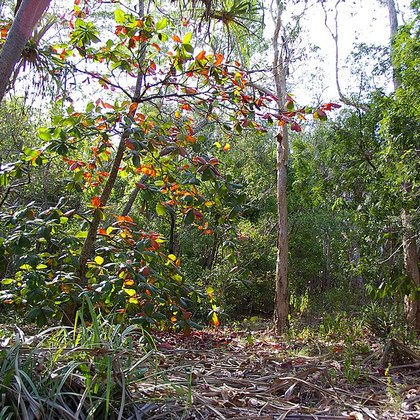
The lower and middle storeys of tropical lowland rainforest and adjoining monsoon forest and vine thicket, by preference where it is dark and damp and the undergrowth is thick. In Australia that confines it to a handful of rainforest blocks in the far north-east of Cape York, around the Iron Range and the McIlwraith Range; in New Guinea it ranges from the lowlands into the mid-mountains. It hunts with short sallies from a low branch and picks insects from leaf, trunk and liana. The small cup nest is camouflaged with moss and lichen.
Where the bird is most often found, arranged by main group and formation.
Range and movements
Most of the range lies in New Guinea, where the species is widespread. Within the guide area it is the Australian subspecies nana, living only in the rainforest of the northern Cape York Peninsula. That is a small, remote and little-travelled area, and the number of Australian records is correspondingly low; the bird is nonetheless resident there and breeds. Migration or wandering is not known of it — a rainforest bird of this kind does not leave closed forest.
- Resident
- dark = core range, pale = thinly spread
Where and when to look
In Australia there is one address: the rainforest of the Kutini-Payamu country near the Iron Range. Walk a forest track there slowly in the morning and watch the middle layer, from eye level up to about five metres. The bird sits still and gives itself away with a short sally to a leaf. The moment it turns, the white of the face is visible at ten metres even in the gloom under the canopy — that mask is the palest thing flying in that forest.
Conservation
Least Concern (LC). Globally the species is widespread and numerous across New Guinea, and the Red List category reflects that. The Australian population is another matter: it is small, restricted to a few rainforest blocks on Cape York, and thereby sensitive to anything that damages that forest — cyclones, changing fire regimes along the forest edge and, in the longer term, a drying climate. Most of the Australian range lies within protected areas, which is the main safeguard.
Scientific name
Eopsaltria leucops | (Salvadori, 1876)
Salvadori described the bird in 1876 as Leucophantes leucops, from specimens taken in the Arfak Mountains of New Guinea; because it was later placed in another genus, author and year stand in parentheses. leucops is formed from Greek leukos (white) and ops (face) — exactly what the Dutch name says, for the lore is the field between eye and bill that is white here too. Many authorities place the species together with Pale-yellow Robin (Eopsaltria capito) in the genus Tregellasia; this guide retains Eopsaltria.