All species › Passerines › Australasian robins › Grey-headed Robin
Grey-headed Robin | Heteromyias cinereifrons
Grijskopstruikvliegenvanger | Petroica cabecigrís
The Grey-headed Robin is the largest and longest-legged robin in Australia and a bird of a single landscape: the cool upland rainforests of the Wet Tropics behind Cairns, with the Atherton Tableland at their heart. It hops across the forest floor on long pink legs, climbs a trunk to peer down again, and on the walking tracks of Mount Hypipamee and Lake Eacham lets itself be watched at very close range.
Voice
A slow, far-carrying series of clear whistled notes, usually three to five, rising in pitch and delivered with a hesitation between the notes — one of the most characteristic sounds of the Atherton upland forest, above all early in the morning and in mist. Alongside it a hard, short chak when uneasy and a soft clucking between partners. The sound nearly always comes from close to the ground.
Recording: András Schmidt — CC BY-NC-SA 4.0 · Lake Eacham, Tablelands Regional, Queensland, Australia · xeno-canto
Identification
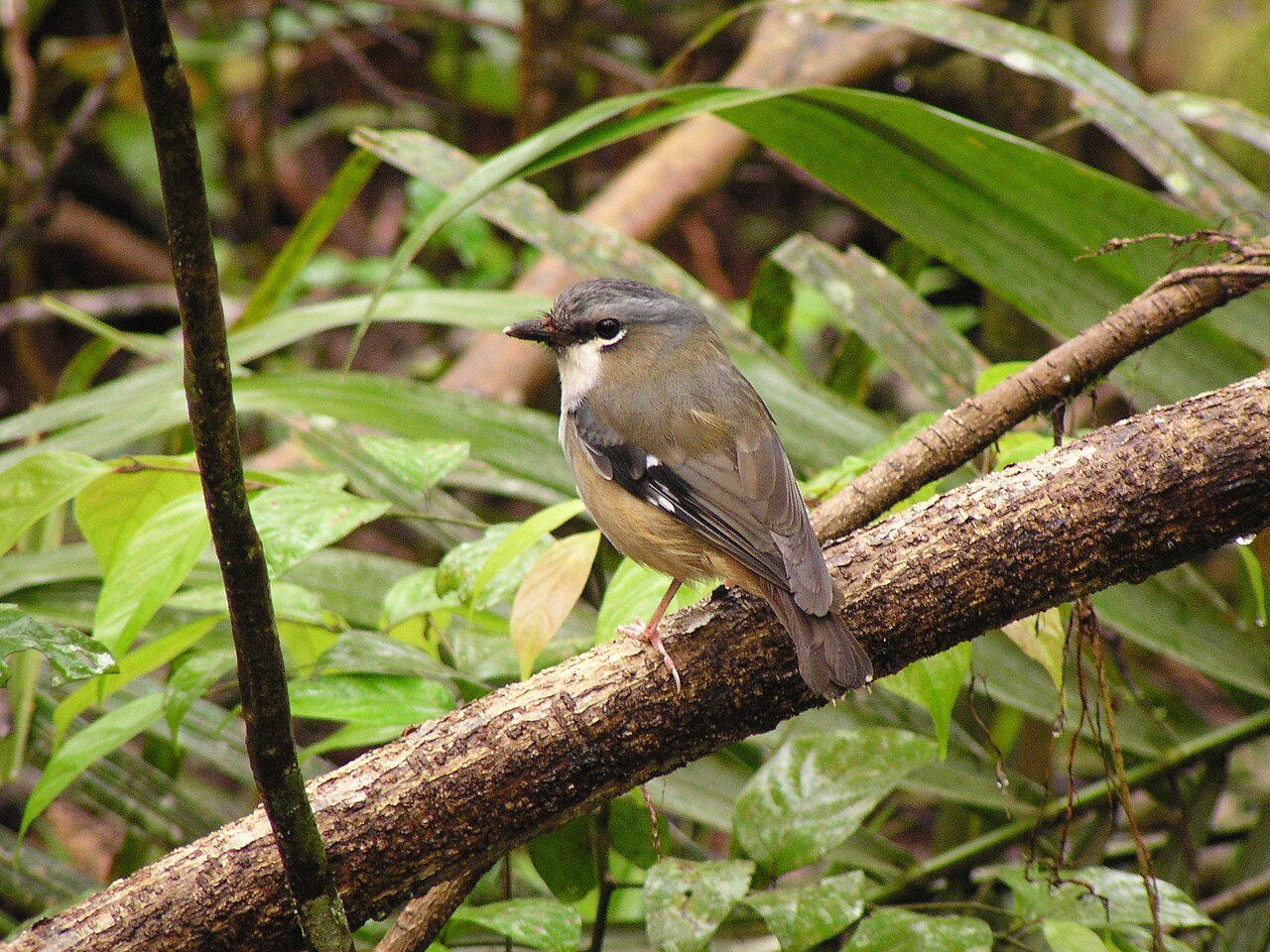
Sixteen to eighteen centimetres and a good thirty-five grams: a heavy, upright bird with conspicuously long, pale pink legs. The head is grey with a dark patch around and behind the eye and a white throat; the back and shoulders are warm rufous brown, which shows up well in the gloom of the forest. The wings are blackish with a white wingbar and white spots on the coverts. The underparts are white with a grey wash across breast and flanks. The sexes are alike; young birds are brown and rustily mottled.
Confusion species
No other robin in Australia looks like it, but two birds walking the floor of the same upland forest resemble it from behind. Chowchilla (Orthonyx spaldingii) is larger and much heavier, dark above and white or orange on the throat, and it works the litter over with its spiny tail spread instead of waiting. Northern Scrub Robin (Drymodes superciliaris) is the other long-legged ground robin of the north-east, but lives only in the lowland rainforest of Cape York, hundreds of kilometres further north, and lacks the rufous back and the white wing spots. The smaller Pale-yellow Robin (Eopsaltria capito) shares the same forest but is half the size and yellow below. Its nearest relatives Heteromyias armiti and Heteromyias albispecularis occur only in New Guinea.
Habitat
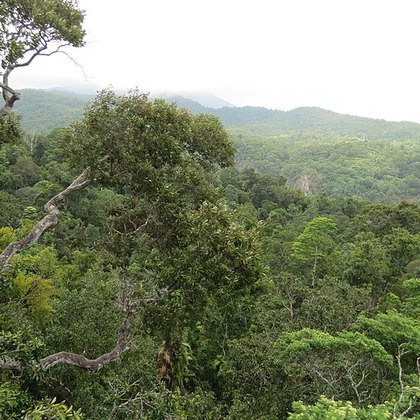
The floor and the lowest few metres of tropical upland rainforest, by preference above six hundred metres and in the dampest, shadiest parts: creek valleys, cloud forest, dense liana forest with an open, thick leaf litter. It hunts from a low vertical perch against a trunk or tree fern, looks down and pounces on prey in the litter; between perches it strides across the ground in long paces. The large, untidy nest of moss, rootlets and leaves sits low in a tree fern or a fork, often right beside a track.
Where the bird is most often found, arranged by main group and formation.
Range and movements
North-eastern Queensland only, in the uplands of the Wet Tropics: from the Windsor and Carbine Tablelands and the Mount Lewis country in the north, across the Atherton Tableland, to the Paluma Range and the Cardwell hinterland in the south — and there, at Rockingham Bay, lies the type locality. It is a small, coherent range of a few thousand square kilometres. It is strictly sedentary; only in the coldest months do a few birds drop a little lower down the slopes.
- Resident
- dark = core range, pale = thinly spread
Where and when to look
This is one of the easiest upland rainforest birds in Australia, provided you are standing at the right altitude. On the Atherton Tableland take a circuit at Lake Eacham, Lake Barrine or in the Mount Hypipamee country, walk slowly and watch the forest floor right beside the track. The bird often comes closer of its own accord and then stands still. Look at the legs: no other robin in that forest stands on legs so long and so pink.
Conservation
Near Threatened (NT). The species is still common within its forest and most of the range lies inside the Wet Tropics World Heritage Area, so logging no longer plays a part. The reason for the category is the combination of a very small range with a strict tie to cool, damp upland forest: as the climate warms, the lower limit of that habitat shifts upward, and above the summits of the Atherton Tableland there is no further room to shift into. Modelling studies of the Wet Tropics upland birds place this species among those with most to lose.
Scientific name
Heteromyias cinereifrons | (Ramsay, 1876)
Ramsay described the bird in 1876 as Poecilodryas cinereifrons, with a question mark against the genus, from a specimen taken near Cardwell on Rockingham Bay; because it was later placed in another genus, author and year stand in parentheses. Heteromyias is formed from Greek heteros (other, deviating) and myia (fly), in the sense of an aberrant flycatcher. cinereifrons is Latin for ash-grey of forehead, from cinereus (ash-grey) and frons (forehead). The Dutch name follows the same character and adds 'scrub' for the way of life low in the forest.