All species › Passerines › Cuckooshrikes › Varied Triller
Varied Triller | Lalage leucomela
Witbrauwtriller | Oruguero variable
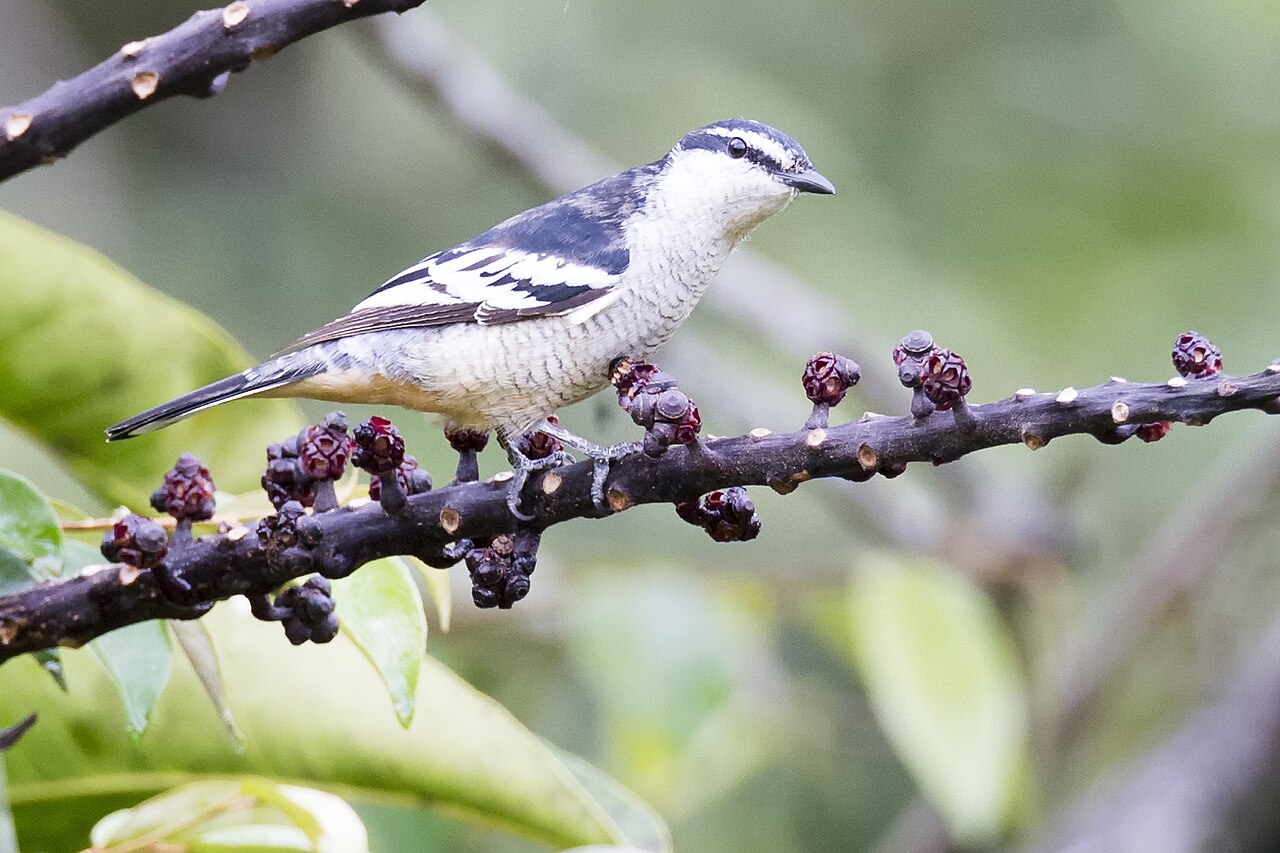
The Varied Triller is the triller of the coastal forests: a stocky, dark bird with a crisp white eyebrow that moves quietly and slowly through the canopy of rainforest, monsoon forest and mangrove and feeds largely on fruit. Unlike its cheerfully rattling inland cousin, it produces a slow, rasping growl that suggests a frog rather than a songbird. Male and female differ clearly but less extremely than in the White-winged Triller: the male is pied and sharply marked, the female browner and softer.
Voice
A slow, rasping, faintly buzzing 'krrrr … krrrr', sliding downwards and repeated in an unhurried series — a strikingly unmusical sound for a bird in the triller group, and the best way of separating it from the White-winged Triller (Lalage tricolor), whose song is fast, clear and rattling. Some observers compare it to a frog or to a wooden rattle turned slowly. There is also a short, hard contact note and a shriller alarm around the nest tree. The bird often calls from cover and so betrays its presence in forests where it can otherwise hardly be seen.
Recording: Andrew Galbraith — CC BY-NC-SA 4.0 · Banks Street Reserve (near Alderley), Brisbane City, Queensland, Australia · xeno-canto
Identification
A stocky triller of about eighteen to twenty centimetres with a fairly long tail and a short, sturdy bill. The male has a black crown crossed by a sharply defined, pure white eyebrow running from the base of the bill to behind the eye — the mark from which the Dutch name is taken. The upperparts are blackish grey with pale edges and spots in the wing, the underparts are white with fine grey barring on breast and flanks, and the undertail coverts are warm buff to rusty. The female is browner and softer throughout: grey-brown rather than black on the crown, a duller and less crisp eyebrow, and more extensive, coarser barring below. This too, then, is one species with two faces, not a species pair. Young birds resemble the female. Across its whole range the species has a large number of forms differing in tone and in the extent of the barring; hence the English name Varied Triller.
Confusion species
The female is the hardest bird, particularly against the female White-winged Triller (Lalage tricolor). That bird is smaller and shorter-tailed, has faint breast streaking instead of clear barring on breast and flanks, lacks the buff undertail and sits in dry, open inland country rather than coastal forest. The female Sahul Cicadabird (Edolisoma tenuirostre) also has an eyebrow and barred underparts, but is considerably larger, much longer-tailed and has plain wings without pale markings. The male is harder to mistake, though anyone watching only the black and white might think of White-winged Triller; that bird, however, has a grey rump, a broad white wing band, no white eyebrow and no buff undertail. In the field one question usually settles matters: if you are standing in closed coastal forest or mangrove, Varied Triller is the likely bird; if you are in dry woodland or mallee (low, multi-stemmed eucalypt scrub of dry southern Australia), White-winged Triller is.
Habitat
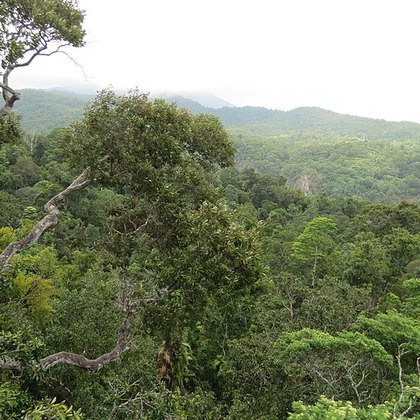
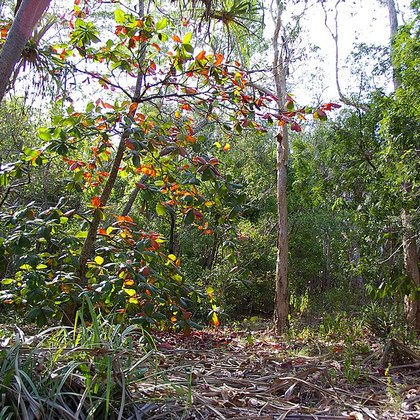
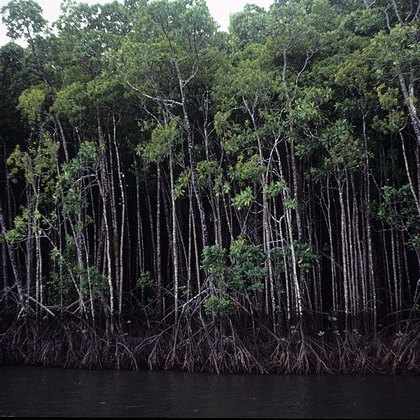
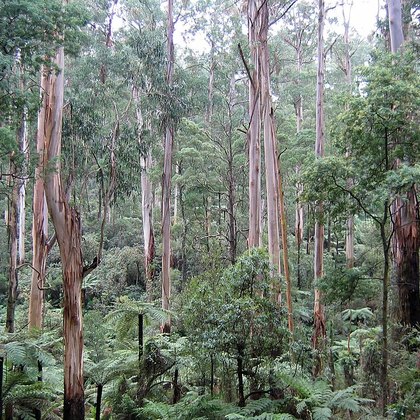
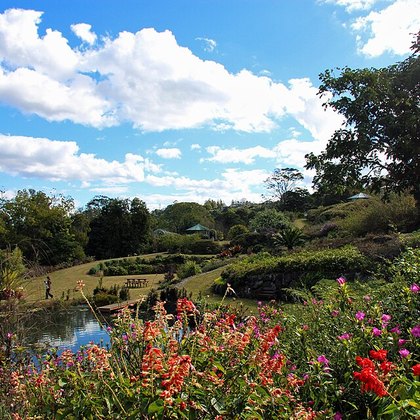
Tropical rainforest and its margins, monsoon vine forest and vine thicket, mangrove and the forest behind it, wet sclerophyll forest and gallery forest along creeks, plus gardens, parks and plantations where fruiting trees stand. The species is more tied to closed vegetation than the White-winged Triller and rarely enters genuinely open country. A considerable part of the diet is soft fruit — figs, lantana, forest berries and the fruit of understorey shrubs — supplemented with insects and caterpillars gleaned from foliage. The nest is a small, shallow cup of twigs, tendrils and bark bound with cobweb into a horizontal fork, usually at middle height in a tree or shrub; the clutch is small and both parents tend the young.
Where the bird is most often found, arranged by main group and formation.
Range and movements
Along the northern and eastern coast of Australia and the adjoining hinterland: from the Kimberley through the Top End and the Gulf Country to Cape York, and on down the east coast into central and southern New South Wales. The species is absent from the arid interior, the south-west and Tasmania. Beyond Australia it occurs on New Guinea and the surrounding islands, where a further series of forms is recognised. The birds are largely sedentary and stay in their patch of forest all year, with at most local movements following the fruit crop. The species does not occur in New Zealand.
- Resident
- dark = core range, pale = thinly spread
Where and when to look
Work the edge of coastal rainforest, a mangrove boardwalk or a garden with fruiting shrubs in northern Queensland or the Top End, and listen for the slow rasping growl — that is nearly always the first clue, because the bird sits still and high and moves little. Having followed the sound, check the eyebrow first: crisp and pure white means a male, duller and softer a female. Then look at the undertail coverts, because the warm buff there is a reliable mark shared by both sexes and absent in White-winged Triller. And note the forest type: this is a bird of dense, humid vegetation and it seldom leaves it.
Conservation
Least Concern (LC): the range is large, the species uses several closed forest types side by side, and it is locally common in northern and north-eastern Australia. The greatest pressure is along the southern edge of the range, where the lowland rainforest of southern Queensland and New South Wales has largely been cleared historically and the bird depends on the remaining patches. Beyond that, as a fruit-eater of closed forest it is sensitive to the loss of fruiting understorey to grazing and fire, and locally to damage to mangrove from coastal development. Keeping coastal forest continuous, shrub layer included, is what matters most for this species.
Scientific name
Lalage leucomela | (Vigors & Horsfield, 1827)
Nicholas Aylward Vigors and Thomas Horsfield described the species in 1827 as Campephaga leucomela, from a bird taken at Broad Sound in central Queensland; authors and year stand in parentheses because the species now sits in Lalage. The epithet leucomela is formed from Greek leukos, 'white', and melas, 'black', and so simply describes the pied male. The genus name Lalage describes nothing: Friedrich Boie took it from a girl's name in the Odes of Horace. The modern names each point a different way. The Dutch witbrauwtriller picks the crispest field mark, the white eyebrow. The English Varied Triller and the Spanish oruguero variable pick the variation instead: across the whole range from north-western Australia to New Guinea many forms are recognised, differing in tone, in the crispness of the eyebrow and in the extent of the barring.