All species › Pigeons and doves › Doves and pigeons › Topknot Pigeon
Topknot Pigeon | Lopholaimus antarcticus
Knoedelduif | Paloma bicrestada
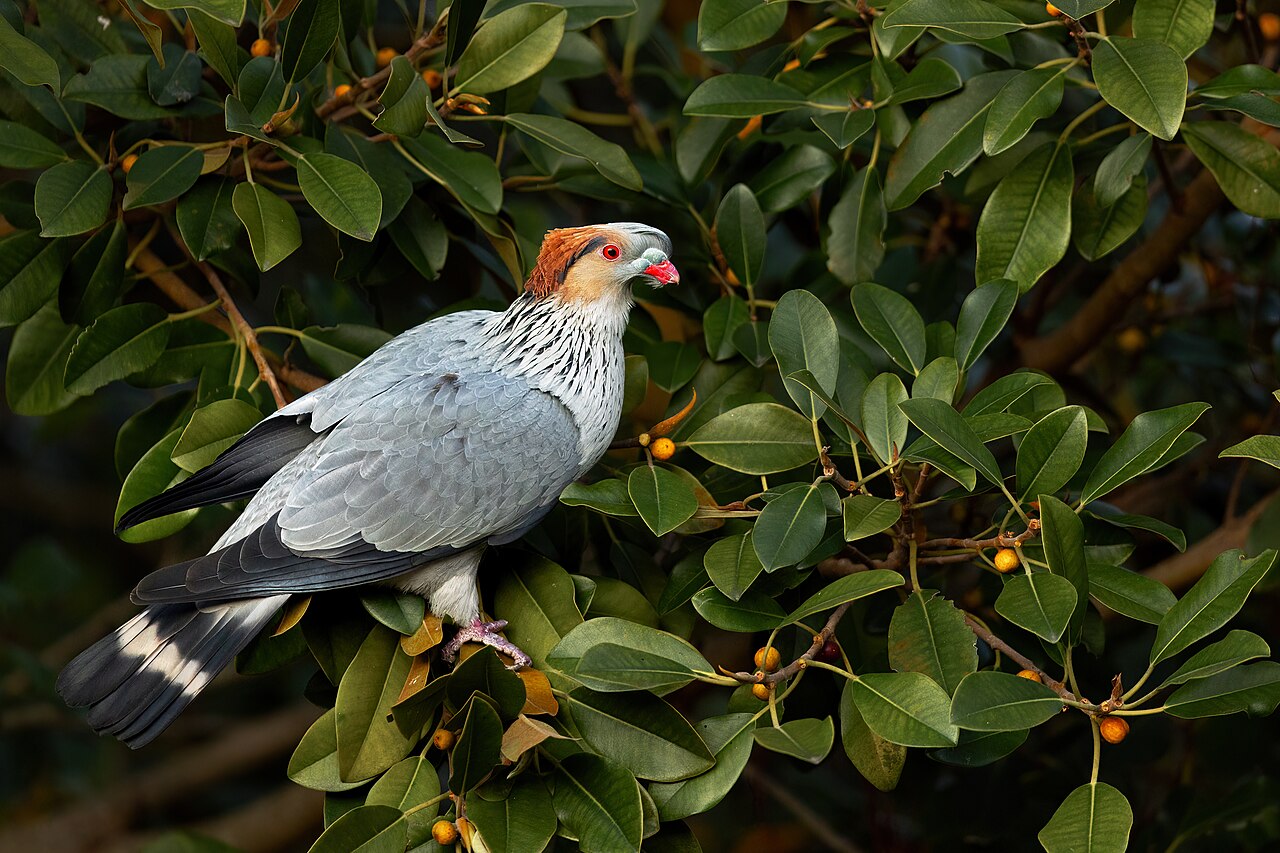
The Topknot Pigeon is the big slate-grey rainforest pigeon of the Australian east coast, carrying a double crest that lies across the head like swept-back hair: grey in front, rusty brown behind. It is markedly nomadic and follows the fruiting trees in flocks that can run to hundreds of birds, high and fast over the canopy.
Voice
A silent bird for its size. While feeding it gives the occasional sharp, high screech that cuts through the snapping of twigs and the thud of falling fruit; at the nest come soft, clear coos. Otherwise it is mostly the sound of the flock itself: the rush of dozens of pairs of wings crossing the treetops together.
No recording with a suitable Creative Commons licence has been found for this species yet; what to listen for is described below.
Identification
A large pigeon of forty to forty-six centimetres, slate-grey above with black feather shafts and paler grey below. The tail is black with a broad pale grey band across it — in flight the decisive mark. On the head sits a double crest: a grey part running forward from the base of the bill over the forehead, and a rusty-brown part with black sides falling back from the crown. Eye and bill are red, and two blue-green knobs sit at the base of the bill. The male carries the larger crest.
Confusion species
Young White-headed Pigeon (Columba leucomela) is the mistake most often made in the same rainforest: it has a paler face, a greenish-black back and an unbanded tail, while a young Topknot has a dark face and the pale tail band. Crested Pigeon (Ocyphaps lophotes) is sometimes called topknot in Australia too, but carries a thin erect black spike instead of a backward-falling double crest and lives in open country, not forest. A flock of large pigeons over rainforest can suggest Torresian Imperial-Pigeon (Ducula spilorrhoa), but that bird is clean white with black flight feathers and tail.
Habitat
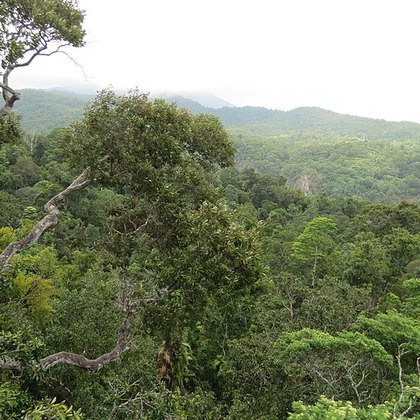
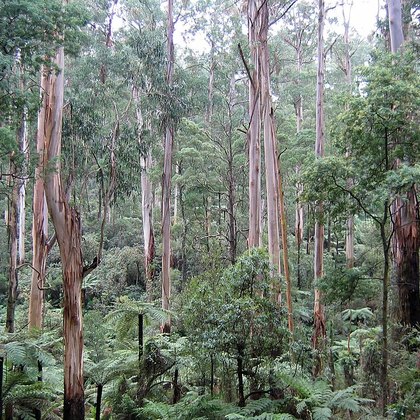
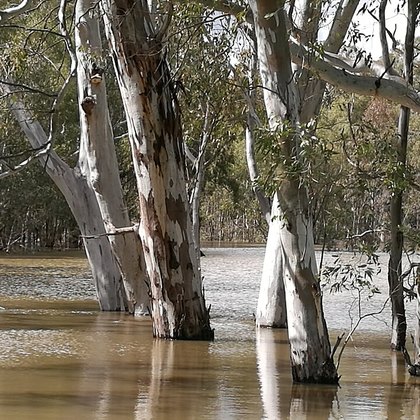
Tropical and subtropical rainforest and the adjoining wet eucalypt forest, especially in moist sheltered gullies and along the creeks in them. It crosses open country without hesitation to reach forest remnants, farmyards and roadsides where fruit hangs, and there it also takes the introduced camphor laurel. Feeding happens in the upper canopy, where it hangs acrobatically from branches, often upside down.
Where the bird is most often found, arranged by main group and formation.
Range and movements
Eastern Australia only, from Cape York in Queensland south along the coast to about Broken Bay in New South Wales. Further south it is scarce, with records to Tathra and Bega and inland to Inverell, and it occasionally reaches eastern Victoria; from Tasmania there are only a couple of old records, from 1907 and 1953. Within that range it is fixed nowhere: northern birds appear around Sydney in autumn and winter, and there is a clear altitudinal movement between coast and highland.
- Resident
- dark = core range, pale = thinly spread
Where and when to look
Look up, not into the trees. Topknot Pigeons usually give themselves away as a tight, fast flock high over the canopy, and that is exactly when the pale band across the black tail shows well against the sky. To watch them at work, find a fruiting camphor laurel or fig along a coastal road in northern New South Wales in May or June and listen for falling fruit; the sharp screech high in the crown does the rest.
Conservation
Least Concern (LC). That was long from certain: the species was shot on a large scale in the nineteenth and early twentieth centuries and lost most of its food trees as the lowland rainforests were cleared. Numbers have since recovered, partly because the introduced camphor laurel, which seeded itself across neglected pasture, supplies a replacement and dependable fruit crop. Because the bird uses no grit in its gizzard, seeds leave its gut undamaged, which makes it a key disperser beneath both its feeding and its roosting trees.
Scientific name
Lopholaimus antarcticus | (Shaw, 1793)
George Shaw described the bird in 1793 as Columba antarctica, in his Zoology of New Holland, from material out of the young colony in New South Wales; the later move puts author and year in parentheses. John Gould introduced the genus Lopholaimus in 1841, from Greek lophos 'crest' and laimos 'throat', for the crest that runs far down onto the neck. antarcticus means 'southern' and refers to the southern lands rather than to Antarctica — a confusing name the species has kept nonetheless.