All species › Pigeons and doves › Doves and pigeons › Brown Cuckoo-Dove
Brown Cuckoo-Dove | Macropygia phasianella
Australische koekoeksduif | Tórtola cuco parda
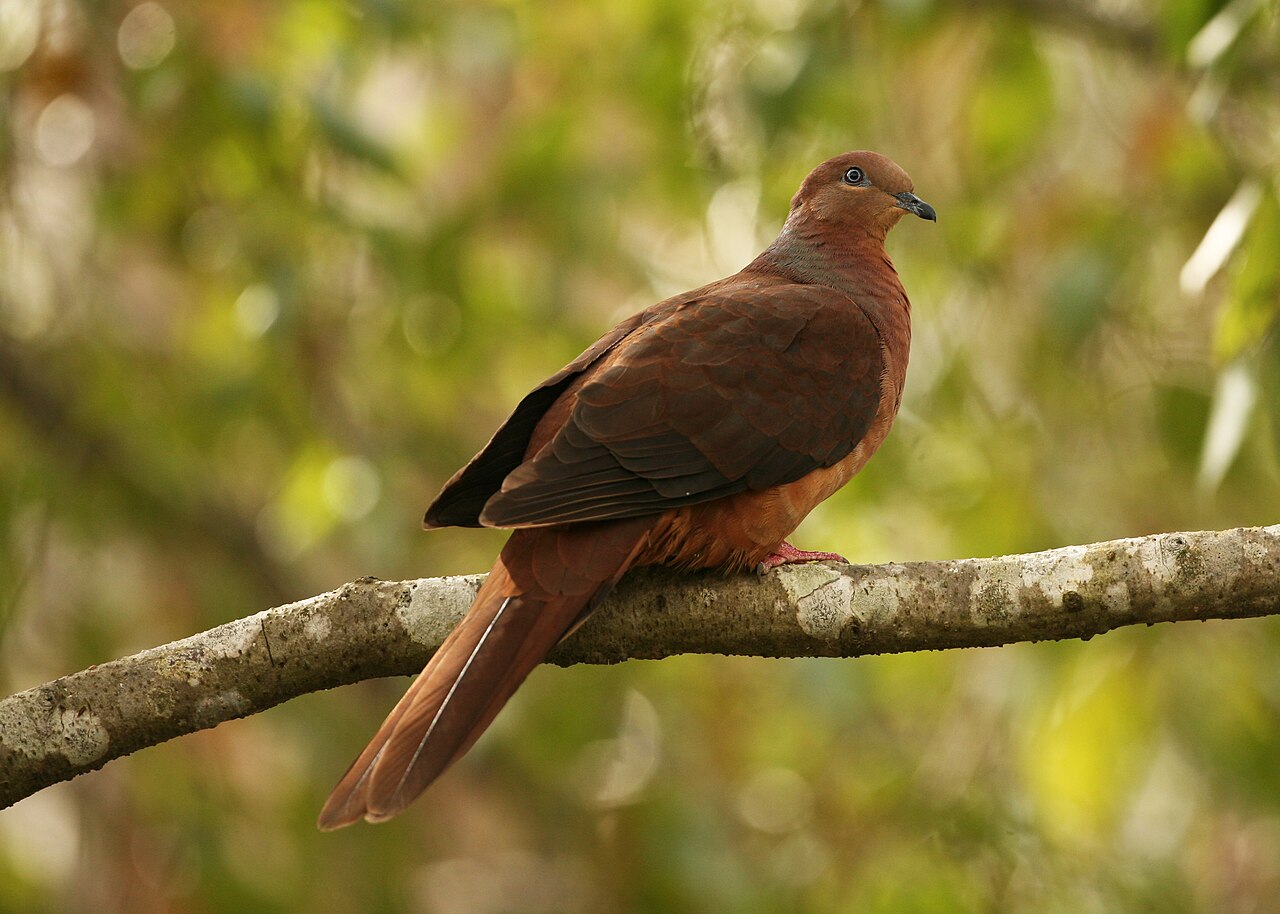
The Brown Cuckoo-Dove is the long-tailed pigeon of the eastern rainforest edge: rufous, slim, with a tail that makes up almost half the bird and serves as a rudder when it balances on a thin branch. It lives almost entirely on fruit and is one of the more important seed dispersers of the coastal forest.
Voice
The call is a loud two-syllable note that jumps upward at the end: whoop-a-whoop, repeated endlessly from the upper storey of the forest and above all early in the morning. At close range there is also a single, duller coo. The sound carries well through closed forest and usually betrays the bird before anything is visible.
Recording: Greg McLachlan — CC BY-NC-SA 4.0 · O'Reilly, Scenic Rim Regional, Queensland, Australia · xeno-canto
Identification
A slim pigeon of forty to forty-three centimetres with a long, broad, graduated tail and short, rounded wings. The male is warm rufous, darker on back and tail, with a rose and green sheen on neck and hindneck. The female is duller, with fine dark barring on neck and breast and a greyer head; young birds are scalloped throughout. In flight the shape is unmistakable: a few short beats and then a glide through the canopy with the long tail spread.
Confusion species
The Spotted Dove (Spilopelia chinensis), introduced and common in the same gardens, also has a long tail, but is grey-brown with a black, white-spotted neck patch and white tail corners. The Pacific Emerald Dove (Chalcophaps longirostris) shares the rainforest with it, but has green wings, a short tail and flies low and straight beneath the canopy. There is no second cuckoo-dove in the region: any long-tailed brown pigeon in eastern forest is this species.
Habitat
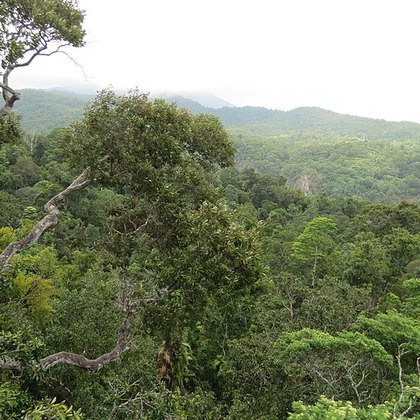
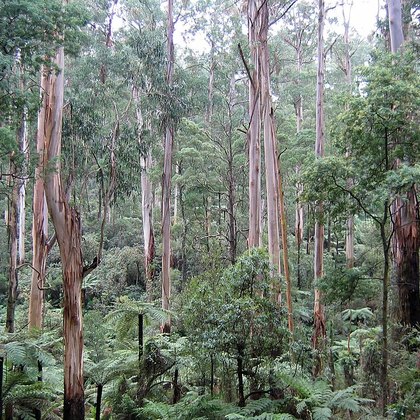
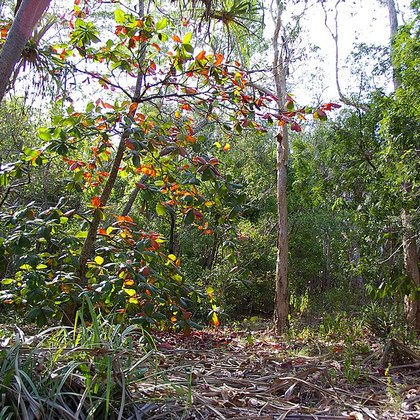
Rainforest and its margins, regrowth after logging, wet eucalypt forest with a closed understorey, and monsoon forest in the north. It follows the fruit, which brings it into gardens, along road verges and into weedy blocks of wild tobacco and lantana. It avoids unbroken dry forest and the interior; its range stops where closed forest stops.
Where the bird is most often found, arranged by main group and formation.
Range and movements
From Weipa and Aurukun on Cape York and on down the east coast to Bega in southern New South Wales, inland to the Atherton Tableland and Toowoomba. It does not migrate but wanders with the fruit supply, moving out of the highlands to the lowlands outside the summer. In the south of its range it has spread with the advance of introduced fruiting shrubs and now holds ground in suburban edges as well.
- Resident
- dark = core range, pale = thinly spread
Where and when to look
Find a fruiting tree or shrub at the forest edge — a wild tobacco, a stand of lantana, a fig — and wait; the birds come in early in the morning and late in the afternoon. As it climbs through the branches, watch for the long tail striking the leaves and giving it away.
Conservation
Least Concern (LC), common throughout its range and increased in many places. Clearing of coastal rainforest pushed it back over the last century, but regrowth and introduced fruiting plants have largely made that loss good. Losses to windows and cats in suburbs are local and not decisive.
Scientific name
Macropygia phasianella | (Temminck, 1821)
Temminck described the species in 1821 as Columba phasianella; because it was later placed in another genus, author and year stand in parentheses. The genus Macropygia was introduced by Swainson in 1837, after Greek makros, 'long', and pyge, 'rump', for the long tail. phasianella means 'little pheasant', after the same resemblance. The type locality lies near Port Jackson, New South Wales.