All species › Tubenoses › Petrels, shearwaters and diving petrels › Salvin's Prion
Salvin's Prion | Pachyptila salvini
Salvins prion | Prión de Salvin
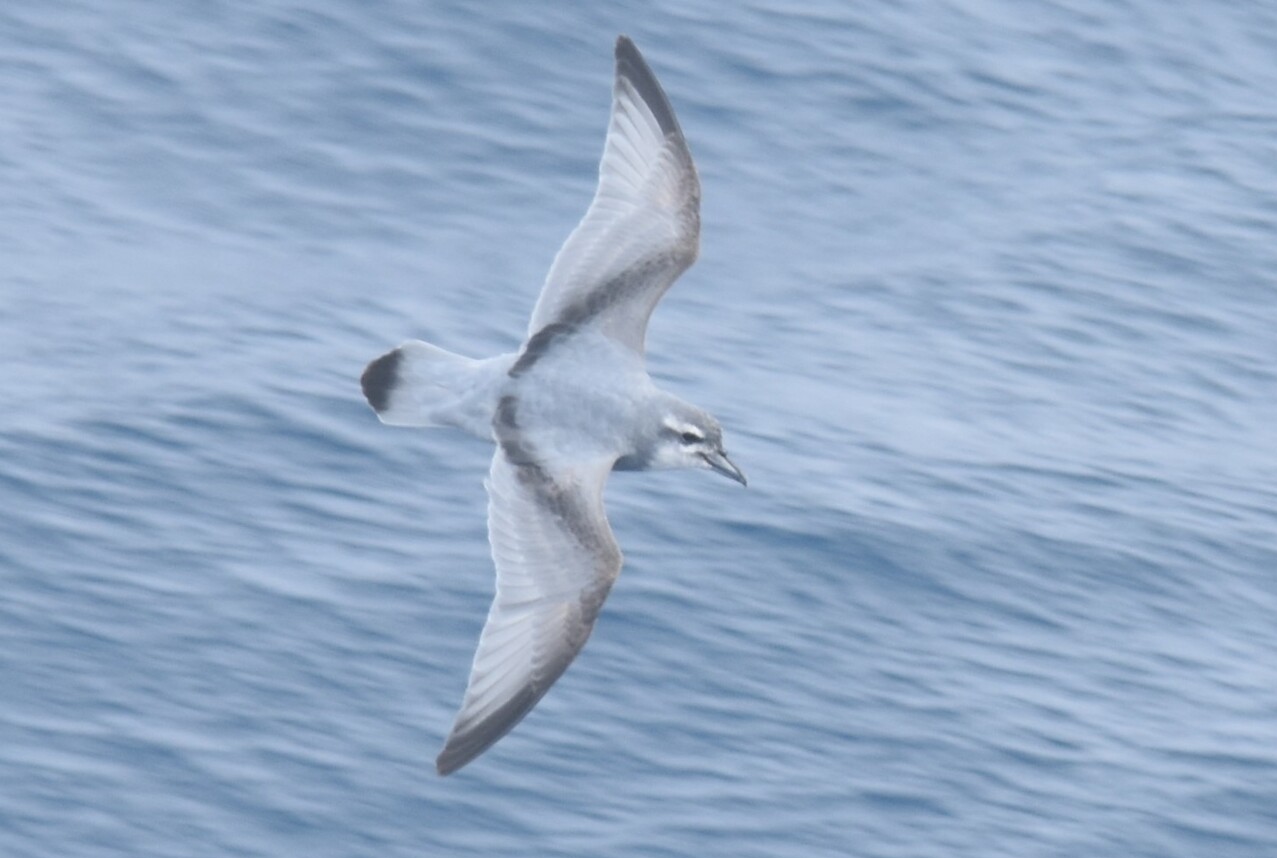
Salvin's Prion (Pachyptila salvini) is a whalebird of the southern Indian Ocean that reaches Australia and New Zealand only as a vagrant — usually dead, on a beach, after a winter storm. It sits in every respect between Antarctic and Broad-billed Prion: 27 cm long, with a bill 13.5 to 17.5 mm wide whose sides bow outwards and on which the filter lamellae remain visible from the side even when the bill is shut.
Voice
In this map window it is voiceless: it does not breed here, and prions are silent at sea. At the colonies on Marion, Prince Edward and the Crozets it calls at night, with the hard rattling chatter and softer dove-like crooning that marks the whole genus; in a dense colony this runs together into one continuous murmur. A beach-wrecked bird in the hand squeaks faintly at most.
No recording with a suitable Creative Commons licence has been found for this species yet; what to listen for is described below.
Identification
About 27 cm long and 170 g, with a wing of some 19 cm — larger than Antarctic Prion, smaller than Broad-billed. Blue-grey above with the black M across the wings, white below, a blue-grey bill and blue legs and feet. Everything distinctive is in the head: the bill is relatively large and dark, with outwardly bowed rather than straight sides, a small nail at the tip, and lamellae that show from the side with the bill closed. The face is greyer than in Slender-billed Prion but less dark than in Broad-billed.
Confusion species
This is the hardest identification problem in the genus, and it is more honest to say that birds at sea can almost never be named Salvin's Prion (Pachyptila salvini) with confidence. Antarctic Prion (Pachyptila desolata) has a narrower (11–15.5 against 13.5–17.5 mm), brighter blue bill with straight sides, a larger nail and lamellae that stay hidden when the bill is closed; the measurements overlap besides, so only bill shape decides. Broad-billed Prion (Pachyptila vittata) is clearly larger (28 cm) with a more massive, duller bill of 18.7–24.3 mm, a higher forehead and a darker head and upper breast; the two were once treated as one species, and salvini was indeed first described as a subspecies of vittata. Slender-billed Prion (Pachyptila belcheri) is ruled out at once by the very narrow bill (9.5–12.5 mm) and strikingly pale face, and Fairy Prion (Pachyptila turtur) and Fulmar Prion (Pachyptila crassirostris) by their smaller size, short blunt bill and much broader black tail tip.
Habitat
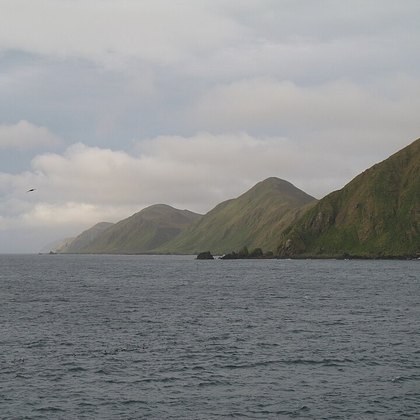
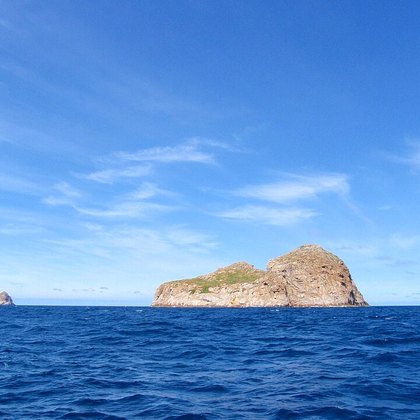
Open subantarctic and cool temperate ocean, outside the breeding season far offshore and largely in the southern Indian Ocean. It feeds at the surface on krill, amphipods and other animal plankton, hydroplaning with wings held open and the bill half in the water, the lamellae working as a sieve. On the breeding islands, all outside this map window, it digs burrows in peat and soft ground under tussock and cushion plants.
Where the bird is most often found, arranged by main group and formation.
Range and movements
It breeds nowhere in this map window. The colonies lie on the Crozets — chiefly Île aux Cochons and Île de l'Est — and on Marion and Prince Edward in the southern Indian Ocean; the world population is put at about 5.4 million pairs. In New Zealand it is a vagrant that washes up on the west coast of the North Island late in winter, sometimes in great numbers: the wreck of 1974 accounted for 5,228 birds. In Australian waters a few birds turn up along the south coast; the guide accordingly treats it as a vagrant.
- Winter
- dark = core range, pale = thinly spread
Where and when to look
Do not count on identifying this bird from a boat. The practical chance is on the beach: in August or September, after a sustained westerly gale, walk the west coast of the North Island or the south coast of Australia and take every wrecked prion in hand. Measure the bill at its widest point, check whether the sides bow out or run straight, and see whether lamellae project below the cutting edge while the bill is closed — that last feature separates it from Antarctic Prion and can never be seen at sea.
Conservation
Least Concern (LC), with a world population of some 5.4 million pairs and a range lying wholly outside this map window. The risks are on the breeding islands: on the Crozets and Marion introduced mice and, historically, cats are the chief threat to eggs, chicks and even adults, and the islands are so few that one failed eradication weighs heavily. In this region the most visible cause of death is the mass storm mortality that produces the beach wrecks.
Scientific name
Pachyptila salvini | (Mathews, 1912)
Mathews described the form in 1912 as Prion vittatus salvini, that is, as a subspecies of Broad-billed Prion; because the genus has changed, author and year carry parentheses. He gave the type locality as 'Crozets, Marion Island, etc.', restricted by himself in 1934 to Marion Island. The epithet honours Osbert Salvin (1835–1898), the English ornithologist. Note the name trap: three species in this guide, in three genera and two families, carry his name — Salvin's Prion (Pachyptila salvini) here, Salvin's Albatross (Thalassarche salvini, Diomedeidae, named for him by Rothschild in 1893) and the Herald Petrel (Pterodroma heraldica), which is called 'Salvins stormvogel' in the Dutch of this guide not because it was dedicated to him but because he himself described it, in 1888. The genus Pachyptila was introduced by Illiger in 1811, from Greek pakhus 'thick' and ptilon 'feather'.