All species › Parrots › Old World parrots › Red-capped Parrot
Red-capped Parrot | Purpureicephalus spurius
Roodkapparkiet | Perico capelo
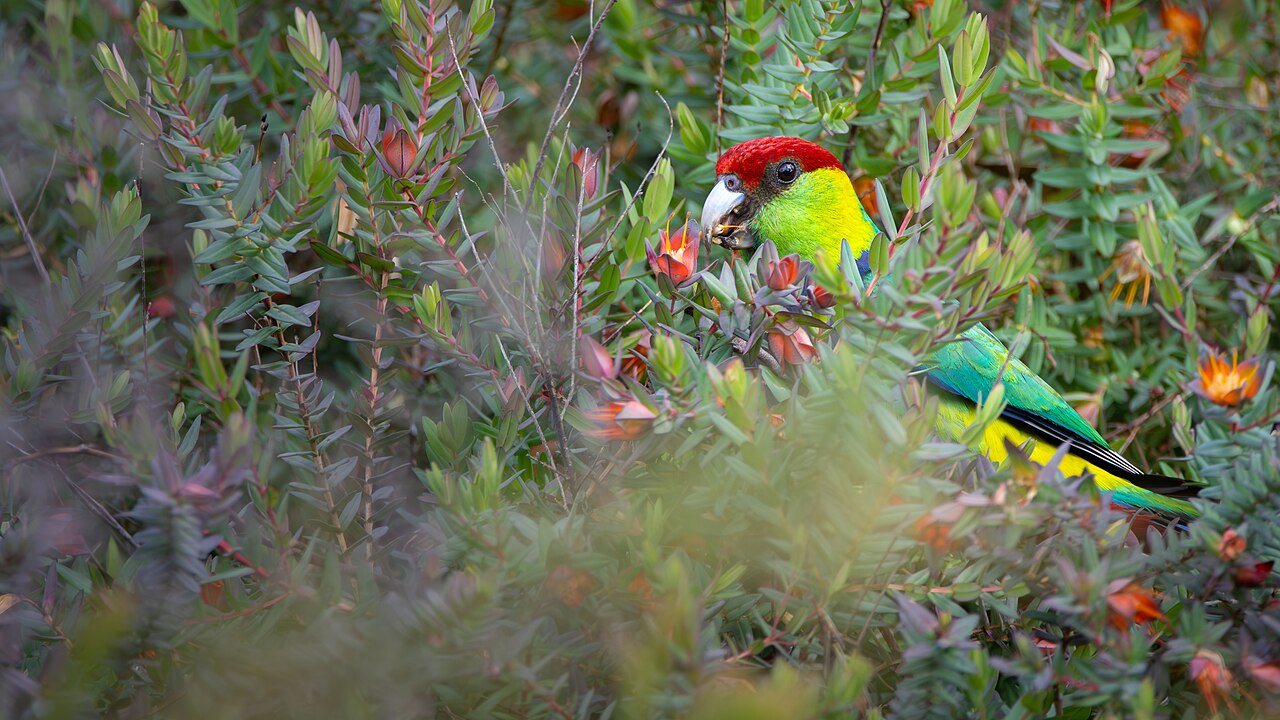
The Red-capped Parrot is the most striking parrot of south-western Western Australia: a solid, long-tailed bird with a crimson crown, green-yellow cheeks and a deep purple-blue underside. Its trademark is the bill — a much-elongated slender hook with which it alone prises open the rock-hard seed capsules of marri.
Voice
The contact call is a grating two-syllable krukk-rak or crrr-uk, repeated rapidly in flight and carrying across a good stretch of forest; it is a hard, slightly rasping sound, not a whistle. Alarmed, it gives high-pitched loud notes. A male guarding a nest hollow or otherwise agitated keeps up a sustained chatter. The flight is undulating and fluttering, and the call belongs to it.
Recording: Randy Moore — CC BY-NC-SA 4.0 · Woogenellup, Western Australia, Australia · xeno-canto
Identification
A large parrot of thirty-four to thirty-eight centimetres with a long tail. The male has a crimson forehead and crown, grey-brown lores, a green hindneck and green-yellow cheeks, dark green upperparts and a dark green tail with a blue tip, while breast and belly are deep purple-blue and thighs and undertail-coverts red. The bill is pale blue-grey with a dark grey tip, and the upper mandible is greatly elongated into a narrow hook — hence the local nickname 'hookbill'. The female is duller, with less intense red, green-yellow spotting on the red flanks and, in flight, a white stripe on the underwing. Juveniles are mostly green with an orange bill that turns pale blue-grey within two to five months; the adult pattern appears only after the first moult, around August.
Confusion species
Within its range it is effectively unmistakable, but in size it recalls the Australian Ringneck (Barnardius zonarius), which shares the same forest; that bird, however, has a black head with a narrow red frontal band, a broad yellow collar and an ordinary short parrot bill, lacks the purple-blue belly and looks far more evenly green in flight. The Western Rosella (Platycercus icterotis) of the same south-west is much smaller, deep red on head and underparts with a sharply bounded yellow cheek patch, and has no long bill. The real difficulty is juveniles: they are mostly green and lack the red crown altogether — then watch for the conspicuously long upper mandible and for the white underwing stripe, both present early.
Habitat
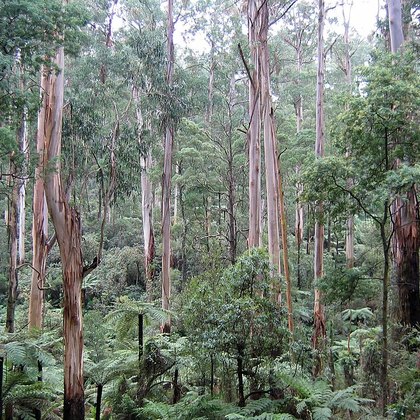
Dense to open eucalypt forest and woodland of the south-west, nearly always where marri (Corymbia calophylla) grows; besides that jarrah, tuart, wandoo (white-barked eucalypt of south-western Australia, and the woodland it forms), yate and peppermint forest and coastal heath. It eats seed prised from a eucalypt capsule or a sheoak cone held in one foot, and the long hooked bill is built exactly for that — a technique it shares with Baudin's Black Cockatoo. It is sedentary year-round. The nest sits in a tree hollow at some ten metres on average, in mature marri, jarrah, tuart or paperbark; the clutch is usually five eggs. In the suburbs of Perth, in parks and in orchards it is a common sight.
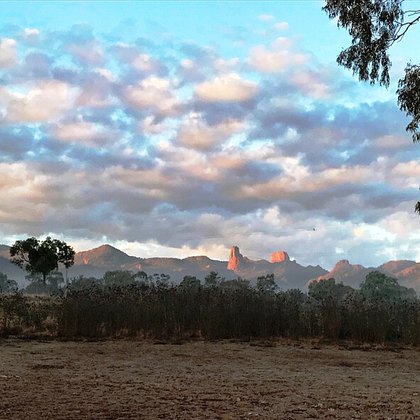
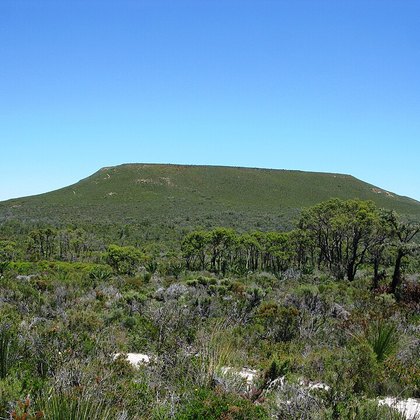
Where the bird is most often found, arranged by main group and formation.
Range and movements
South-western Western Australia only, from the Moore River north of Perth south along the coast to Esperance, inland as far as Gingin and Mooliabeenee but thinning quickly further in: most birds sit within a hundred kilometres of the coast. Outside that corner of the continent it occurs nowhere — not elsewhere in Australia, not in Tasmania, not in New Zealand and not on Norfolk Island.
- Resident
- dark = core range, pale = thinly spread
Where and when to look
Find a marri stand in the Perth Hills, in Dryandra Woodland or around Margaret River and look up at the capsules: a Red-capped Parrot holding a marri nut in one foot and working at it with that hooked bill stays quietly in one place for minutes on end. The grating krukk-rak of a passing bird is the starting signal. A garden or park in the south-western towns with an old marri in it gives you the easiest close view.
Conservation
Least Concern (LC), with a population rising rather than falling. It was not always so: because it takes apples and pears as well, it was declared harmful for decades and shot on a large scale, bounties and all. That persecution has ended and the bird is now protected; international trade falls under CITES Appendix II, so wild-taken birds cannot simply be traded. The lasting concern is the forest itself: it depends for food almost entirely on marri, and the felling of marri stands, the loss of old hollow-bearing trees and the death of eucalypts from the root fungus Phytophthora across the south-west eat at the base of its existence. In gardens and orchards, by contrast, it gains from planted trees.
Scientific name
Purpureicephalus spurius | (Kuhl, 1820)
Heinrich Kuhl described the species in 1820 as Psittacus spurius, from an immature bird that Baudin's expedition collected at Albany in Western Australia between 1801 and 1803; Albany is thus the type locality. Latin spurius means 'false, illegitimate' and refers to the green juvenile plumage resembling the adult so little that Kuhl took the bird for an aberrant specimen. Bonaparte introduced the genus Purpureicephalus in 1854, from Latin purpureus 'purple' and Greek kephalē 'head'; the combination is sometimes read as 'bastard purple-head'. Because the species was moved out of Psittacus, author and year stand in parentheses. In Western Australia itself it goes locally by 'king parrot' or 'hookbill'.