All species › Parrots › Old World parrots › Rainbow Lorikeet
Rainbow Lorikeet | Trichoglossus moluccanus
Regenbooglori | Lori de cocotero
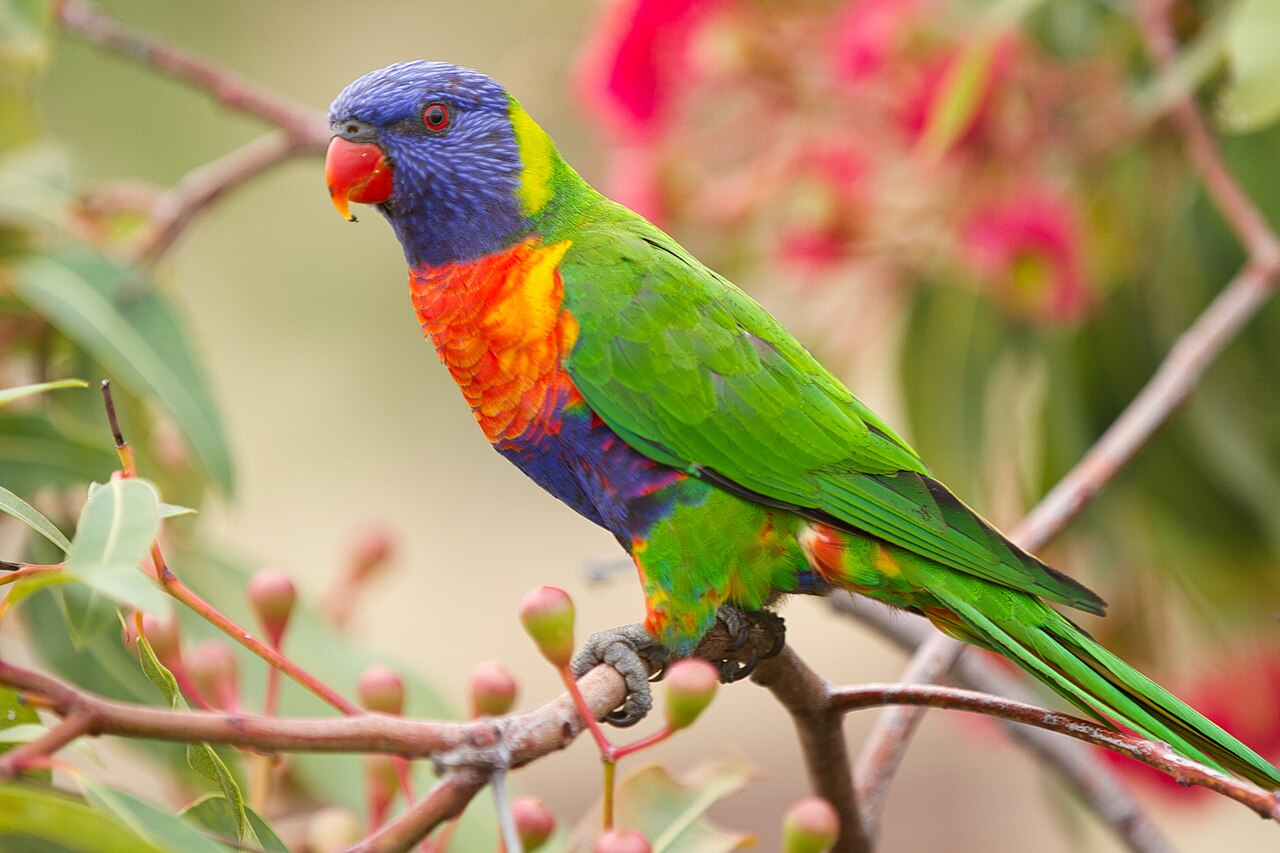
The Rainbow Lorikeet is the loudest and most gaudily coloured bird of the Australian east coast: a stocky parrot with a blue-purple head, a green mantle, an orange-red breast barred with yellow and a bright red bill. It lives on nectar and pollen, taken from the flowers with a brush-tipped tongue, and it moves with the flowering of the eucalypts.
Voice
Sustained sharp screeching and chattering is the characteristic sound: a flock passing over makes a shrill rolling racket that carries the length of a street, and at a roost hundreds of birds screech on well past sunset. Feeding birds give softer throaty contact notes and a wet smacking. A quarrel over a flowering branch brings a short high squeal. It is really only quiet while eating.
No recording with a suitable Creative Commons licence has been found for this species yet; what to listen for is described below.
Identification
A stocky parrot of about thirty centimetres with a short pointed tail and a bright red, fairly slender bill. The head is deep blue-purple, with a green-yellow collar across the nape; mantle, wings and tail are green. The breast is orange-red with narrow blue-black barring, the belly deep blue-purple, and the flanks and thighs yellow and green. In flight a broad yellow band lights up across the middle of the underwing, the best mark on a passing flock. The sexes cannot be told apart. Juveniles are duller, with a brown-black bill that only reddens after some months.
Confusion species
Red-collared Lorikeet (Trichoglossus rubritorquis) of the Top End has a broad orange-red collar in place of the green-yellow one and a black belly, and the two meet around the Gulf of Carpentaria. Scaly-breasted Lorikeet (Trichoglossus chlorolepidotus) of the east coast is all green with yellow scaling on the breast and no blue head. The smaller southern lorikeets, Musk Lorikeet (Trichoglossus concinnus) and Little Lorikeet (Parvipsitta pusilla), are green with red on the face and much smaller. Within the guide area a lorikeet with a blue-purple head and a yellow underwing band is always this species.
Habitat
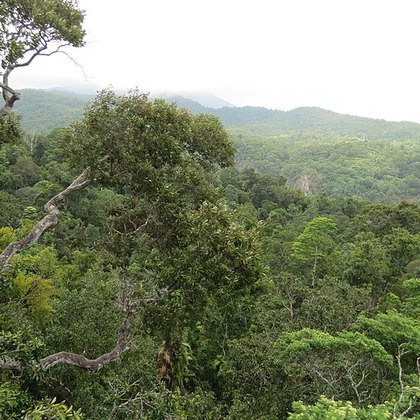
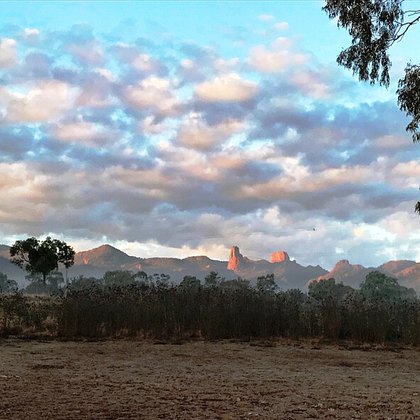
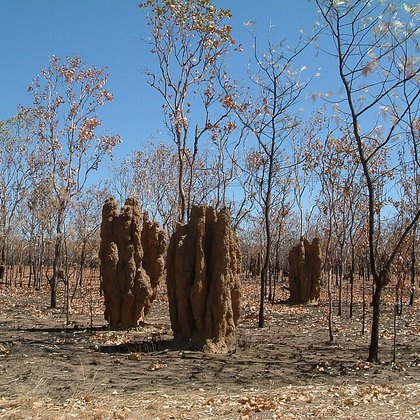
Anything that flowers and carries trees: rainforest and its edges, wet and dry eucalypt forest, northern savanna woodland, mangrove, and above all gardens, parks, street trees and orchards in the east-coast cities. It follows the flowering of eucalypts, banksias, melaleucas and planted blossom, and wanders tens to hundreds of kilometres to do so. It nests in a hollow high in a eucalypt, usually near water, the eggs laid on rotted wood.
Where the bird is most often found, arranged by main group and formation.
Range and movements
The coast and hinterland of northern and eastern Australia, from the Kimberley and the Top End around Cape York and down the whole east coast into South Australia. The birds at Perth and in Tasmania are released stock, treated there as introduced and controlled in Western Australia. A small established population in Auckland, New Zealand, was cleared again. It does not migrate along fixed routes but wanders after the blossom, so a district can be full of lorikeets one summer and empty the next.
- Resident
- dark = core range, pale = thinly spread
Where and when to look
Find a flowering eucalypt or banksia in an east-coast city park and stand under it: the birds hang upside down in the flower heads, drop husks, and can be watched at two metres. To see the numbers, come to a street-tree roost half an hour before sunset — in Brisbane or Sydney thousands come in. Do not offer bread or honey water; it makes lorikeets ill and ties them to one place.
Conservation
Least Concern (LC) and sharply increased in the east-coast cities, because planted blossom supplies nectar all year where native forest supplies it only in season. Against that, it is a local pest in orchards and vineyards, and the released population near Perth is controlled as a threat to native hollow-nesters. In the forest itself the supply of old hollow-bearing trees is the limit, and psittacine beak and feather disease spreads around feeding tables.
Scientific name
Trichoglossus moluccanus | (Gmelin, 1788)
Gmelin described the bird in 1788 as Psittacus moloccanus, believing the specimen came from the Moluccas; in fact it came from Australia, and Mathews fixed the type locality at Botany Bay in 1916. Because the species was later moved to another genus, author and year stand in parentheses. The genus Trichoglossus was introduced by Stephens in 1826, from Greek thrix, trikhos, 'hair', and glōssa, 'tongue', after the brush-tipped tongue with which these birds lap nectar. Until 2019 the Australian bird was carried under Trichoglossus haematodus; this guide holds it as a species of its own, leaving haematodus for the bird of New Guinea and Melanesia.