All species › Parrots › Old World parrots › Musk Lorikeet
Musk Lorikeet | Trichoglossus concinnus
Muskusparkiet | Lori almizclero
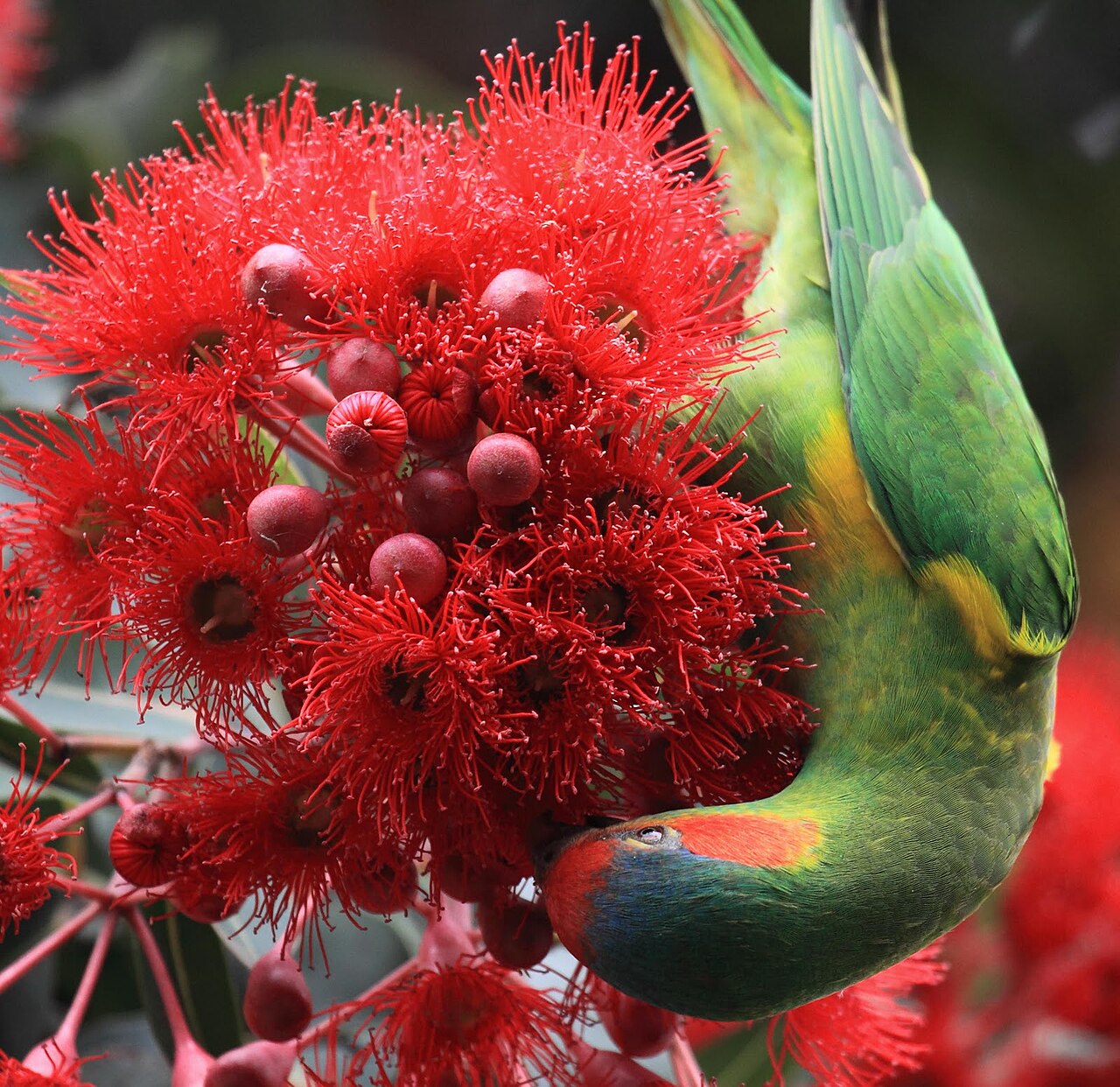
The Musk Lorikeet is the mid-sized lorikeet of south-eastern Australia: green, with a red band running straight through the eye to the ear coverts and a blue crown above it. In thirty years it has become a familiar city bird in Melbourne and Sydney, and it owes its name to the musky scent it carries.
Voice
A shrill, metallic screech, clearly higher and sharper than the Rainbow Lorikeet but lower than the thin tinkle of the Little Lorikeet, given both in flight and from a perch. In flight it is a hard rolling kreet-kreet; feeding flocks keep up an unbroken high chatter and grating that makes a flowering tree audible from a distance. Squabbling over blossom turns this into sharp screaming.
No recording with a suitable Creative Commons licence has been found for this species yet; what to listen for is described below.
Identification
Twenty to twenty-three centimetres and around seventy grams — clearly bulkier than Little and Purple-crowned Lorikeets, clearly smaller than the Rainbow. Mostly grass-green, with a bright red forehead continuing as a red band through the eye onto the ear coverts, and above it a blue crown that extends further in the male than the female. A yellow patch sits at each side of the breast, a bronze-yellow wash over mantle and nape, and in flight the brown flight feathers and a golden-yellow tail base show well. The bill is black with a distinct red tip to both mandibles, the iris orange-yellow.
Confusion species
Little Lorikeet (Parvipsitta pusilla) is a quarter smaller, has an all-black bill and red covering the throat as well, and lacks both the blue crown and the yellow breast patch. Purple-crowned Lorikeet (Parvipsitta porphyrocephala) has a purple crown, an orange-yellow ear patch and pale blue rather than green underparts. Rainbow Lorikeet (Trichoglossus moluccanus) is nearly a third longer with an entirely blue-purple head and orange-red breast. Scaly-breasted Lorikeet (Trichoglossus chlorolepidotus) has an all-green head with no red at all and a wholly red bill. Red eye-stripe plus blue crown plus red bill tip belongs to Musk Lorikeet alone.
Habitat
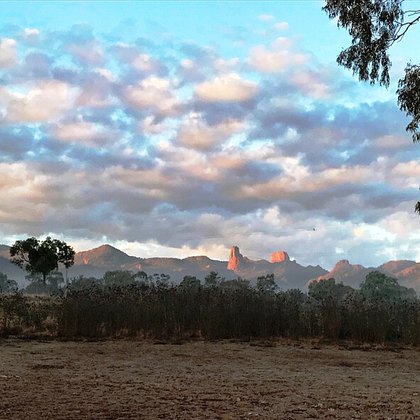
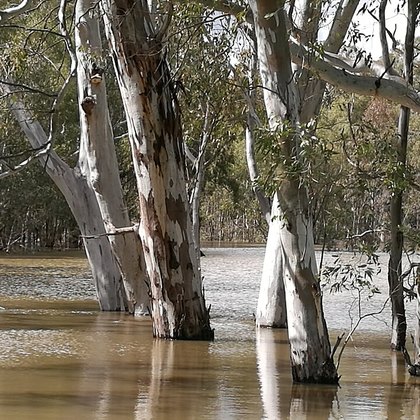
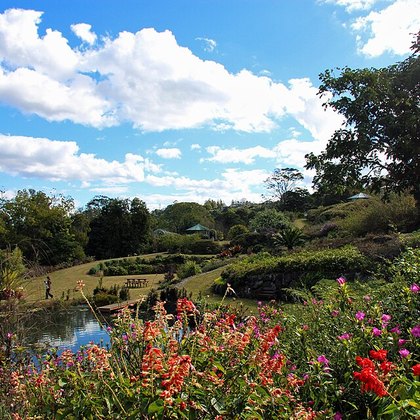
Tall, open and rather dry eucalypt forest and woodland, where it stays almost entirely in the canopy; box-ironbark (dry eucalypt forest of box and ironbark species; ironbark: eucalypt with deeply furrowed, hard bark) and yellow box country are favoured, as are old river red gums along creeks. Beyond that it has become a genuine city bird of outer suburbs with plenty of mature street trees, parks and gardens holding flowering eucalypts. Roost trees often lie kilometres from the feeding trees, so there are fixed flight lines every morning and evening.
Where the bird is most often found, arranged by main group and formation.

Range and movements
Endemic to south-eastern Australia: eastern New South Wales, all of Victoria, the south-east of South Australia including Kangaroo Island, and eastern and northern Tasmania. The stronghold is on the inland side of the Great Dividing Range. It has settled in Melbourne and Sydney since the 1990s on the back of planted nectar-bearing eucalypts, where it now competes with Rainbow Lorikeets for the same blossom. Within that range it wanders after the flowering.
- Resident
- dark = core range, pale = thinly spread
Where and when to look
In late winter and spring walk streets lined with flowering Yellow Gum and listen for the shrill screeching overhead; a flock of Musk Lorikeets in a flowering tree is audible a block away. Then put the glass on the head profile: the red eye-stripe runs horizontally and shows as a dark band even against the light. If a tame bird in a park carries a sweetish, musky smell, the name is doing its work.
Conservation
Least Concern (LC), and one of the few nectar-feeders of south-eastern Australia to have done better in recent decades: urban planting of flowering eucalypts has given it a new year-round food supply and established it in Melbourne and Sydney. In the country the loss of old hollow-bearing trees still counts, since it nests in hollows of living eucalypts that are centuries old. Local losses come from collisions and from poisoning when it takes sprayed fruit in orchards.
Scientific name
Trichoglossus concinnus | (Shaw, 1791)
George Shaw described the species in 1791 as Psittacus concinnus, in volume three of his The Naturalist's Miscellany; the type locality is 'New Holland', which in practice means New South Wales. Author and year take parentheses because the bird later changed genus. Latin concinnus means 'elegant, neat'. The species long sat in Glossopsitta, but this guide places it in Trichoglossus, the genus Stephens introduced in 1826 from Greek thrix, trikhos, 'hair', and glōssa, 'tongue', for the brush tip with which lorikeets lap nectar. The Dutch and English names refer to the bird's musky scent.