All species › Passerines › Monarchs and allies › Paperbark Flycatcher
Paperbark Flycatcher | Myiagra nana
Kleine witkeelmonarch | Monarca chico
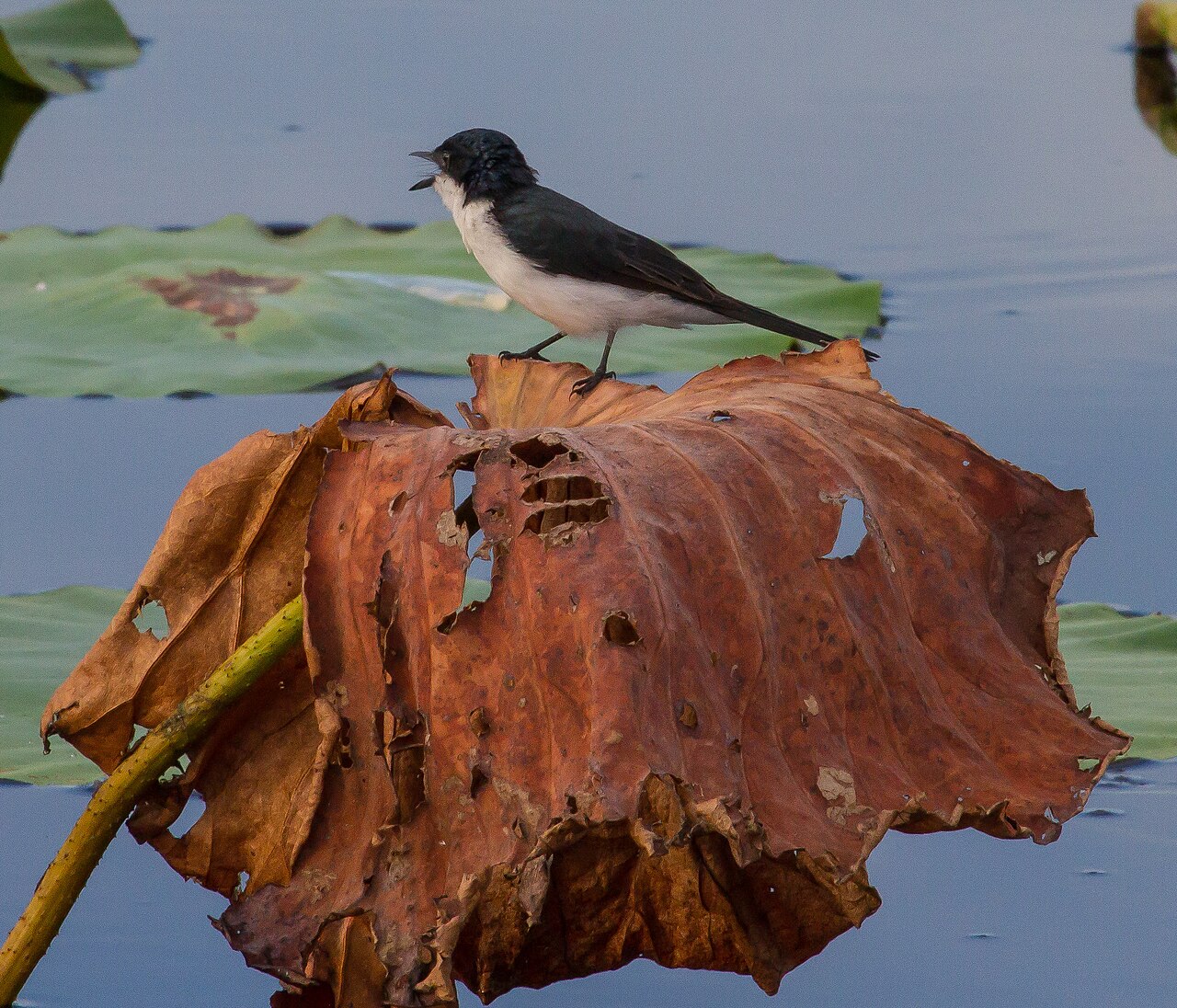
The Paperbark Flycatcher is the tropical counterpart of the Restless Flycatcher: the same glossy black-and-white suit, the same hovering hunt, but everything one size smaller. It belongs to northern Australia, to the paperbark trees along the creeks and swamp margins, and was only recognised as a separate species late on. Anyone wanting to separate it in the field from its southern twin will get most help from the map.
Voice
A rasping, grinding sound while hovering, of the same type as in Restless Flycatcher but generally less loud and less drawn out; the full scissors-grinding rattle of the southern bird is absent or much weaker. Beyond that a clear two-syllable tu-whit contact call and short sharp whistles. Since the two species barely meet, the vocal difference is rarely needed in practice to tell them apart.
Recording: Craig Robertson — CC BY-NC-SA 4.0 · Delamere, Victoria Daly Region, Northern Territory, Australia · xeno-canto
Identification
A compact flycatcher of sixteen to eighteen centimetres with glossy blue-black upperparts, crown and head sides, and a pure white underside taking in chin and throat. The tail is proportionately short and the crest on the crown small to almost absent, so the head looks round rather than peaked. Male and female are near identical; young birds show a browner wash above. The bird hovers, flicks its tail, and readily forages low over open ground and at water edges.
Confusion species
The twin species is Restless Flycatcher (Myiagra inquieta), treated as the same species until the 1990s. Honestly, the two are barely separable on plumage: only the shorter tail, the smaller crest and the smaller size mark out Paperbark Flycatcher, and those are differences you see when the birds sit side by side — which in practice never happens, because the ranges hardly overlap. In tropical northern Australia every hovering white-throated Myiagra is this species. Shining Flycatcher (Myiagra alecto) shares the habitat but has an all-black throat and belly in the male and a rufous back in the female. Broad-billed Flycatcher (Myiagra ruficollis) has an orange-rufous throat in both sexes, never white.
Habitat
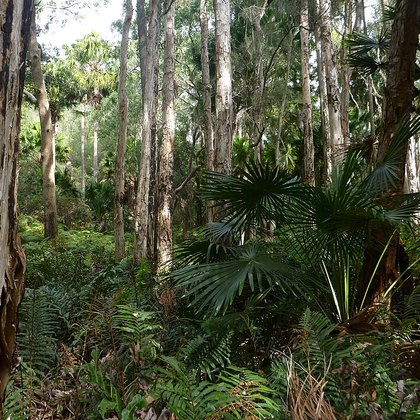
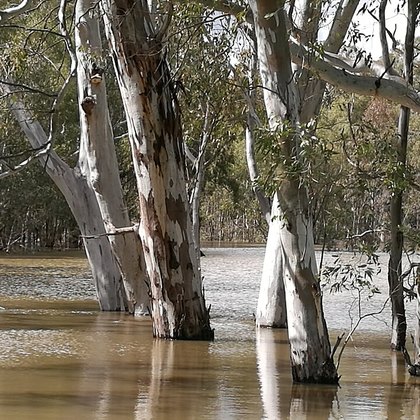
Paperbark woodland and open eucalypt woodland in the tropical north, almost always near water: along creeks, around lagoons and swamps, and on the landward side of mangrove belts. Like its southern relative the bird needs open space to hunt by hovering; it plucks insects from grass, bark and foliage and also takes them in flight.
Where the bird is most often found, arranged by main group and formation.
Range and movements
Northern Australia from the Kimberley in north-western Australia to the south-west of Cape York Peninsula in northern Queensland, plus the north-western islands of Torres Strait and southern New Guinea. It is a resident with no demonstrable migration; local movements follow the monsoon and the drying or filling of the swamps.
- Resident
- dark = core range, pale = thinly spread
Where and when to look
In the dry season, walk the paperbark fringe of a billabong (cut-off river channel that flows only at high water) or creek and watch for a small black-and-white bird holding station above the grass. North of roughly the Tropic of Capricorn every hovering white-throated Myiagra is this species and the identification is settled; around the base of the Gulf of Carpentaria it is still worth judging tail length. Do not go looking for a crest — here there is hardly one.
Conservation
Least Concern (LC). The species occupies a vast, thinly settled part of tropical Australia and southern New Guinea, and rather benefits from the pastoral landscapes there than suffers under them, since cattle keep the grassy floor short. Possible concerns are altered fire regimes and the damage cattle and pigs do to creek and swamp margins, which degrades the paperbark stands in which the species breeds. There is nothing here of the visible decline its southern twin is undergoing in farmed south-eastern Australia.
Scientific name
Myiagra nana | (Gould, 1870)
John Gould described the bird in 1870 as Seisura nana, from material out of northern Australia; because it now stands in Myiagra, author and year are in parentheses. The genus Myiagra goes back to Ancient Greek muia ('fly') and agra ('catching'). The epithet nana is Latin for 'dwarf' and sets the bird against the larger Restless Flycatcher (Myiagra inquieta), of which it long counted as a subspecies. The English name Paperbark Flycatcher takes the tree the species is tied to, the melaleuca or paperbark; the Dutch Kleine witkeelmonarch and the Spanish monarca chico both take the size.