All species › Pigeons and doves › Doves and pigeons › Pacific Emerald Dove
Pacific Emerald Dove | Chalcophaps longirostris
Smaragdduif | Palomita esmeralda cabecigrís
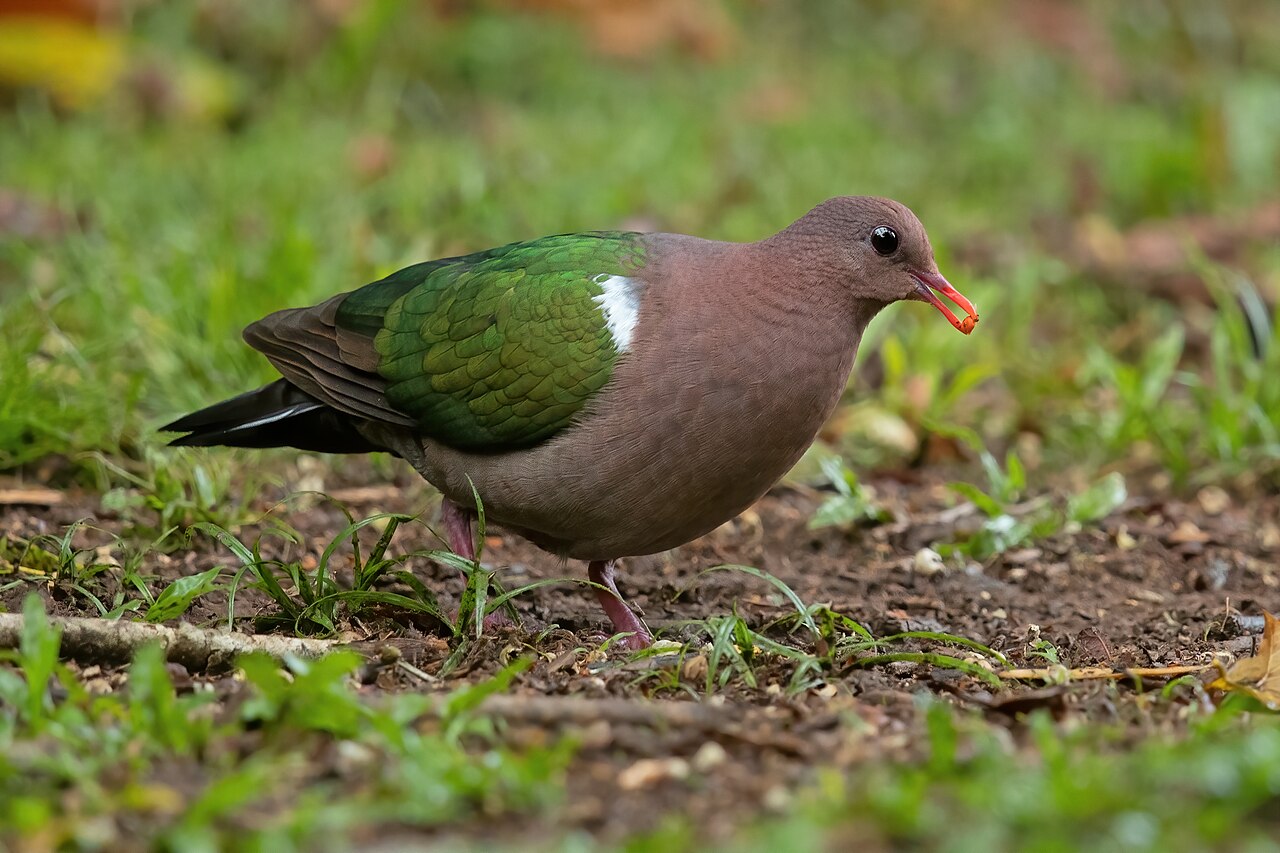
The Pacific Emerald Dove is a stocky forest pigeon you will nearly always meet on the ground, and one whose colour shows only when light falls on its back: the shoulders and wings are deep metallic green against a warm wine-pink head and underside. It shoots off low and fast between the trunks and then vanishes so completely that you begin to doubt you saw it.
Voice
A low, soft, mournful run of six or seven coos that starts quietly and swells and rises as it goes: oo … oo … hoo-hoo-hoo-hoo, often from a low branch in thick cover and hard to place. There is also a short nasal hoo-hoo-hoon. Take-off brings a dry clatter of wings.
Recording: Greg McLachlan — CC BY-NC-SA 4.0 · Maleny, Sunshine Coast Regional, Queensland, Australia · xeno-canto
Identification
A small, compact dove of just under thirty centimetres with a short tail, a red bill and pink-red to red-brown legs. The mantle and upperwing are unmistakably emerald green with a bronze sheen; head, neck and breast are dull pink to wine-red, the belly greyer. The male has a grey crown and a white patch at the bend of the wing; the female is browner, lacks the white shoulder patch and shows at most a grey mark there. Two pale bars across the dark rump stand out as it flies away from you — that, plus the green, is usually all you get. Young birds resemble the female but are scalloped brown.
Confusion species
Little scope for confusion, since no other pigeon in the region has that green back. On the forest floor it does share ground with Wonga Pigeon (Leucosarcia melanoleuca), much larger and blue-grey with a white V on the breast. In the north it overlaps with Bar-shouldered Dove (Geopelia humeralis) and Peaceful Dove (Geopelia placida), which are slimmer, long-tailed and finely barred, with no green at all. A bird flushing away can suggest a small cuckoo or a kingfisher, but the rounded wings and heavy build of the dove rule that out.
Habitat
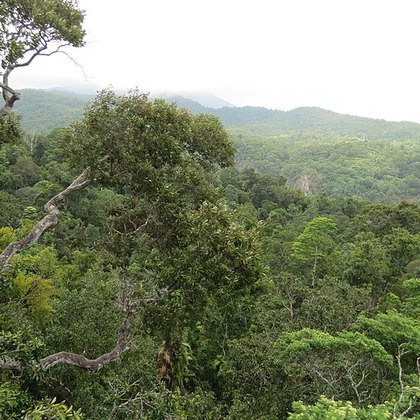
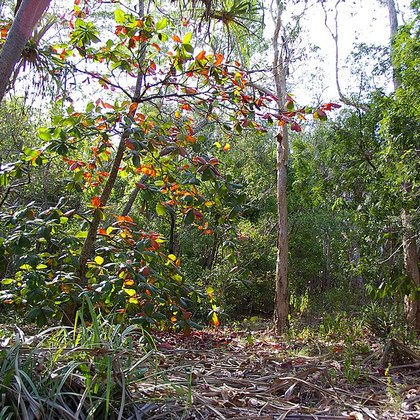
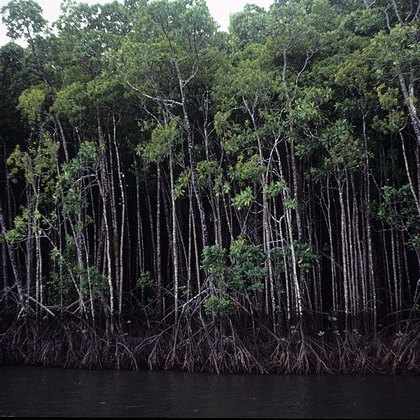
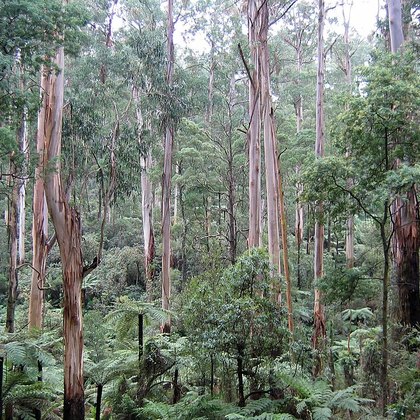
Rainforest and monsoon forest form the core, with vine thicket, mangrove, dense coastal heath, wet eucalypt forest and the sheltered edges of plantations and gardens besides. It works the floor for fallen fruit, seeds and small invertebrates and goes into trees almost only to roost and nest. Dense understorey and a damp, shaded forest floor are the constant.
Where the bird is most often found, arranged by main group and formation.
Range and movements
From the Kimberley through the Top End of the Northern Territory and Cape York, and on down the east coast of Queensland and New South Wales into far eastern Victoria. Within the map window it also occurs on Norfolk Island and Lord Howe. It is absent from the arid interior and from New Zealand; in the southern part of its range it is local and tied to the surviving coastal rainforest strips.
- Resident
- dark = core range, pale = thinly spread
Where and when to look
Walk a rainforest track quietly at sunrise and attend to sound from the floor rather than movement in the canopy; usually you see it as a low, fast, straight-flying bird that flashes green in raking light. Standing still pays: birds you have not flushed often return to the same walking route within minutes.
Conservation
Least Concern (LC). The species has a wide range across Australia and the islands of the western Pacific and is still numerous in the north. In the south-east the story is more fragile, because there it hangs on narrow, fragmented coastal rainforest remnants, and its habit of flying low across clearings costs birds along roads. Feral cats and foxes add pressure on a dove that spends most of its time on the ground.
Scientific name
Chalcophaps longirostris | Gould, 1848
John Gould described the species in 1848 directly in the genus Chalcophaps, which he had introduced in 1843, so author and year carry no parentheses, and the Australian birds were long treated as part of the Asian Chalcophaps indica. Chalcophaps is built from Ancient Greek khalkos 'bronze' and phaps 'pigeon'. The epithet longirostris means 'long-billed' and points to the difference from the Asian species. The type bird comes from Australia.