All species › Passerines › Australasian robins › Northern Scrub Robin
Northern Scrub Robin | Drymodes superciliaris
Cape York-fluiter | Petroica matorralera norteña
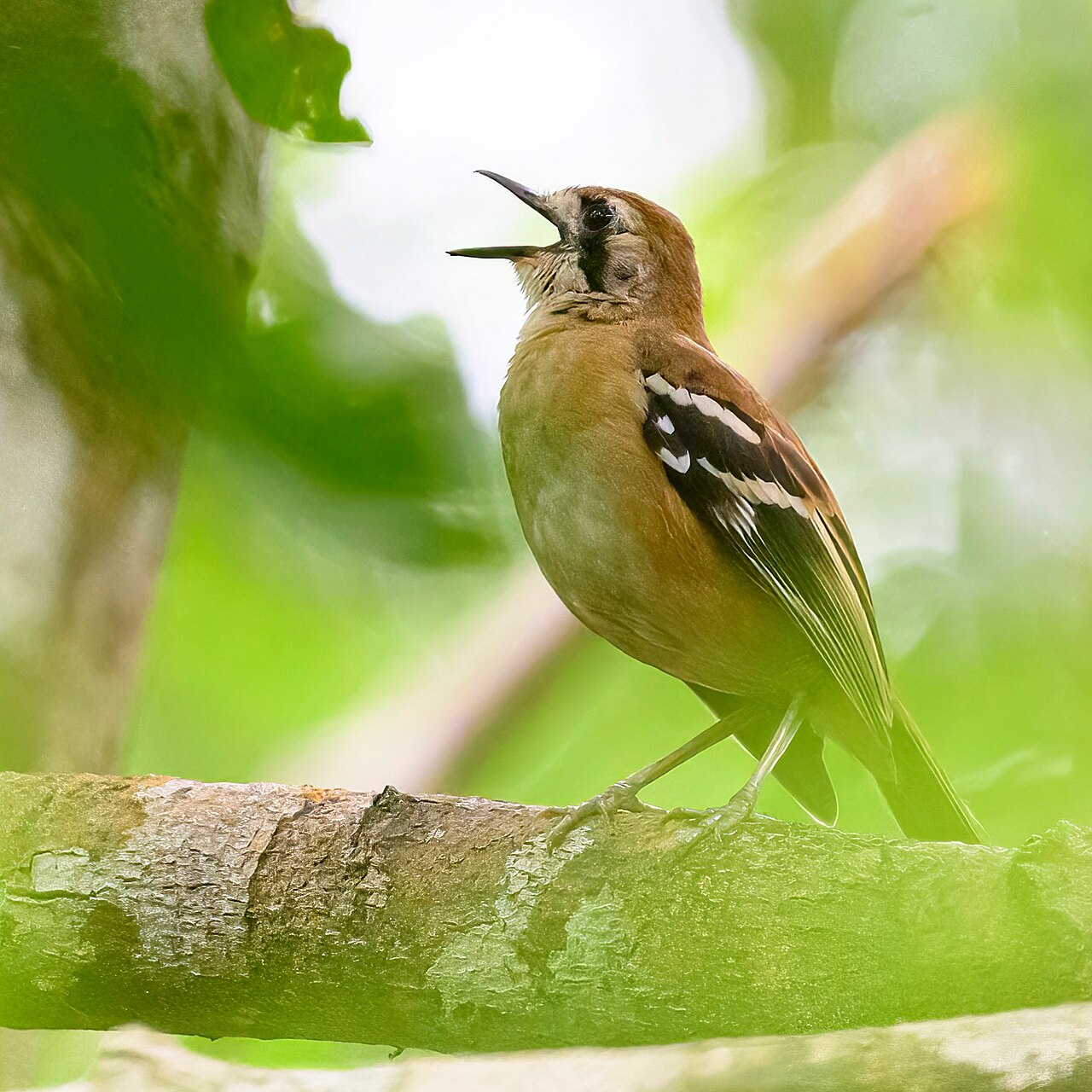
The Northern Scrub Robin is a large, long-legged robin that lives not in the shrubbery but on the forest floor: it hops and runs through the leaf litter of the rainforest of northern Cape York. In Australia it occurs nowhere else, within a belt only a few hundred kilometres long.
Voice
Clear, mournful whistles, often two or three rising notes in succession with silences between; the sound is hard to place, since in closed forest it seems to come from every direction. There is also a harsh, rattling scold when a bird is disturbed. It calls chiefly at first light and again towards evening.
Recording: nick talbot — CC BY-NC-SA 4.0 · Lockhart River, Cook Shire, Queensland, Australia · xeno-canto
Identification
Twenty to twenty-three centimetres, with long pale legs and a long tail often held slightly cocked. The upperparts are warm rufous-brown with a rufous rump and tail, the underparts off-white. The face carries the pattern everything rests on: a black line through the eye and above it a sharp white eyebrow. Two white bars cross the dark wing. Male and female look alike. On the ground it moves in short hops and pauses between them, flicking the wings.
Confusion species
Its only congener, Southern Scrub Robin (Drymodes brunneopygia), lives thousands of kilometres to the south in the mallee (low, multi-stemmed eucalypt scrub of dry southern Australia) of southern Australia; confusion in the field is impossible, yet the two are unmistakably related in build, carriage and behaviour: long legs, long tail and a life on the forest floor. Within the Cape York rainforest, White-faced Robin (Eopsaltria leucops) is the other small brownish bird of the lower storey, but it is far smaller, has a white face and yellow underparts, and clings crosswise to upright saplings instead of walking on the ground. The birds of New Guinea, once included in this species, are now usually treated as a species of their own, Drymodes beccarii; the Australian population therefore stands alone.
Habitat
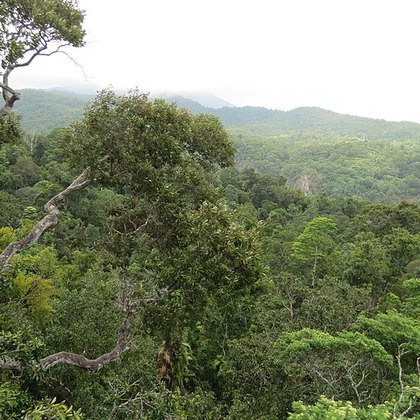
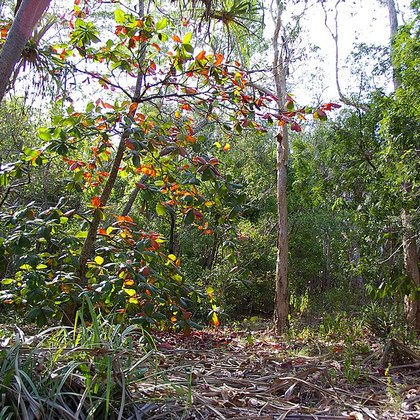
Rainforest, monsoon forest and vine thicket on Cape York, together with the gallery forest along creeks that goes with them. What it needs is a thick, unbroken layer of leaves on the ground to search through, with a closed canopy above to keep that layer damp. Where the litter is turned over or burnt away, it disappears.
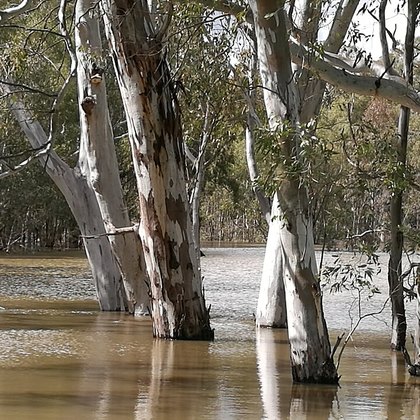
Where the bird is most often found, arranged by main group and formation.
Range and movements
Only the north-east of Cape York Peninsula in far northern Queensland, centred on the rainforest of the Iron Range and McIlwraith Range country. Further south it quickly becomes scarce. Resident: a pair holds the same piece of forest year-round and hardly moves. Outside Australia related birds live in New Guinea, but these are usually kept separate.
- Resident
- dark = core range, pale = thinly spread
Where and when to look
Stand quietly on a forest track at first light and listen for the whistle; the bird often crosses the track a few metres away and then pauses. Listen to the litter as well: the turning of leaves gives it away sooner than movement does, for in the gloom of the floor its brown back hardly shows. Search low, because it seldom flies higher than a metre or two, and then only to rest on a low branch.
Conservation
Least Concern (LC) globally, but the Australian range is small, which leaves the population here exposed. The main local pressure comes from feral pigs, which turn over the litter layer in which the bird feeds and nests on the ground, and from fires that push in from the savanna and drive back the rainforest edge. Feral cats take birds that live on the ground. Protecting the rainforest blocks of Cape York and controlling pigs are the measures that work here.
Scientific name
Drymodes superciliaris | Gould, 1850
John Gould described the species in 1850 in Contributions to Ornithology, from a bird taken at Cape York in Queensland. superciliaris is Latin for eyebrowed, from supercilium (eyebrow), and refers to the sharp white line above the eye that is the species' best feature. The genus Drymodes was introduced by Gould in 1841, from Greek drymodes (woody, of the woodland), after the forest floor on which these birds live. The Dutch name joins the range to the clear whistle.