All species › Tubenoses › Northern storm petrels › Matsudaira's Storm-Petrel
Matsudaira's Storm-Petrel | Hydrobates matsudairae
Japans stormvogeltje | Paíño de Matsudaira
Matsudaira's Storm-Petrel is the largest uniformly dark storm petrel that can turn up in this region: close to a quarter of a metre long, with long narrow wings, a deeply forked tail and a slow, languid flight that suggests a small skua rather than a storm petrel. It breeds only in Japan's Volcano Islands and then crosses the equator into the Indian Ocean; in Australian waters it is a rare vagrant.
Voice
At sea it is silent, and every record from this region comes from the sea, so voice plays no part in identification here. At the colony on Minami-Iwo-jima, which the birds visit only in darkness, a low purring churr comes from the burrows with short, high, hurried notes over it. Away from the breeding islands the species is effectively mute.
No recording with a suitable Creative Commons licence has been found for this species yet; what to listen for is described below.
Identification
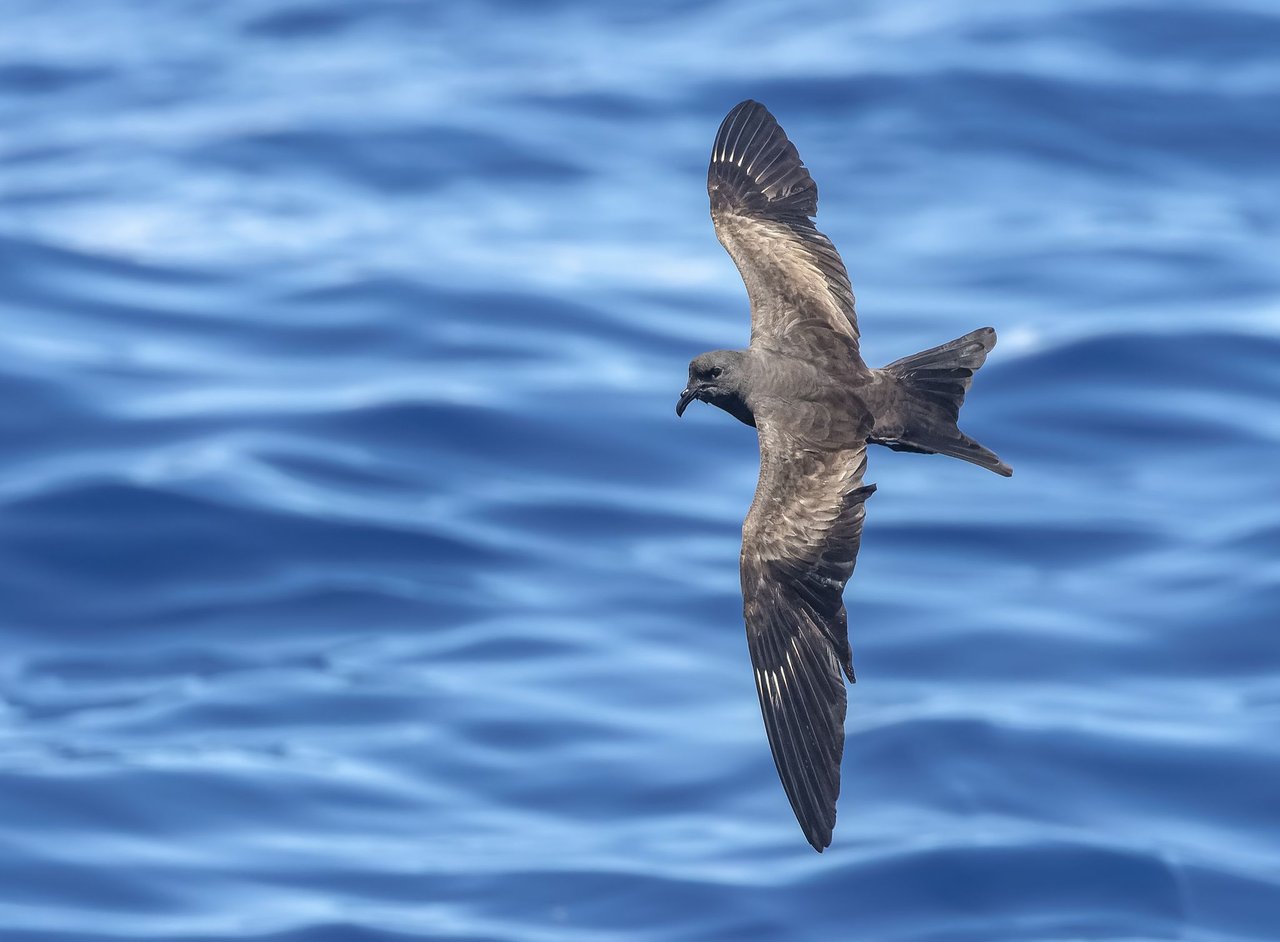
Twenty-four to twenty-five centimetres with a wingspan of about fifty-six: far larger and heavier than the other dark storm petrels. The plumage is blackish brown, with a broad light-brown to buff carpal bar across the upperwing curving in towards the body like a crescent. The clinching feature is in the primaries: the shafts at the base of the outer primaries are pure white and together form a distinct pale patch or flash on the wing that carries at some distance. The tail is long and deeply forked, the bill black and fairly heavy. Flight is slow and easy, with deep beats and long, high glides — almost skua-like, not the fluttering expected of a storm petrel.
Confusion species
Swinhoe's Storm-Petrel (Hydrobates monorhis) is the main counterpart: a quarter smaller, faster and more restless in flight, and without the conspicuous white shaft patch — in that species it amounts only to a thin streak visible at close range. Bulwer's Petrel (Bulweria bulwerii) is likewise large, dark and long-tailed and also flies low and easily, but has a tapering wedge-shaped tail rather than a forked one, and lacks the white shafts. Wilson's Storm-Petrel (Oceanites oceanicus) is much smaller and shows a broad white rump band. Confusion with the more northerly Tristram's Storm-Petrel (Hydrobates tristrami) does not arise in this region, but in the literature that pair is separated on exactly this point: Tristram's lacks the white shafts.
Habitat
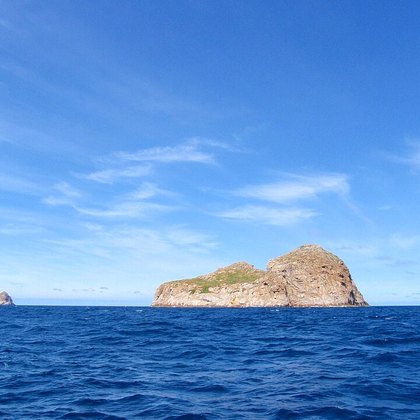
Open sea over deep water, usually well beyond the continental shelf. Outside the breeding season it lives in the tropical and equatorial Indian Ocean, picking small squid, crustaceans and lanternfish from the surface, often over upwelling water. It breeds on steep, rocky volcanic slopes on uninhabited islands, in burrows among rubble and vegetation. In the guide area it is a bird of the open ocean and nothing else.
Where the bird is most often found, arranged by main group and formation.
Range and movements
Within this guide's map window a vagrant only. GBIF data for 2015–2024 hold fifteen records, all in Australian waters and from only two of those ten years — scarcer and more erratic, therefore, than Swinhoe's Storm-Petrel. For New Zealand there is one further documented record: a beach-wrecked bird at Maukatia Bay on the west coast near Auckland on 27 May 2022. Because the non-breeding range lies in the Indian Ocean, Australian records are chiefly to be expected in north-western waters.
- Non-breeding visitor
- dark = core range, pale = thinly spread
Where and when to look
Expect it only on a pelagic trip over deep water, and then usually out of Western Australia or the Timor Sea. Look for a large, dark, long-winged storm petrel passing the boat on strikingly slow beats and holding higher above the water than the smaller species. Watch for the pale flash at the base of the primaries: that is the feature a photograph settles fastest, and it shows up well even against the light.
Conservation
Vulnerable (VU), almost entirely because of the size of the breeding range: as far as is known the species breeds only on Minami-Iwo-jima and possibly Kita-Iwo-jima in Japan's Volcano Islands. A population standing on one or two islands can be erased by a single event: introduced rats, a volcanic eruption, or human use of the island. Minami-Iwo-jima is for now predator-free and strictly protected, and the species' fate hangs on that. At sea, bycatch and plastic add to the pressure. In Australian waters the bird is far too scarce to show any trend.
Scientific name
Hydrobates matsudairae | (Kuroda, 1922)
Kuroda described the species in 1922 and named it for the Japanese ornithologist Marquis Yorikata Matsudaira; because it later moved from Oceanodroma to Hydrobates, author and year stand in parentheses. The epithet matsudairae is therefore a dedication and carries no descriptive sense. The type came from Japanese waters, and the only certain breeding ground in the world lies in the Volcano Islands south of Iwo Jima. The Dutch guide name points to that breeding range, the English and Spanish to Matsudaira himself.