All species › Tubenoses › Northern storm petrels › Band-rumped Storm-Petrel
Band-rumped Storm-Petrel | Hydrobates castro
Madeirastormvogeltje | Paíño de Madeira
The Band-rumped Storm-Petrel is a bird of warm, deep water and a vagrant in Australian and New Zealand seas. It breeds on islands in the Atlantic and the tropical Pacific, and the few birds that appear here are almost always seen on a pelagic trip or arrive off course after a cyclone.
Voice
In this region it is a bird to be seen and not heard: at sea it is silent. At the colonies, all of them outside this region, it gives a shrill squeaking chee-chee-cheerr over the breeding slope at night and a purring churr from the burrow. Anyone who thinks they hear that in Australia or New Zealand is almost certainly hearing another species.
Recording: Ben Porter — CC BY-NC-SA 4.0 · Praia, Açores, Portugal · xeno-canto
Identification
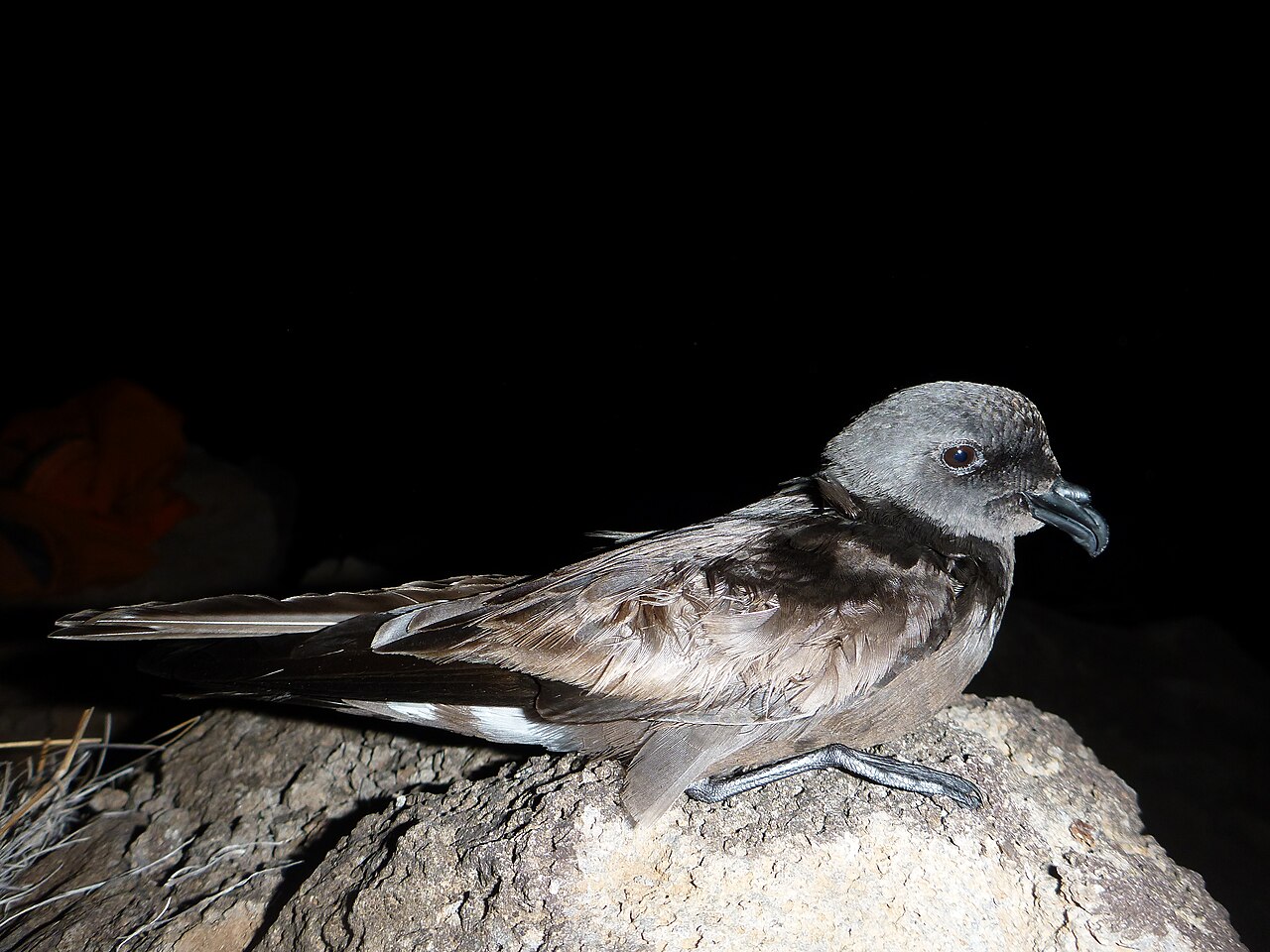
A medium-sized storm petrel of nineteen to twenty-one centimetres, brownish black with a faint, narrow pale bar across the upperwing and a wingspan of just over forty centimetres. The white rump band is narrow, square-cut and even in width, and continues only a little way onto the sides of the undertail coverts. The tail is slightly notched, which at sea often looks square, and the feet do not project beyond the tail tip. The sexes are alike. Flight is notably steady for a storm petrel: long, flat glides on slightly bowed wings, more like a small shearwater than a fluttering swallow.
Confusion species
With this species, separating it from its relatives is the heart of the observation. Wilson's Storm-Petrel (Oceanites oceanicus) has a broader rump band running well onto the flanks, a square-cut tail, projecting feet with yellow webs and a pattering flight with the wings held in a V. Leach's Storm-Petrel has a clearly forked tail, a V-shaped rump patch often divided down the middle, a far more contrasting pale wing bar and an erratic, veering flight. The Fregetta species have a white belly. Photograph every suspect storm petrel: tail shape, rump shape and wing bar together are decisive, and all three are rarely visible to the naked eye.
Habitat
Warm ocean water beyond the shelf edge, where it feeds alone or in small parties and seldom follows a ship. It avoids shallow inshore water and the cold water south of the subtropical convergence. Here it is seen from land only after a tropical storm drives birds onto the coast.
Where the bird is most often found, arranged by main group and formation.
Range and movements
The breeding sites lie on the Berlengas, the Azores, Madeira, the Canary Islands and St Helena in the Atlantic, and in the Pacific off Japan, on Hawaii and on the Galapagos; birds there breed in two separate seasons, which makes the group taxonomically complicated. In this region it does not breed and is a vagrant; records are scattered through the warm waters off eastern and northwestern Australia and northern New Zealand. Exactly how many records are accepted differs by committee and by country, and the number rises as more pelagic trips are run and more birds photographed.
- Non-breeding visitor
- dark = core range, pale = thinly spread
Where and when to look
Look for it on a pelagic trip over deep water in the warm months, and keep the camera on every storm petrel that does not fly off as a Wilson's. Judge the tail only when the bird spreads it: closed, a slightly notched tail looks square, and that very difference separates it from Leach's.
Conservation
Least Concern (LC) globally, with a population in the hundreds of thousands, but with colonies that are one and all small and vulnerable. Rats, cats and feral goats have reduced several island populations to birds breeding only on mammal-free stacks. Light pollution near colonies and the ingestion of plastic come on top of that; for this region the species poses no conservation question of its own, since it does not breed here.
Scientific name
Hydrobates castro | (Harcourt, 1851)
Harcourt described the bird in 1851 as Thalassidroma castro, from material on the Desertas off Madeira; because it was later placed in another genus, author and year stand in parentheses. The genus Hydrobates was introduced by Boie in 1822, from Greek hudro-, water, and -bates, walker — for a bird that seems to walk on the sea. castro is not Latin but Portuguese: roque de castro is the name the islanders of Madeira use for the bird. The Dutch name refers to that same type locality.