All species › Passerines › Munias, parrotfinches, waxbills and allies › Long-tailed Finch
Long-tailed Finch | Poephila acuticauda
Spitsstaartamadine | Diamante colilargo
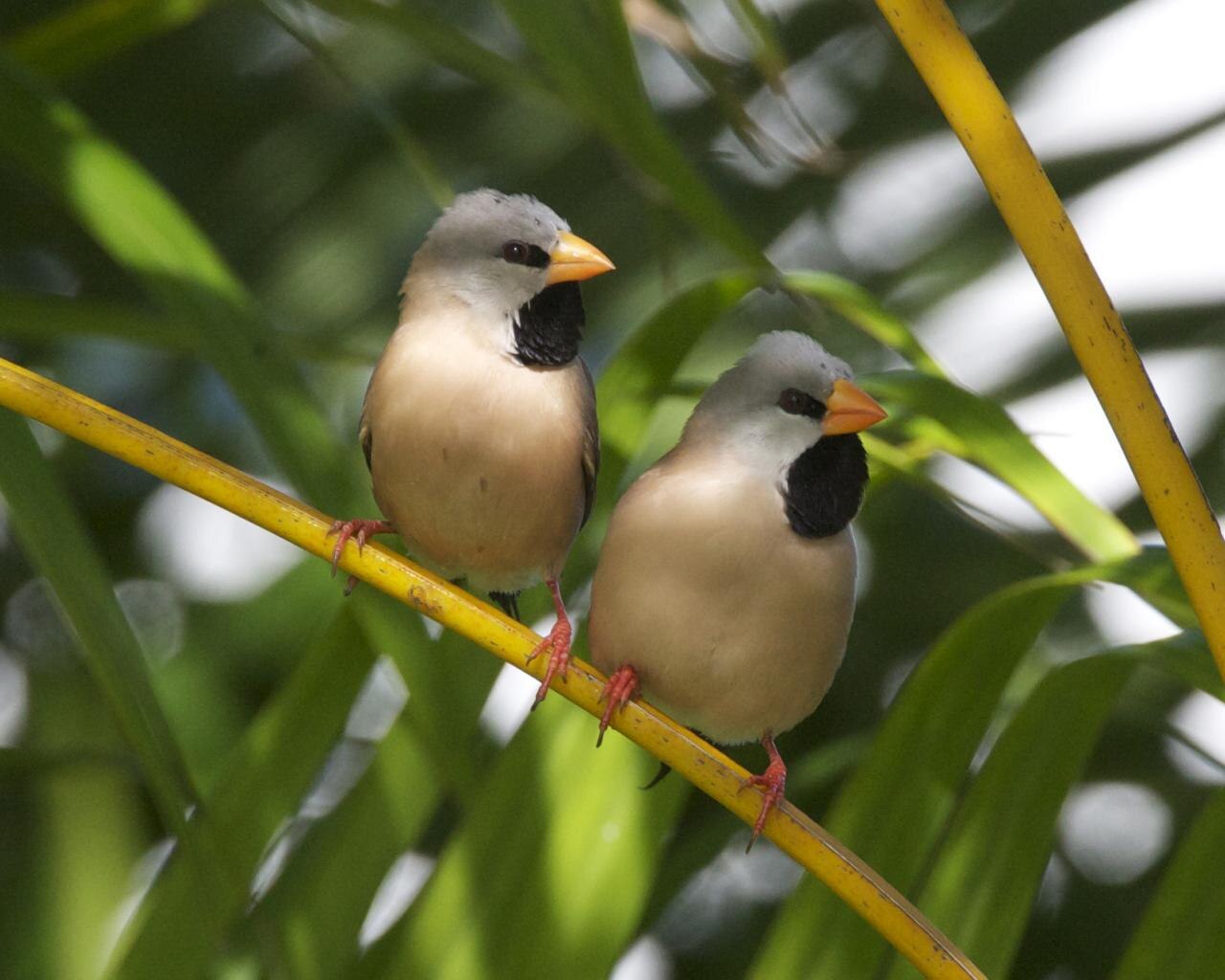
The Long-tailed Finch is the longest of the Australian grassfinches, though almost all of that length sits in the strongly elongated, needle-pointed black tail. It is a bird of the northern savanna: blue-grey head, rounded black bib, soft pink flanks, and a bill that is yellow in the west of the range and orange-red in the east.
Voice
The contact note is a clear, far-carrying whistle with a plaintive fall in it, used constantly by parties in flight and on the ground; in savanna country in the late morning it is one of the most obvious sounds. There is also a short, dry alarm note. The male's song is a soft, hesitant mixture of whistles, rattles and squeaks, given with the throat feathers raised and a small bow; it carries only a few metres.
Recording: Nigel Jackett — CC BY-NC-SA 4.0 · Mount Hardman, Western Australia, Australia · xeno-canto
Identification
Fifteen to sixteen centimetres, but at barely fourteen grams no heavier than its two relatives — the difference is all tail. Head and neck are pale blue-grey, with a black lore and a rounded, teardrop-shaped black bib in the middle of the throat, ending not square but in a point. The body is warm pinkish buff, paler on the belly, with a black flank patch and a white rump; the undertail-coverts are black. The tail is black, and the two central feathers are drawn out into long fine points. The bill is yellow in the nominate form of the Kimberley and western Top End and orange-red in the subspecies hecki further east, with orange-billed intergrades between them. Sexes alike, though the male's bib averages slightly larger.
Confusion species
At rest Black-throated Finch (Poephila cincta) is the real difficulty: also grey-headed with a black bib, but with a short square tail, a black rather than yellow or red bill, and a bib cut off square below instead of pointed. Do not confuse the yellow bill with that of Masked Finch (Poephila personata): that bird has a brown head and a small black mask round the bill base, not a grey head with a large bib. Outside the genus, no other small finch of the northern savanna has such elongated tail feathers, which makes the species virtually unmistakable in flight.
Habitat
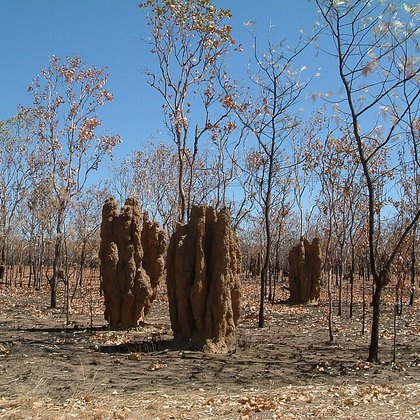
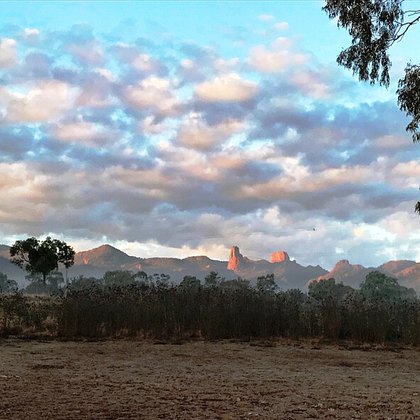
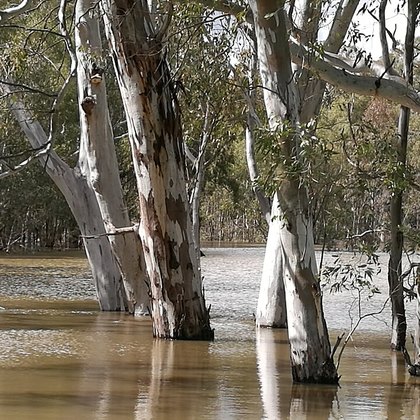
Open tropical savanna with scattered eucalypts over a grass layer, grassland with pandanus and paperbark along creeks, and the rougher margins of floodplains — always within a few kilometres of permanent water, where it drinks several times a day. Grass seed is the staple, taken from the ground or directly from the stem; flying termites are caught on the wing in the breeding season.
Where the bird is most often found, arranged by main group and formation.
Range and movements
The northern savanna belt of Australia: from the Kimberley in Western Australia through the Top End of the Northern Territory to the Gulf country and the far north-west of Queensland. The yellow-billed form holds the west, red-billed hecki the east, with a broad zone of intergradation between them.
- Resident
- dark = core range, pale = thinly spread
Where and when to look
Watch the silhouettes on a wire or a bare branch above grassland: a finch with two thin tail streamers is settled at once. Noting bill colour tells you which part of the range you are in as well — yellow in the Kimberley, red in the Gulf country.
Conservation
Least Concern (LC): the species remains common to locally numerous throughout its range, with no strong national decline. Locally the same forces operate as on other savanna seed-eaters: fire too late and too hot, and heavy grazing, reduce the supply of perennial grass seed in the late dry season. It is one of the best-known aviary birds in the world — the red-billed subspecies is known in aviculture as Heck's Grassfinch — and the present captive stock descends from birds exported before the Australian export ban; there is no current pressure from trapping in the wild.
Scientific name
Poephila acuticauda | (Gould, 1840)
Gould described the species in 1840 as Amadina acuticauda, from yellow-billed birds of north-western Australia (Derby); because of the change of genus, author and year stand in parentheses. Poephila is Greek for 'grass-loving'; acuticauda is Latin acutus 'pointed' and cauda 'tail' — exactly what the Dutch name spitsstaartamadine says. The eastern red-billed subspecies hecki is named after the German zoo director Ludwig Heck.