All species › Kingfishers, bee-eaters and rollers › Kingfishers › Laughing Kookaburra
Laughing Kookaburra | Dacelo novaeguineae
Kookaburra | Cucaburra común
The Laughing Kookaburra is the largest kingfisher in the world and the bird that opens and closes the day in eastern Australia with a chorus of laughter. It seldom eats fish: it sits upright on a low branch, watches the ground and drops onto lizards, snakes, mice and large insects.
Voice
The chorus starts with a low hiccuping chuckle from one bird and builds into a loud rolling laugh as the group joins in; it comes at first light and again at dusk. It is territorial: neighbouring groups answer each other across the boundary. There is also a short kooaa as a contact note and loud screeching when the nest is disturbed.
Recording: Romuald Mikusek — CC BY-NC-SA 4.0 · Marlo, East Gippsland Shire, Victoria, Australia · xeno-canto
Identification
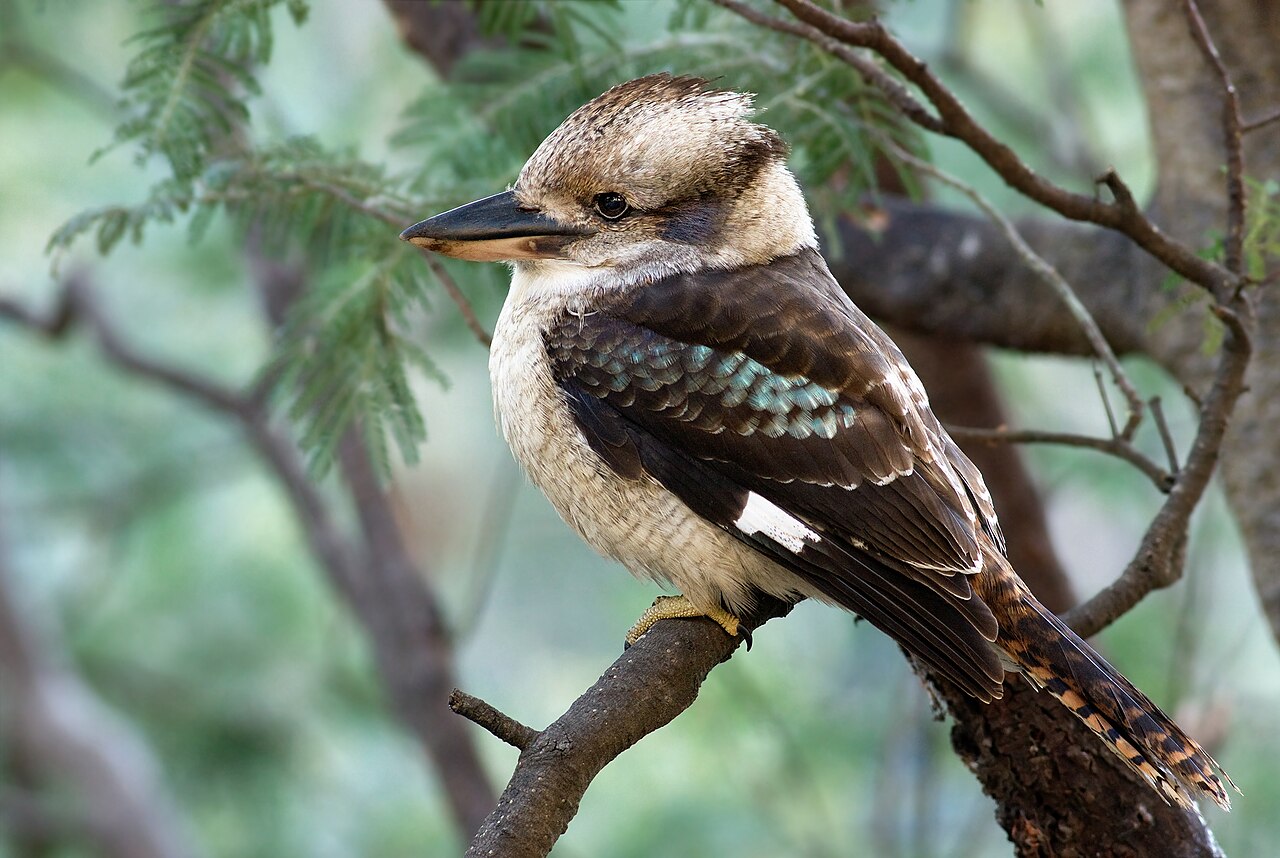
A heavy, short-tailed bird with a large head and a long dagger bill, dark above and bone-coloured below. The head is cream-white with a broad dark brown eye-stripe and a finely streaked crown, the eye dark; back and wings are dark brown with pale blue spots on the coverts, the tail rufous with black bars. The male has a bright blue rump, duller and browner in the female. Young birds have a shorter bill and dark scaling.
Confusion species
Blue-winged Kookaburra (Dacelo leachii) of the north is the only real confusion: a pale whitish eye, no dark eye-stripe, a streaked white head and a large bright blue wing panel, with an entirely blue tail in the male. Its voice is not a laugh but a hoarse barking screech. Where the two meet in northeastern Queensland, eye colour and eye-stripe settle the bird.
Habitat
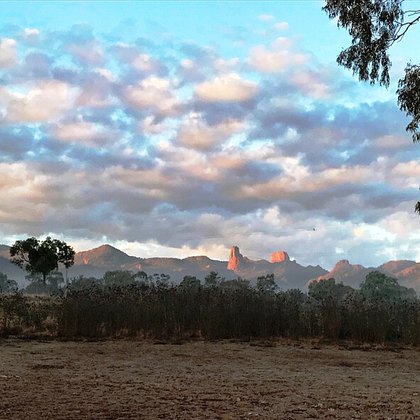
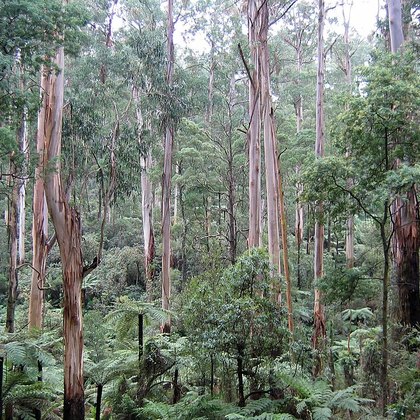
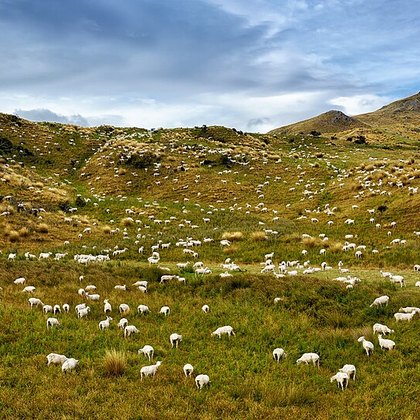
Open eucalypt forest and woodland with sparse understorey and plenty of grass, river red gum along creeks, and beyond them farmland with trees, parks, gardens and built-up areas. What it needs is a lookout perch over open ground and a hollow in a thick old tree or an arboreal termite nest to breed in. Dense rainforest and treeless interior are avoided.
Where the bird is most often found, arranged by main group and formation.


Range and movements
Native to eastern Australia, from Cape York to Cape Otway and west to Yorke Peninsula and the Flinders Ranges. Beyond that it has been established by people: in southwestern Western Australia from 1883, in Tasmania from 1906, on Kangaroo Island in 1926 and in New Zealand from the 1860s, where a small population still holds north of Auckland. Because the species is native within the guide area, the guide does not mark it as an exotic; the introduced populations are movements within the same region.
- Resident
- dark = core range, pale = thinly spread
Where and when to look
Stand at a wooded edge with old trees at first light and wait for the chorus; the group usually sits close together on one dead limb. By day the quickest way to find it is to drive the clearings along a road: it perches low and motionless, and gives itself away by the heavy head and short tail.
Conservation
Least Concern (LC) and common in its native range, including the middle of cities. The loss of old trees with hollows is the main constraint, because a group without a nest hollow does not breed. In the introduced populations it competes for those same hollows with native parrots and takes nestlings and small reptiles, which is locally regarded as a problem.
Scientific name
Dacelo novaeguineae | (Hermann, 1783)
Hermann described the bird in 1783 as Alcedo novaeguineae; because it was later moved to another genus, author and year stand in parentheses. The species name rests on a mistake: the description was based on a plate labelled as New Guinea, while the animal came from New South Wales and does not occur in New Guinea at all. The genus Dacelo was introduced by Leach in 1815 and is an anagram of Alcedo, the genus of the kingfishers.