All species › Waterfowl › Ducks, swans and geese › Green Pygmy-Goose
Green Pygmy-Goose | Nettapus pulchellus
Groene dwergeend | Gansito australiano
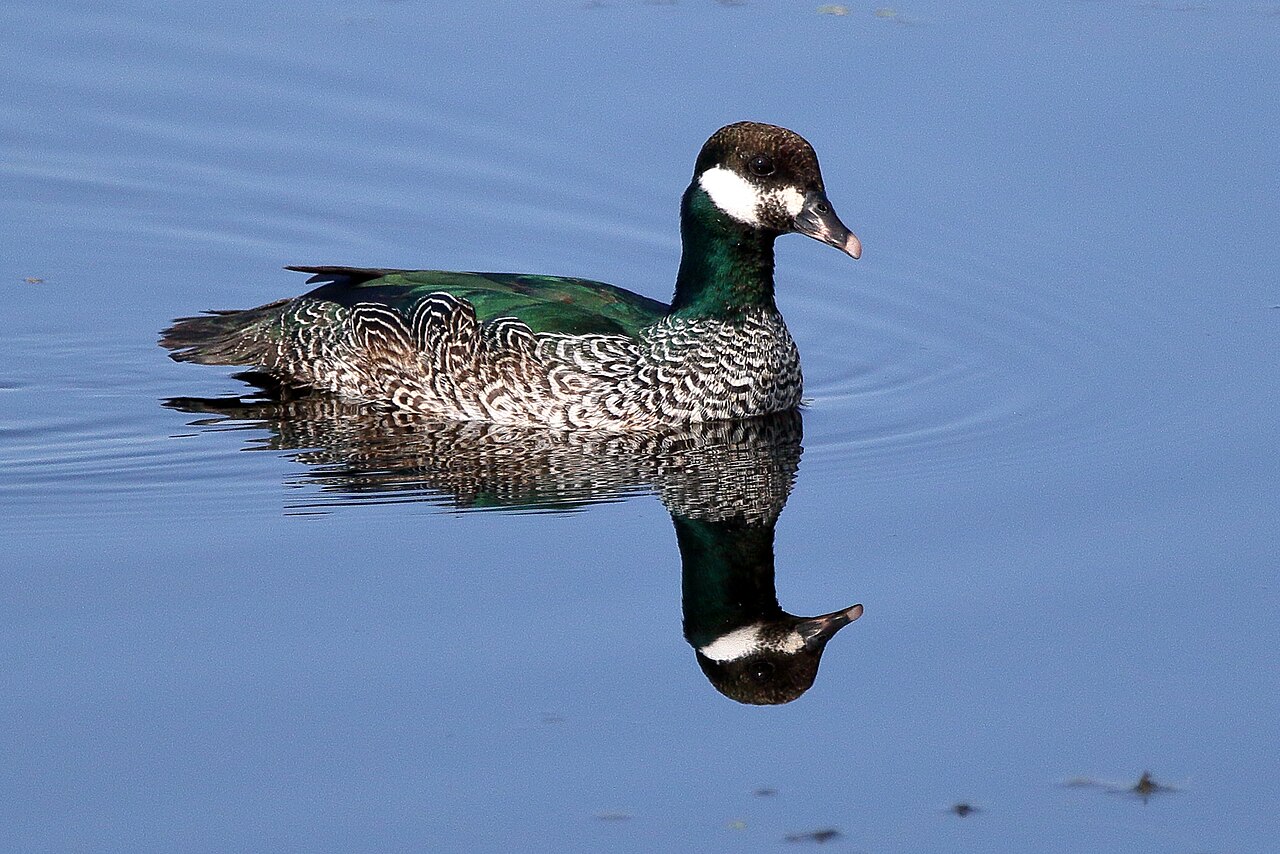
The Green Pygmy-Goose is Australia's smallest duck: a bird of some thirty centimetres that floats like a dark cork among the water lilies. The glossy green upperparts and the sharply cut white cheek name it at once at close range. It almost never comes ashore, resting instead on the water or on a branch leaning over the lagoon.
Voice
A light, musical whistling that carries far across still water. The male repeats a high two-note pee-whit, often in short runs and clearest in the early morning; the female answers lower and harsher, closer to a quack. Birds taking wing give a quick tumble of whistles, and a pair drifting together among the lilies keeps up a soft muttering.
Recording: Björn Söderlund — CC BY-NC-SA 4.0 · Lakeland, Cook Shire, Queensland, Australia · xeno-canto
Identification
Thirty to thirty-six centimetres, with a wingspan under sixty and a weight of 245 to 430 grams — one of the smallest ducks in the world. The male's head, neck and upperparts are glossy dark green, with a large white cheek reaching below the eye; breast and flanks are so finely vermiculated green and white that they read as grey at distance. The female is duller, with a barred neck and a faint dark eye-stripe, but keeps the same white cheek. Both show a broad white panel on the secondaries in flight. The bill is short, dark and deep-based in a goose-like way, and the bird lies strikingly low and level on the water.
Confusion species
The only real confusion species is Cotton Pygmy-Goose (Nettapus coromandelianus), which can share the same water along the Queensland coast. That bird is far whiter: head and whole neck white with a black crown, and in the male a black neck ring, where the Green Pygmy-Goose is dark green from crown to flank with only the cheek white. In flight the wing settles it — on Cotton the white runs out into the primaries, on Green it stops at the secondaries. At longer range a floating pygmy goose is often taken for an Australasian Grebe (Tachybaptus novaehollandiae), but that bird dives constantly and has a pointed bill.
Habitat
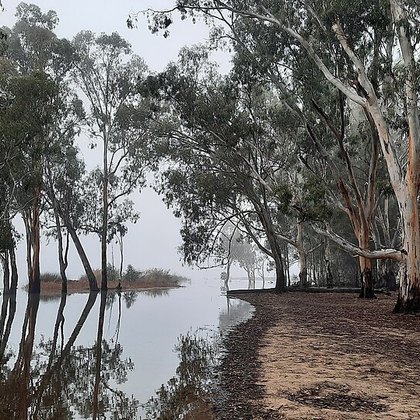
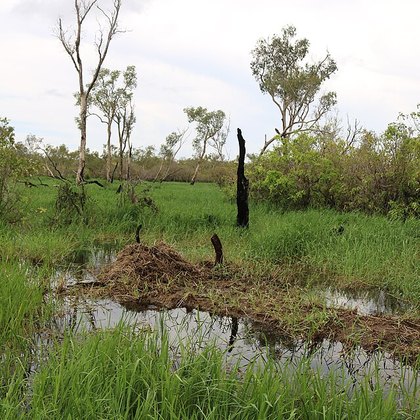
Permanent, well-vegetated freshwater lagoons, billabongs (cut-off river channel that flows only at high water) and farm dams carrying floating plants, and above all waters thick with lilies. It picks the seeds and buds of lilies and other water plants from the surface and does not dive for them. It nests in natural tree hollows just above or beside the water, the ducklings jumping down on hatching. Temporary rain pools are of no use to it: it needs water that stands all year with old trees along the edge.
Where the bird is most often found, arranged by main group and formation.
Range and movements
The tropical north, from the Kimberley in Western Australia through the Top End of the Northern Territory and around the Gulf of Carpentaria to Cape York, then south along the Queensland coast to about Fraser Island. Further south it is a rare vagrant, with a handful of records in New South Wales; it does not occur in New Zealand. Within that range it is strongly site-faithful — the same lagoon holds its own birds year after year — and it shifts only locally as water rises in the wet or falls away late in the dry.
- Resident
- dark = core range, pale = thinly spread
Where and when to look
Do not work the shoreline but the open middle of a lily-covered lagoon, and look for small dark specks among the pads; through a scope the white cheek jumps out at once. Fogg Dam and Yellow Water in Kakadu, the billabongs near Kununurra and Rinyirru (Lakefield) National Park are among the classic places. Go early: in the afternoon heat the birds withdraw into the shade of overhanging branches, where they also like to perch.
Conservation
Least Concern (LC) and still numerous across the tropical north wherever lagoons hold permanent water. It is vulnerable on two counts at once: it needs lasting open lily beds and old hollow-bearing trees beside them. Where water buffalo and feral pigs churn the margins, where introduced para grass (Urochloa mutica) smothers the lilies, or where hollow trees go in clearing, the bird goes with them. At the southern edge of its range, in south-eastern Queensland, it has already grown scarcer.
Scientific name
Nettapus pulchellus | Gould, 1842
Gould described the species in 1842 as Nettapus pulchellus, and it has stayed in that genus, so author and year carry no parentheses. The genus Nettapus was introduced by Brandt in 1836 and is built from Greek nētta, 'duck', and pous, 'foot'. pulchellus is the Latin diminutive of pulcher and means something like 'pretty little thing'. The type locality is Port Essington, the short-lived British settlement on the north coast of the Northern Territory, from where Gould's specimen came.