All species › Waterfowl › Ducks, swans and geese › Blue-billed Duck
Blue-billed Duck | Oxyura australis
Australische stekelstaart | Malvasía australiana
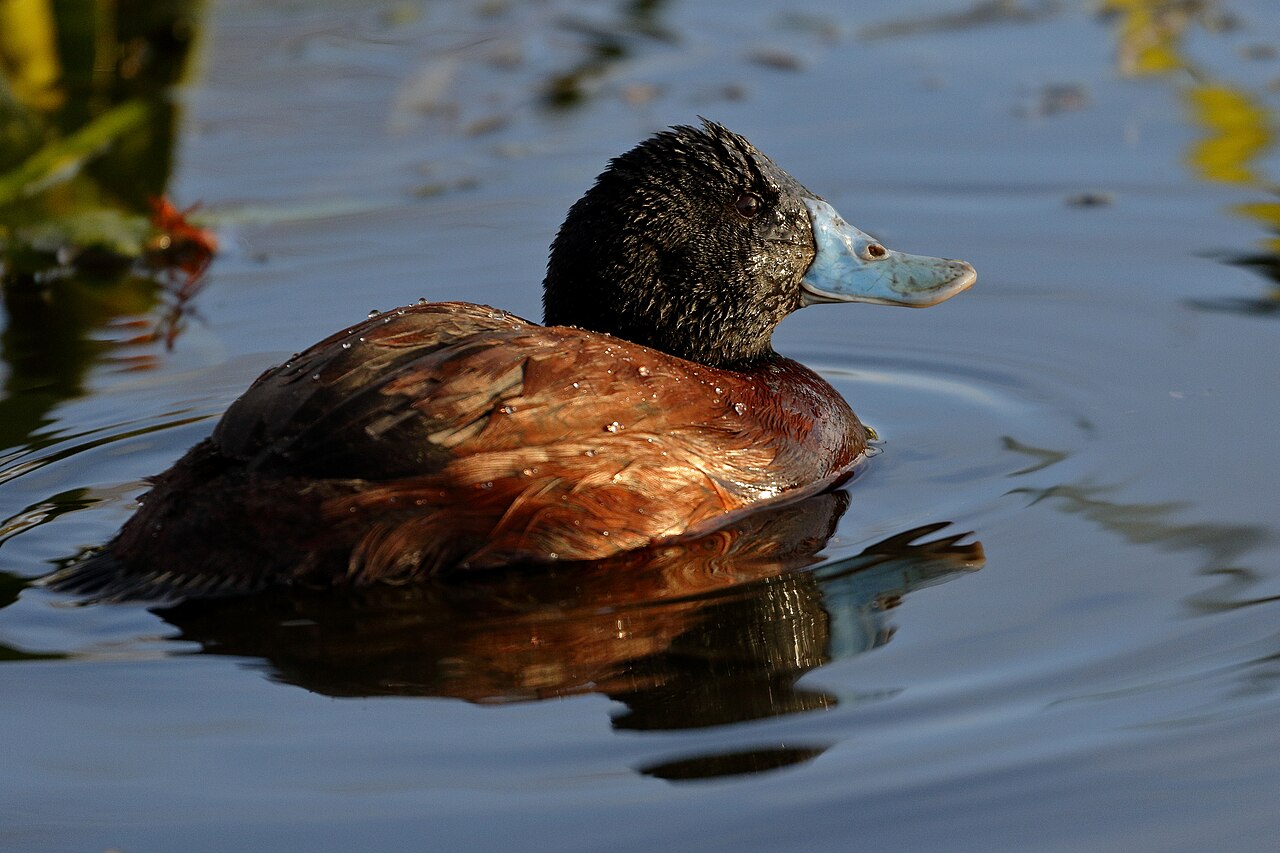
The Blue-billed Duck is a squat diving duck that spends its whole life on the water and can barely walk on land. In the breeding season the male is deep chestnut with a glossy black head and a bright blue bill; the stiff tail usually lies flat on the surface but is raised like a fan in display or alarm. Disturb the bird and it does not flush — it dives.
Voice
Outside the breeding season it is close to silent, which makes the display sounds all the more striking. During his performance the male gives a fast, low rattle, an rrrrrr that carries across the water more as a vibration than a call, together with a sudden burst of spray kicked forward by his feet. The female answers with a soft, low quek. There is hardly any wing noise, because it seldom flies.
Recording: Ramit Singal — CC BY-NC-SA 4.0 · Oatlands, Southern Midlands Council, Tasmania, Australia · xeno-canto
Identification
Thirty-five to forty-four centimetres, about 850 grams, with a short thick neck, a large head and a long stiff tail of needle-tipped feathers. The breeding male is chestnut with a black head and neck and a striking pale blue bill with a grey nail; out of season that fades to dull grey-brown and the bill loses its colour. The female is dark brown all year, finely barred yellowish, with a grey-brown bill. The bird sits very low, often with only head and back showing, and dives with a short forward roll. On land it stands upright and waddles, penguin-like.
Confusion species
Hardhead (Aythya australis) is the other common diving duck: slimmer, with a white eye, a white belly and a grey bill band, and without the blue bill and stiff tail. The much larger Musk Duck (Biziura lobata) sits just as low and also cocks its tail, but is nearly twice the length, grey-black, and the male carries a big leathery lobe under the bill. Freckled Duck (Stictonetta naevosa) is finely speckled, has a high peaked forehead and does not dive. In non-breeding plumage the male closely resembles the female; the bluish wash on the bill then remains the best mark.
Habitat
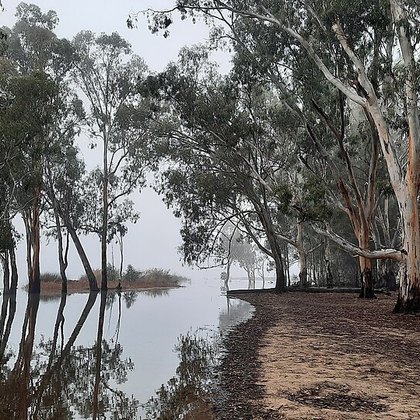
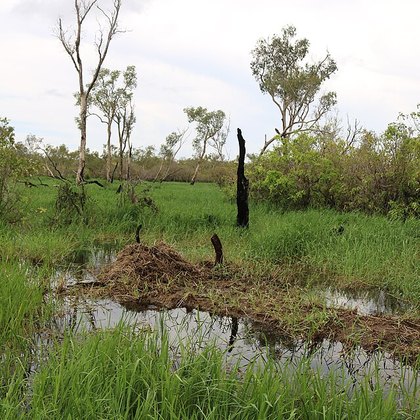
Deep, permanent freshwater swamps with heavy fringing vegetation are the breeding ground: the nest goes into dense bulrush and reed, often just above the water and sometimes in an abandoned coot nest. Outside the breeding season the birds move to large, deep open waters — lakes, reservoirs and above all sewage treatment ponds — where flocks of several hundred gather in autumn. It feeds mainly on small aquatic animals, from midge larvae and caddisflies to water beetles and snails, sifted from the mud on dives of about ten seconds.
Where the bird is most often found, arranged by main group and formation.

Range and movements
Two separate areas in temperate Australia: the south-east, from southern Queensland through New South Wales and Victoria to Tasmania, with its centre of gravity in the Murray–Darling basin, and the south-west corner of Western Australia. The species is endemic to Australia and does not occur in New Zealand. Outside the breeding season it wanders, and when the inland dries out birds turn up on the coast, where it is otherwise scarce. The national population is put at some twelve thousand birds.
- Resident
- dark = core range, pale = thinly spread
Where and when to look
The most reliable places are big sewage ponds and city lakes: the Western Treatment Plant at Werribee, Lake Wendouree at Ballarat and Herdsman Lake in Perth. Look late in the afternoon or early in the morning, when the birds feed. Scan open water for small, dark, very low-sitting ducks that keep vanishing; keep watching, because they surface tens of metres away. The cocked tail names the species even when the colour is lost against the light.
Conservation
Least Concern (LC) worldwide, with an estimated twelve thousand birds, but within Australia it stands less well than that category suggests: Victoria lists it as Vulnerable, New South Wales likewise, and South Australia as Rare. The bottleneck is the loss of deep, permanent swamps with dense reed beds — precisely the water that is drained or reclaimed first. Beyond that weigh grazing of the margins by stock, salinisation, introduced fish that stir up the bottom fauna, and the fact that the breeding waters and the moulting waters can lie far apart.
Scientific name
Oxyura australis | Gould, 1837
Gould described the species in 1837 (the part carries the imprint year 1836) as Oxyura australis, in the Proceedings of the Zoological Society of London; because he placed it straight into Oxyura, author and year carry no parentheses. The genus Oxyura was introduced by Bonaparte in 1828, from Greek oxus, 'sharp', and oura, 'tail' — after the stiff, pointed tail feathers of the stifftails. australis simply means 'southern'. The type locality is the Swan River in Western Australia.