All species › Penguins › Penguins › Fiordland Penguin
Fiordland Penguin | Eudyptes pachyrhynchus
Fjordlandkuifpinguïn | Pingüino de Fiordland
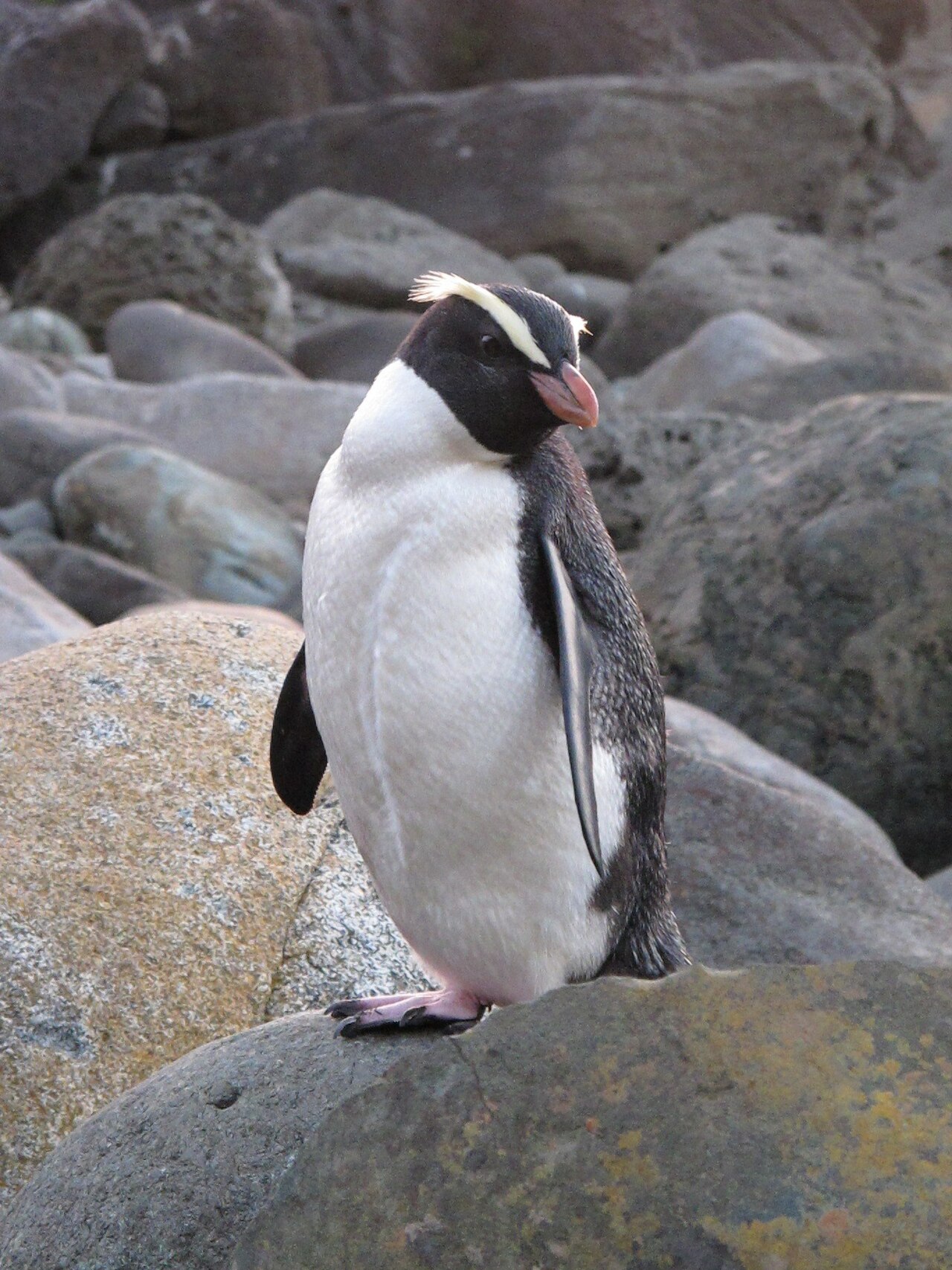
The Fiordland Penguin is the only crested penguin that breeds on the New Zealand mainland, and it does so where a penguin is not expected: under the roots and ferns of the coastal rainforest of Fiordland and Westland. A broad yellow eyebrow stripe runs from the base of the bill over the red eye and hangs in loose plumes down the nape.
Voice
At the colony comes a loud braying trumpet delivered with the head thrown back and the flippers spread, with high contact calls between bouts and low hissing and growling between neighbours that come too close. The sound carries through the dense forest to the beach. At sea it is silent; what you hear comes from land, usually at dusk as birds walk to the nest.
Recording: Raphaël SANE — CC BY-NC-SA 4.0 · Southland District, Southland, New Zealand · xeno-canto
Identification
A medium-sized crested penguin of some sixty centimetres, blue-black above and silky white below, with a broad yellow eyebrow stripe that starts at the base of the bill, runs over the red-brown eye and hangs in loose plumes behind the head. The bill is large and orange-brown with only a thin strip of black skin at the base. The best character is on the cheek: three to six whitish stripes across the otherwise black cheek, most obvious when the bird is agitated. Young birds have a shorter, thin pale-yellow eyebrow stripe and a mottled whitish chin and throat.
Confusion species
The four other crested penguins here separate mainly on the bill base, the crest and the island. Snares Penguin (Eudyptes robustus) is the same size but has a heavier bill with a clear strip of bare pink skin around the base, a broader eyebrow stripe and no white cheek stripes — and it breeds only on the Snares. Erect-crested Penguin (Eudyptes sclateri) is larger, has pale blue-white skin at the bill base, a crest held erect and running roughly parallel when seen head-on, and breeds only on the Bounty and Antipodes Islands. Eastern Rockhopper Penguin (Eudyptes filholi) is clearly smaller with a thin, parallel-sided eyebrow stripe low on the forehead. Royal Penguin (Eudyptes schlegeli) is larger, has a white to pale grey cheek and chin instead of black, and is confined to Macquarie. Yellow-eyed Penguin (Megadyptes antipodes) shares the same coasts but has a yellow band round the nape and no crest.
Habitat
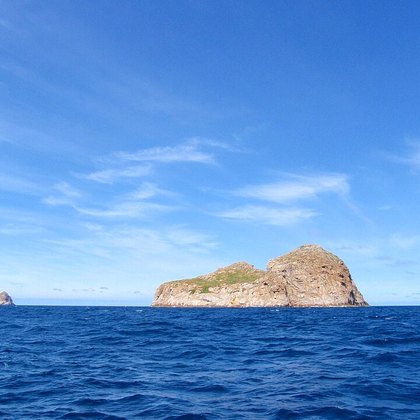
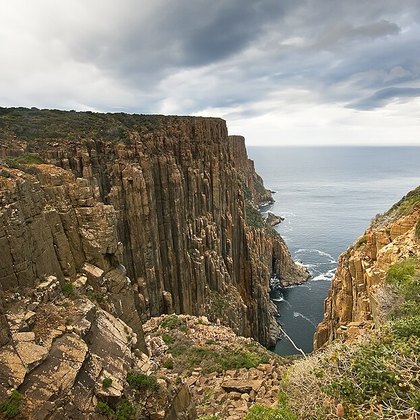
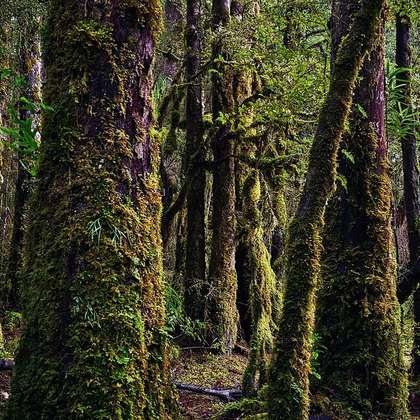
Cool temperate inshore water over the continental shelf, where it dives for squid, krill and small fish. Ashore it is unique among penguins: it nests in temperate coastal rainforest, in caves and crevices, under the root plates of rata and kamahi, among ferns and dense scrub, up to hundreds of metres from the water and sometimes well above sea level. The nest is out of sight of the neighbours, so colonies are loose gatherings of pairs rather than crowds.
Where the bird is most often found, arranged by main group and formation.
Range and movements
The south-west coast of the South Island, from Bruce Bay and Jackson Bay south through all of Fiordland, plus Stewart Island with its outliers, Codfish Island and the Solander Islands. Outside the breeding season birds disperse widely across the Tasman Sea; moulting and weakened individuals then come ashore as far north as Northland and Hawke Bay, and regularly on Tasmanian and southern Australian beaches too. In Australia this is the crested penguin most often found as a vagrant.
- Resident
- Breeding (summer)
- dark = core range, pale = thinly spread
Where and when to look
Look for it between July and November, when the birds are ashore: Munro Beach near Lake Moeraki and the coasts around Jackson Bay are the classic places, and on a boat trip through Milford or Doubtful Sound they swim past the vessel. Sit well back from the beach in the last hour of light and do not move — a tawaki that sees people waits in the surf and does not land. In the early morning they walk back down to the sea.
Conservation
Near Threatened (NT) on the world list; the New Zealand assessment is stricter and calls it declining, with some two and a half thousand pairs counted in the 1990s and probably rather more in reality. Stoats, dogs and cats kill chicks and sitting birds in the coastal forest, and the colonies lie along a coast that walkers and boats also visit. At sea an estimated few tens to well over a hundred birds a year are taken in fishing gear. Breeding falls in winter, so a poor food year strikes the chicks at once.
Scientific name
Eudyptes pachyrhynchus | Gray, 1845
George Robert Gray described the species in 1845 as Eudyptes pachyrhynchus, and it has stayed in that genus, so author and year carry no parentheses. The genus Eudyptes was introduced by Vieillot in 1816, from Greek eu, 'good', and dyptes, 'diver'. pachyrhynchus is formed from pachys, 'thick', and rhynchos, 'bill', after the heavy bill that separates this species from the rockhoppers. The type locality is Dusky Sound in Fiordland. The Maori name tawaki is that of a demigod, and is used in Fiordland as the ordinary name for the bird.