All species › Penguins › Penguins › Eastern Rockhopper Penguin
Eastern Rockhopper Penguin | Eudyptes filholi
Oostelijke rotspinguïn | Pingüino saltarrocas oriental
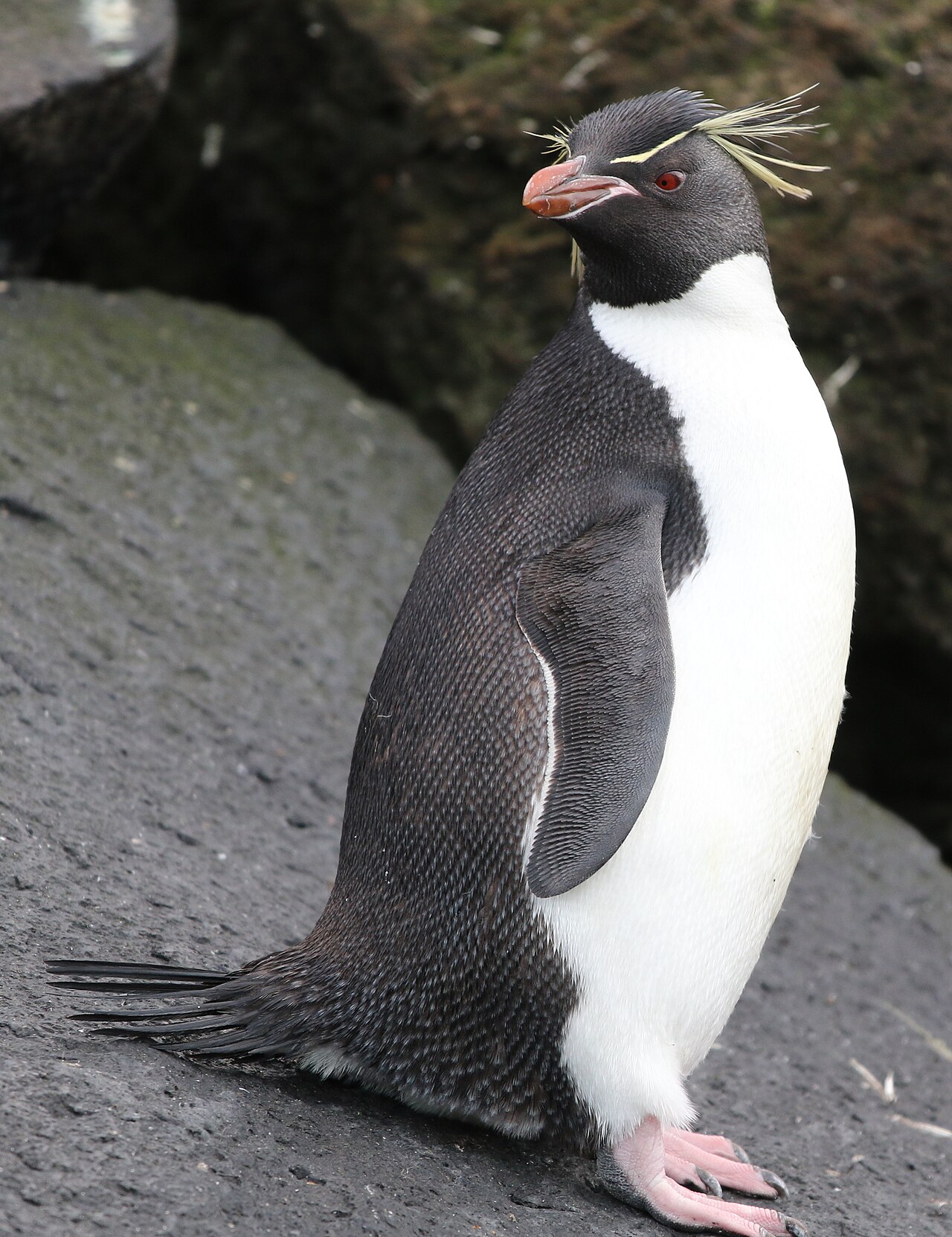
The Eastern Rockhopper Penguin is the smallest crested penguin of this area: a stocky bird with a red eye, a thin yellow eyebrow stripe that flares behind the eye into spiky drooping plumes, and the habit of bounding up steep rock with both feet together instead of climbing. On Campbell Island its numbers fell by ninety-five per cent in seventy years.
Voice
Breeding birds give a loud pulsing bray that goes with a set display: the head goes back, the bill points up and the flippers spread, and the call then rolls through the colony in a series of pulses. On land and at sea there is also a short contact bark. The call is higher and more piercing than the deep boom of Erect-crested Penguin (Eudyptes sclateri), which breeds on the same islands.
No recording with a suitable Creative Commons licence has been found for this species yet; what to listen for is described below.
Identification
The smallest crested penguin here, forty-five to fifty-five centimetres and two to four kilograms, with black back, black head and throat and white underparts. A thin, parallel-sided yellow stripe starts low on the forehead, runs over the bright red eye and flares behind it into loose, spiky yellow crest plumes that droop out to the sides. The bill is orange-brown and much lighter than in the larger crested penguins, with a narrow pink rim of bare skin at the base; in New Zealand birds up to ninety per cent of the lower mandible is white. Legs and feet are dirty white to pink. Young birds have a duller bill and a short pale eyebrow stripe without a crest.
Confusion species
Size alone separates it from the other crested penguins here: it is a head shorter than Snares Penguin (Eudyptes robustus) and Erect-crested Penguin (Eudyptes sclateri), both of which have a far heavier bill, a broader eyebrow stripe beginning closer to the bill, and no loose crest at the back of the crown. Fiordland Penguin (Eudyptes pachyrhynchus) is also larger, with a dull red-brown rather than bright red eye and white stripes on the cheek. Royal Penguin (Eudyptes schlegeli), with which it breeds on Macquarie Island, is nearly twice the size and has a white face. Outside this area lie the other two rockhoppers: the Southern or Western Rockhopper (Eudyptes chrysocome) has black rather than pink skin around the bill base and a wedge-shaped yellow eye mark, and the Northern Rockhopper (Eudyptes moseleyi) has improbably long pendulant crest feathers reaching below the throat line.
Habitat
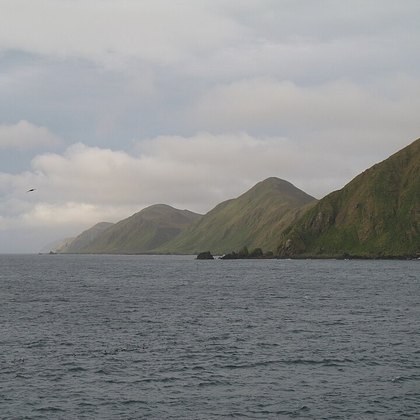
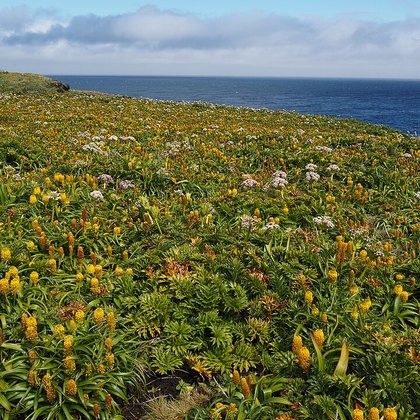
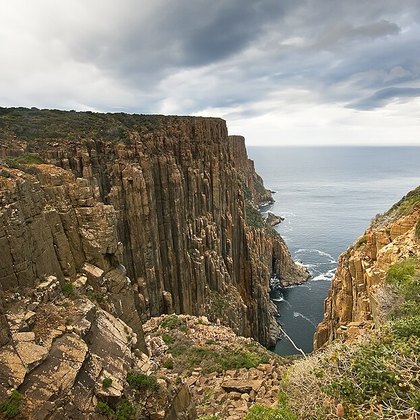
Subantarctic sea, where the birds dive for krill, small fish and squid and range far from land outside the breeding season. Colonies lie on rocky shore and steep slopes reachable only by fixed, worn paths; the nest is a scrape among boulders, under overhanging rock or in poa tussock (grassland of loose, tall clump-forming grasses, especially in New Zealand), often tens of metres above the surf. The climb to it gave the bird its name: bounding with both feet together rather than scrambling step by step.
Where the bird is most often found, arranged by main group and formation.
Range and movements
Within this map window it breeds on Campbell Island, the Auckland Islands, the Antipodes Islands and Macquarie Island; outside the window also on several islands in the Indian Ocean. At sea the birds spread across the subantarctic zone south of New Zealand and Australia. Moulting and weakened individuals come ashore regularly on the south coast of the South Island and on Stewart Island, and now and then on Tasmanian and Victorian beaches.
- Resident
- dark = core range, pale = thinly spread
Where and when to look
At the breeding grounds it can be seen from a subantarctic expedition voyage: Northwest Bay on Campbell Island and the colonies of the Antipodes and Macquarie are visited between November and January. Look there at the rock faces themselves rather than at the beach — this species lands in the surf and then bounds up the rock, and the fixed paths give the colony away at a distance. On a southern New Zealand beach in late summer, any small crested penguin with a bright red eye and a thin yellow stripe is this one.
Conservation
Vulnerable (VU), and the figures behind those letters are startling: on Campbell Island some eight hundred thousand pairs were counted in 1942 and thirty-three thousand two hundred in 2012, a fall of ninety-five per cent. The Antipodes and the Auckland Islands hold fewer than three thousand pairs between them, and numbers on Macquarie Island are falling too. The main cause is sought in the food: warming and poorer water forces the birds to forage further, so chicks get less and adults come through the moult in worse condition. On top of that come predation by sea lions and fur seals, the risk of oil spills and possible competition with fisheries.
Scientific name
Eudyptes filholi | Hutton, 1879
The English-born New Zealand naturalist Frederick Wollaston Hutton described the species in 1879 as Eudyptes filholi, from a specimen taken on Campbell Island, and it has stayed in that genus, so author and year carry no parentheses. The epithet honours Henri Filhol, the French physician and palaeontologist who stayed on Campbell Island with the French expedition for the 1874 transit of Venus. The genus Eudyptes is Vieillot's, 1816, from Greek eu, 'good', and dyptes, 'diver'. For a long time the bird counted as a subspecies of the Southern Rockhopper Penguin (Eudyptes chrysocome); This guide treats it as a species of its own. The Maori name tawaki piki toka means roughly 'the tawaki that climbs the rocks'.