All species › Waders, gulls and terns › Sandpipers and allies › Eurasian Whimbrel
Eurasian Whimbrel | Numenius phaeopus
Regenwulp | Zarapito trinador
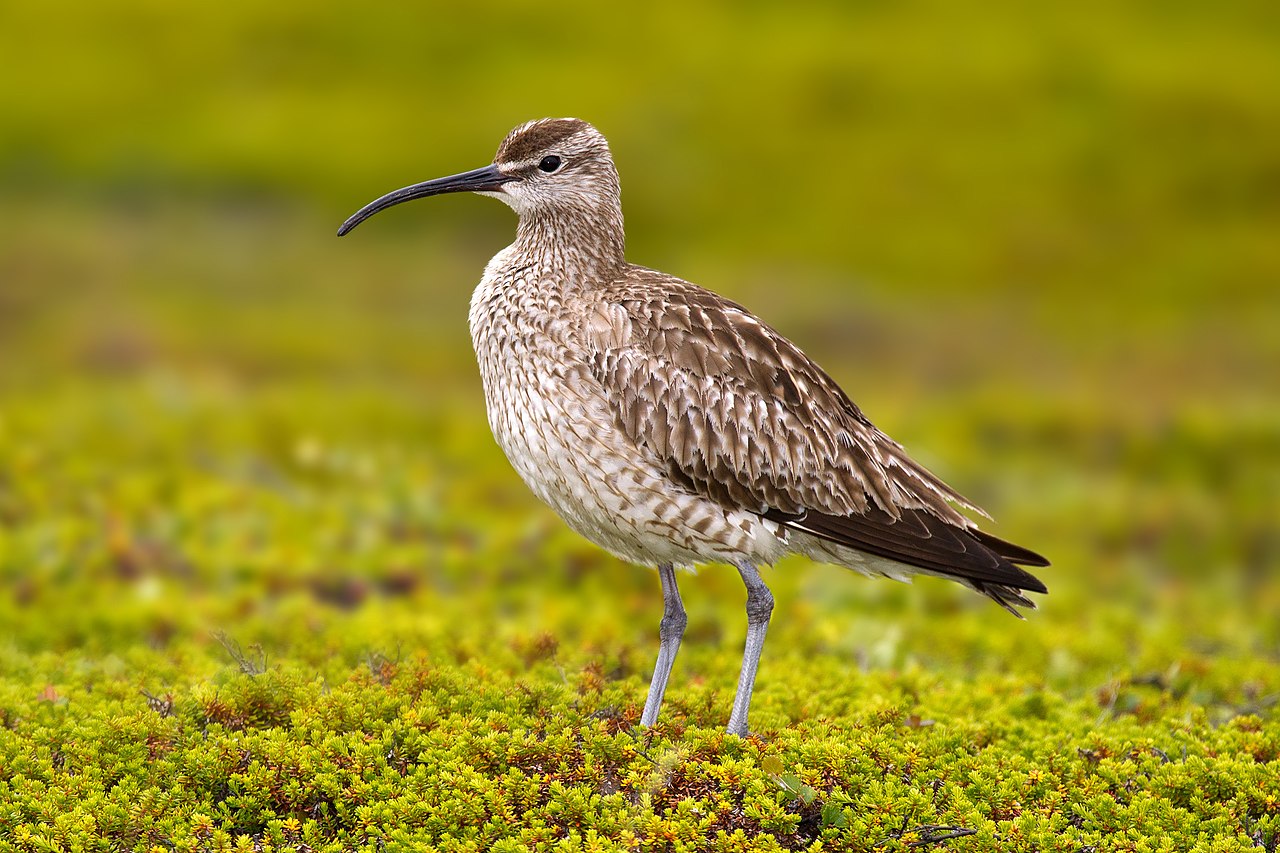
The Eurasian Whimbrel is the middle size among the curlews of this region: a brown-streaked wader with a decurved bill shorter than that of Far Eastern Curlew and far longer than that of Little Curlew. Its best mark is on the head, for it is the only curlew here with a crisply striped crown, a pale central line between two dark bands. It is numerous along the whole north coast of Australia and keeps largely to the mangrove edge.
Voice
The usual call is a far-carrying, evenly rattling whistle of six or seven fast notes on one pitch: bi-bi-bi-bi-bi-bi-bi, mostly in flight and often the first sign that a party is passing over. It is a cheerful, trilling sound, quite unlike the plaintive rising call of Far Eastern Curlew. On the flats, feeding birds exchange soft, clipped contact notes. Once you know the rattling whistle you can identify the species in the dark or in fog.
Recording: Paul Kelly — CC BY-NC-SA 4.0 · Rosslare Harbour, Wexford, County Wexford, Ireland · xeno-canto
Identification
A medium-sized curlew of forty to forty-five centimetres and about three hundred and fifty grams, streaked brown with a white belly. The bill is eight to nine centimetres long and decurved, but the curve sits mostly in the outer part, so that it reads as a kink rather than an even arc; the base of the lower mandible is flesh-coloured, the rest dark. The legs are long and blue-grey. The decisive mark is the head: a dark crown with a clear pale central stripe flanked by two dark lateral stripes, plus a pale supercilium and a dark eye-stripe. In flight the wings are pointed and the beat fast; the subspecies that reaches this region has a brown-barred rump and no white wedge up the back.
Confusion species
Far Eastern Curlew (Numenius madagascariensis) is much larger, with a bill of fifteen to twenty centimetres, nearly twice as long and curving in an even arc; its head is evenly streaked without crown stripes and its rump is plain brown. Eurasian Curlew (Numenius arquata), a vagrant here, is also larger and lacks the crown stripes, but stands out above all for the white wedge running from the rump up the back and the almost white underwing; the Whimbrel has neither. Little Curlew (Numenius minutus) is clearly smaller and lighter in build, with a shorter and far less curved bill, and prefers dry grassland and airfields to tidal flat. The godwits and the Asian Dowitcher all have straight bills and are ruled out on that alone.
Habitat
The coast above all: intertidal mud and sandflats of estuaries and sheltered bays, and within those the strips that abut mangrove, because crabs are its main food. It also uses sandy beaches, coral platforms and rocky shores, and roosts at high water in mangrove tops, on sandbars and on jetties. Inland it hardly appears. It feeds by day and by night, probing the mud or picking from the surface.
Where the bird is most often found, arranged by main group and formation.




Range and movements
Common along the whole north coast of Australia, from the Kimberley through the Top End into the Gulf of Carpentaria and Cape York, and on south along both coasts in falling numbers; in the south it is uncommon to rare. On Norfolk Island it occurs annually. In New Zealand about seventy birds arrive each year, mostly in the northern half of the North Island and on Farewell Spit, with the occasional bird oversummering. It leaves the north and northeast coasts by late April and returns from August to October, then works south along the east coast.
- Resident
- Breeding (summer)
- dark = core range, pale = thinly spread
Where and when to look
Look for it on a falling tide along the edge of a mangrove creek and check the crown before anything else: the pale central stripe between two dark bands carries a long way in a telescope and separates it at once from every other curlew here. On birds flying over, watch the rump, because the absence of a white wedge rules out Eurasian Curlew. And learn the rattling whistle: on a flat holding thousands of birds it is the fastest identification tool you have.
Conservation
Least Concern (LC) globally, because the species breeds across an enormous area of northern Eurasia and North America and the world population is large. That does hide the fact that things are going less well on this particular flyway: the East Asian-Australasian population is put at about fifty-five thousand birds and is falling, through the same loss of staging grounds around the Yellow Sea that hits the other waders of this route. Within Australia the key issue is keeping the mangrove fringes and the flats behind them, which it must live off for the whole non-breeding season.
Scientific name
Numenius phaeopus | (Linnaeus, 1758)
Linnaeus described the bird in 1758 as Scolopax phaeopus, with Sweden as the type locality; because of the later move to another genus, author and year stand in parentheses. The epithet phaeopus is built from Greek phaios, 'dusky', and pous, 'foot'. The genus name Numenius goes back to Greek noumenios, 'new moon', after the crescent shape of the bill. The Dutch name, 'rain curlew', goes back to the old folk belief that its call foretold rain; the birds that reach Australia and New Zealand belong to the eastern subspecies variegatus.