All species › Passerines › Snowfinches and Old World sparrows › Eurasian Tree Sparrow
Eurasian Tree Sparrow | Passer montanus
Ringmus | Gorrión molinero
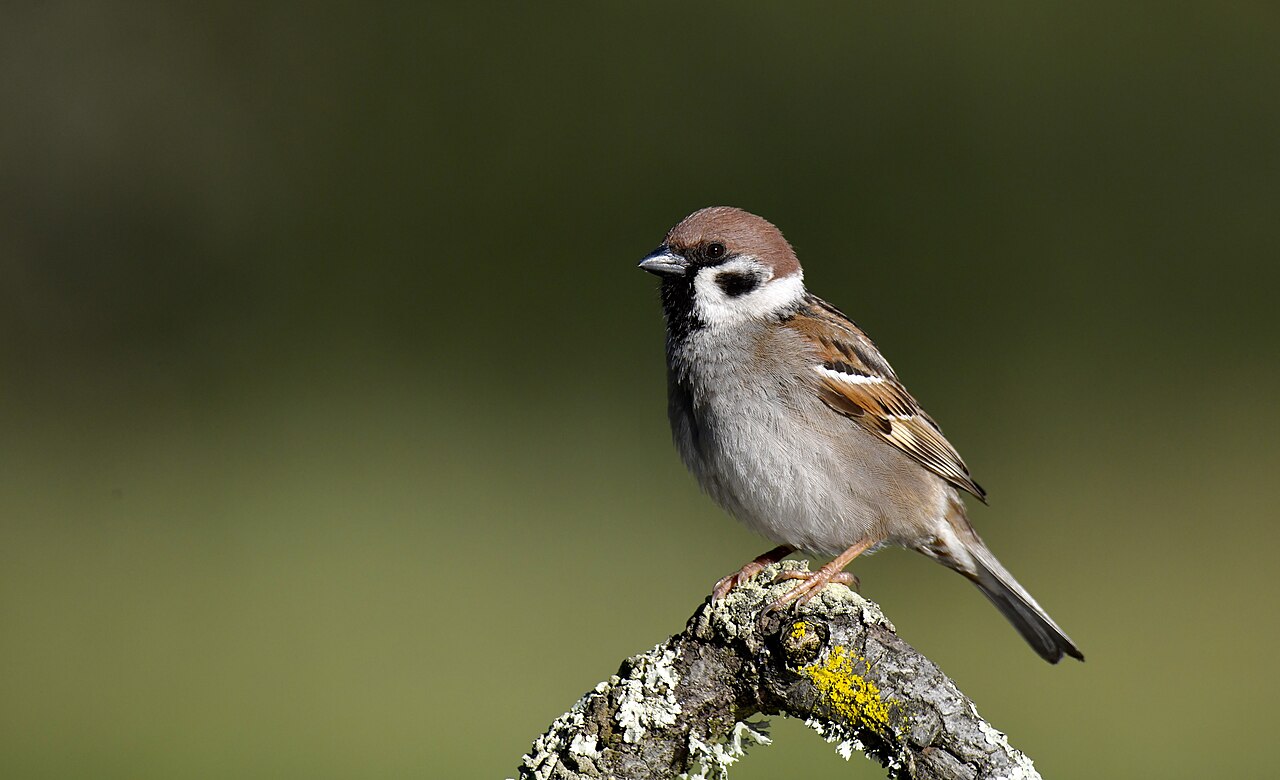
The Eurasian Tree Sparrow arrived in Melbourne around 1863 on the same shipments as the House Sparrow, but where that bird took half a continent, the Tree Sparrow a hundred and fifty years later has still barely got beyond Victoria and a handful of Riverina towns. It is the tidy version of a sparrow: chestnut cap, white collar, and a black spot on each white cheek.
Voice
The voice resembles the House Sparrow's but is higher, drier and more clipped: a sharp tchik or tchek, often doubled. In flight comes the diagnostic hard tek-tek, a note the House Sparrow does not make and one that gives the species away over a country street before you see it. The song is no more than a run of those same calls set closer together, from a roof edge or a telephone wire.
Recording: Philippe_Grange — CC0 · Arrondissement of Bressuire (near Saint-André-sur-Sèvre), Deux-Sèvres, Nouvelle-Aquitaine, France · xeno-canto
Identification
A small, compact sparrow of twelve and a half to fourteen centimetres, smaller and neater than a House Sparrow. The whole crown and nape are plain chestnut, the cheek is white with a sharply bounded black spot in the middle of it, and a white collar runs round the neck and almost closes at the back. The chin carries a small black bib, far more modest than the House Sparrow's. Male and female cannot be told apart, and that alone helps in the field.
Confusion species
House Sparrow (Passer domesticus) is the only real confusion: the male has a grey crown and a large black bib with no cheek spot, the female is dull grey-brown with a pale brow stripe and shows nothing of the Tree Sparrow's pattern. Where both sit together on a village square, the Tree Sparrow is the smaller, with the rounder head and the crisper markings. In New Zealand confusion is impossible, because the Tree Sparrow does not occur there.
Habitat
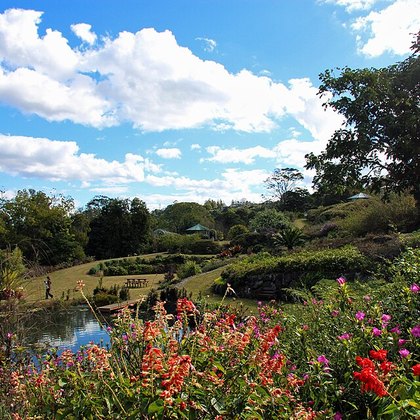
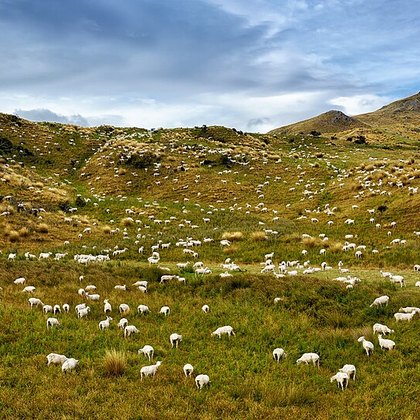
Older inner suburbs, town centres, parks with mature trees, orchards, grain paddocks and farmyards. It nests in cavities: under roof tiles, in wall holes, in hollow street trees and in nest boxes. Strikingly, in Australia it holds the built-up ground, whereas in Europe it takes the farmland and leaves the town to the House Sparrow — here the roles are the other way round.
Where the bird is most often found, arranged by main group and formation.


Range and movements
Melbourne and its surrounds, the towns of central and northern Victoria as far as the Murray, and a few centres in the Riverina of New South Wales. Beyond that, almost nothing. In Western Australia it is a prohibited species: it arrives there regularly on ships from Southeast Asia and is destroyed each time, so it never gains a foothold. It is absent from New Zealand.
- Resident
- dark = core range, pale = thinly spread
Where and when to look
Walk an old Victorian country street under the chestnuts and listen for the hard tek-tek overhead; that is almost always the first sign. Then look at the cheek: one black spot on white, as clear from the side as from the front, and the identification is done. In mixed sparrow flocks around a grain shed it usually sits at the edge.
Conservation
Least Concern (LC) and established in Australia as an introduced bird — but an introduced bird that has hardly spread in a hundred and fifty years. At this scale it does little damage: some grain and fruit, and local competition for nest cavities. The real story is the one of the near miss: Western Australia keeps it out, as it does the House Sparrow, by a destruction policy held to without a break, and that works.
Scientific name
Passer montanus | (Linnaeus, 1758)
Linnaeus described the bird in 1758 as Fringilla montana, among the finches; because it later moved to another genus, author and year stand in parentheses. The genus Passer was introduced by Brisson in 1760 and is the Latin word for sparrow. montanus means 'of the mountains', and that is a misnomer: the species is not a mountain bird but a bird of farmland and villages. The Dutch name, ringmus, points at the white collar.