All species › Waders, gulls and terns › Sandpipers and allies › Common Sandpiper
Common Sandpiper | Actitis hypoleucos
Oeverloper | Andarríos chico
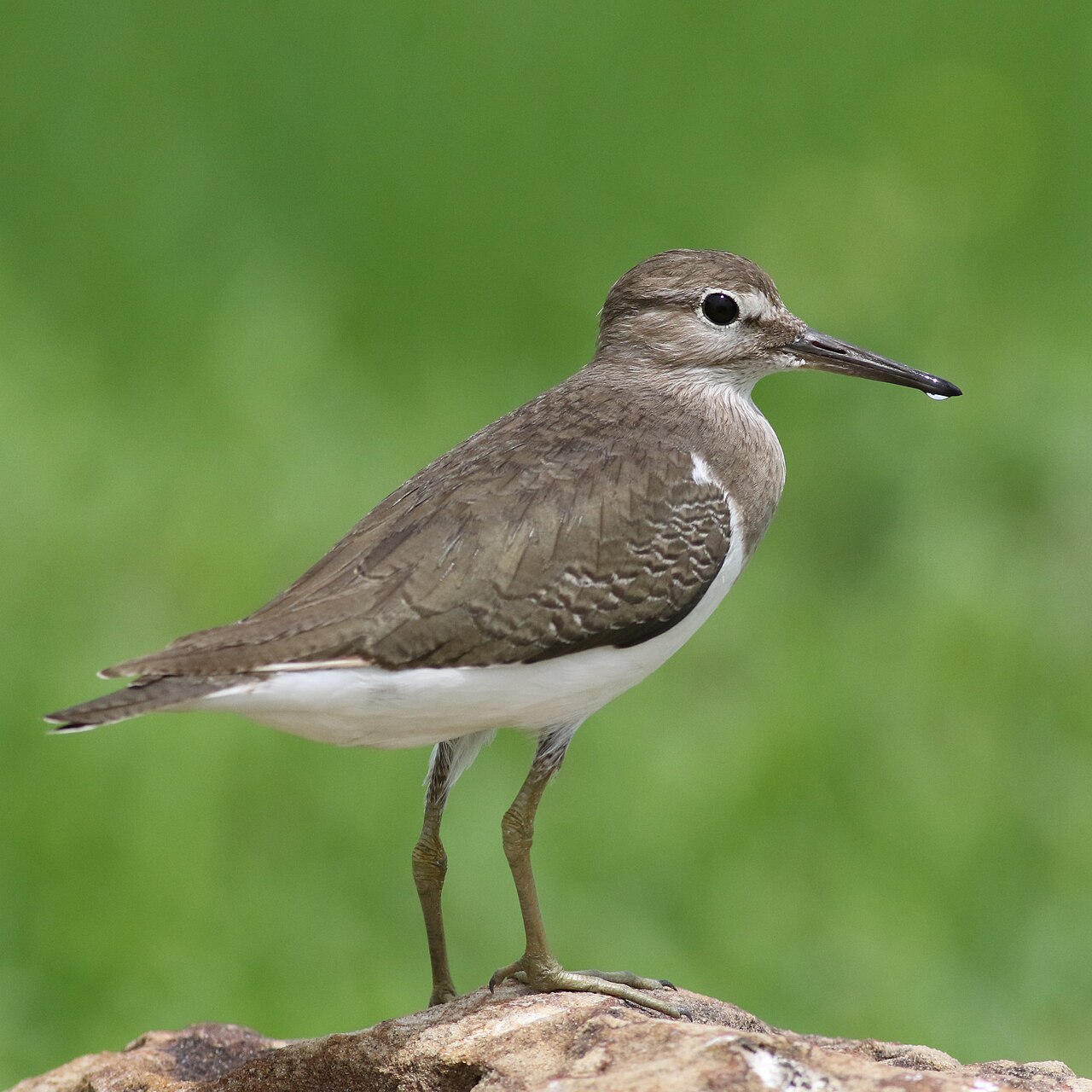
The Common Sandpiper is the smallest and lowest-slung wader in this group, and the only one you identify by its movement before you have seen any plumage: it teeters head and rear end continuously, as if standing on a spring. It does not belong taxonomically with the Tringa shanks, but is constantly confused with them in the field on account of its build — which is why it stands here beside them.
Voice
The call is a clear, high, fast three-part whistle that slides down in pitch: hee-dee-dee, almost always given as the bird flies off low over the water, and often repeated three or four times. It is thinner and more hurried than the full tew-tew-tew of Common Greenshank and carries even over rippling water. On the bank, when uneasy, it gives a short repeated tswee.
Recording: Astrid Cervantes — CC BY-NC-SA 4.0 · Arrondissement of Leuven (near Leuven), Vlaams-Brabant, Vlaams Gewest, Belgium · xeno-canto
Identification
A small, low-slung wader of eighteen to twenty centimetres and about fifty grams, plain grey-brown above with fine dark vermiculation, white below. The best mark on a standing bird is the white wedge that pushes up between the grey-brown breast side and the bend of the wing — a small white hook that no Tringa here shows. Beyond that a white eye-ring, a dark eye-stripe and a pale supercilium; the bill is straight, short and brownish with a pale base, the legs short and dull grey-green. At rest the tail projects clearly beyond the wing tips. In flight a broad white wingbar across the middle of the wing catches the eye, while the bird skims just above the water on stiff, slightly bowed wings with fast shallow beats.
Confusion species
Wood Sandpiper (Tringa glareola) stands taller on yellow-green legs, is heavily spotted above, lacks the white breast wedge and shows no wingbar in flight but a square white rump. Marsh Sandpiper (Tringa stagnatilis) and Common Greenshank (Tringa nebularia) are both far larger and longer-legged and carry a white wedge up the back. Common Redshank (Tringa totanus) has red legs and broad white trailing edges rather than a bar across the middle. Terek Sandpiper (Xenus cinereus) is equally dumpy and also teeters, but its bill is long and upturned and its legs orange-yellow. Anyone using the teetering as a mark should know that Terek Sandpiper and Ruddy Turnstone teeter too: on Common Sandpiper the movement is faster, more continuous and confined to rear end and head.
Habitat
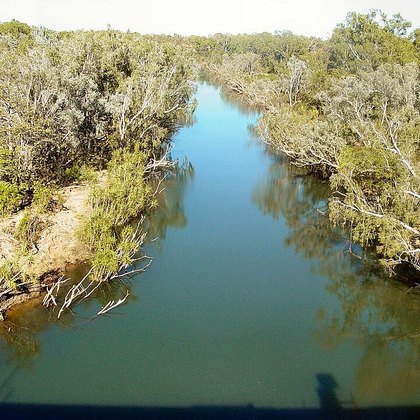
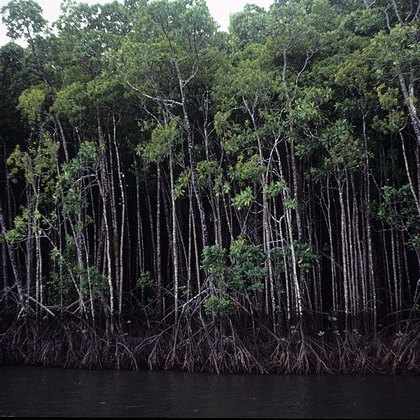
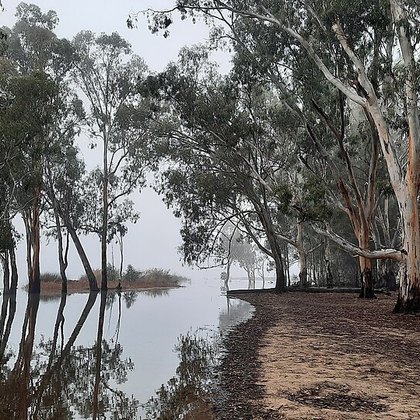
Narrow margins rather than open flats: the stony and muddy edges of creeks and rivers, mangrove channels, pools, reservoirs and stock dams, and on the coast the rocky edges of harbours, jetties, breakwaters and pontoons. It is almost always alone or in twos and threes, feeding along the waterline, picking from the surface and at times leaping after an insect. Large open mudflats holding thousands of waders are not its world.
Where the bird is most often found, arranged by main group and formation.


Range and movements
Widespread across the whole of Australia but everywhere in small numbers and rarely more than a handful together — it occurs along creeks and harbours right across the continent, with the emphasis in the north and on the tropical coasts. Birds arrive from August and September and leave in March and April; a few immatures oversummer. On Norfolk Island it is a scarce but recurring visitor. New Zealand it barely reaches: since 1964 there have been fewer than eight records per decade, almost all of single birds, the majority on the North Island with a handful on the South Island and Stewart Island.
- Resident
- Breeding (summer)
- dark = core range, pale = thinly spread
Where and when to look
Look for it not on the flats but on the edge: work a harbour wall, a jetty or the bank of a mangrove creek and watch for movement. A small wader that teeters without stopping and then flies off low over the water on stiff, bowed wings calling hee-dee-dee is never anything else. If you get it still in the scope, look for the white wedge at the bend of the wing: that mark alone rules out every Tringa shank here.
Conservation
Least Concern (LC): the breeding range runs from Ireland to Japan and the world population is large. That it nowhere gathers in large concentrations in Australia actually makes it less vulnerable than the flat-dependent waders, since it does not rely on a small number of great mudflats but spreads across thousands of small margins. It does appear on watch lists in several Australian states, because creek banks and mangrove channels are in many places being fixed, hardened or disturbed by recreation.
Scientific name
Actitis hypoleucos | (Linnaeus, 1758)
Linnaeus described the bird in 1758 as Tringa hypoleucos, with Sweden as the type locality; Illiger placed it in the new genus Actitis in 1811, so author and year stand in parentheses. That genus name comes from Greek aktites, 'coast-dweller', from akte, 'coast' — exactly what the bird does, though more often on a creek bank than at sea. The epithet is built from hupo, 'beneath', and leukos, 'white': white below. The Dutch name oeverloper describes its habit of walking to and fro along the waterline.