All species › Waders, gulls and terns › Jacanas › Comb-crested Jacana
Comb-crested Jacana | Irediparra gallinacea
Australische jacana | Jacana crestada
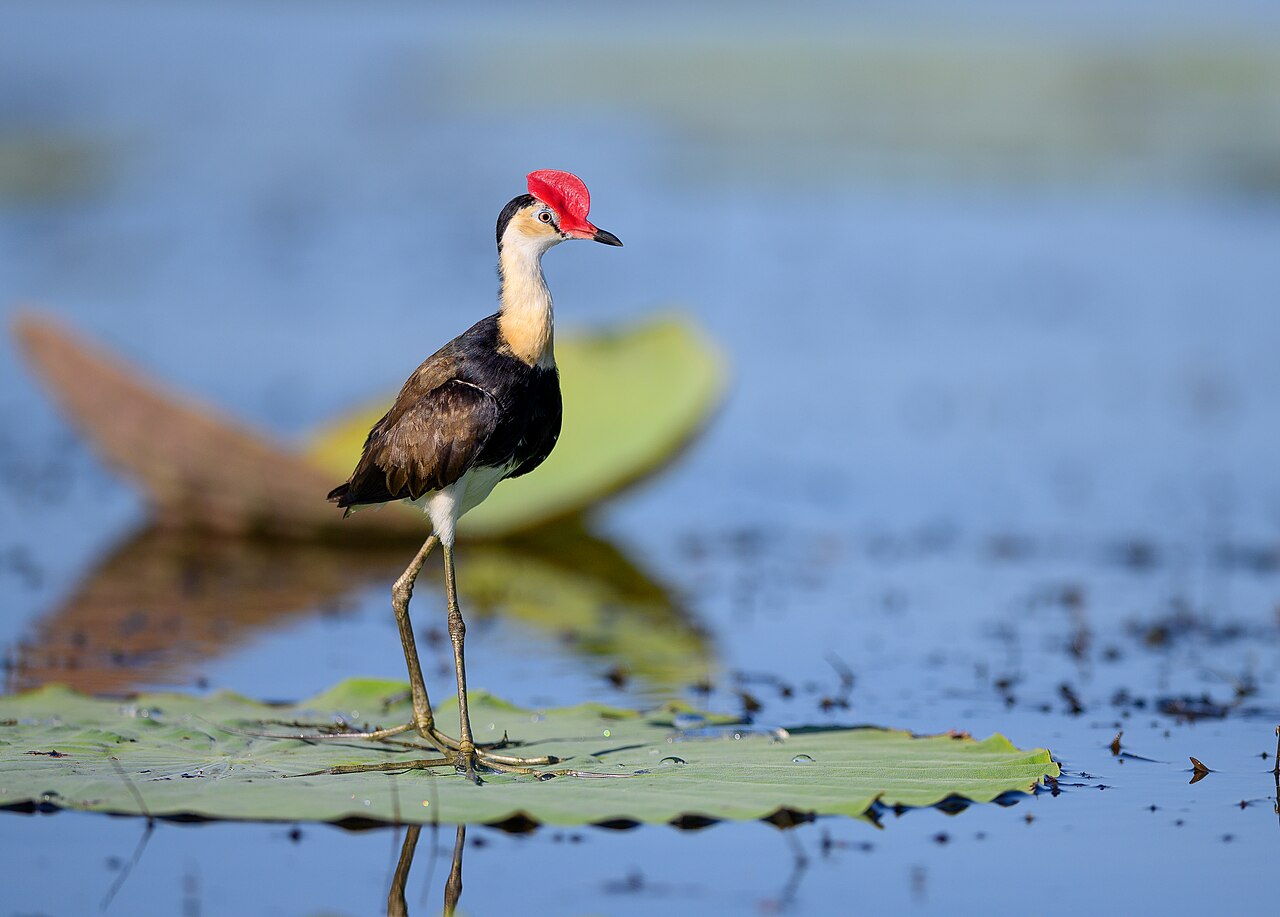
The Comb-crested Jacana walks over floating waterlilies as if they were solid ground, on toes almost as long as its leg. A red fleshy comb above the bill makes it instantly recognisable on any swamp lake in the north. The female is much larger than the male and pairs with several males, each of which incubates alone and carries the chicks tucked under its wings.
Voice
The call is a high squeaky chittering that carries across the water, a fast kree-kree-kree that runs into a shrill trill when the bird is excited. Birds approaching each other over a lily bed exchange short sharp notes like snipping scissors. In alarm there is a persistent plaintive piping, and the male calls his chicks with a soft clucking audible only a few metres off. On a quiet lake the jacana is usually heard before it is seen.
Recording: Greg McLachlan — CC BY-NC-SA 4.0 · Landsborough, Sunshine Coast Regional, Queensland, Australia · xeno-canto
Identification
A slender marsh bird with a black crown and neck, white throat and cheeks, a golden wash on the neck sides and a black breast band cutting sharply across the white belly; the upperparts are glossy dark brown. On the forehead sits an upright red wattle, rose-red in the breeding season and more orange outside it. Toes and claws are extravagantly long and spread the weight across the leaves; in flight they trail far behind the tail. The female is larger and heavier than the male but marked the same. Young birds lack the wattle, have a rufous crown, white underparts without a breast band and a pale eyebrow.
Confusion species
On a lily bed no other bird is built like this, but at range a young one can suggest a Dusky Moorhen (Gallinula tenebrosa): darker, with much shorter toes, genuinely swimming and bobbing its head. Purple Swamphen (Porphyrio porphyrio) is three times the weight, blue and red, and walks through reeds rather than over leaves. Masked Lapwing (Vanellus miles) walks the same shores but is far larger, carries yellow facial wattles and stays on firm ground. In flight the jacana is unmistakable: loose-beating rounded wings, a drooping body and those long toes trailing behind like an anchor.
Habitat
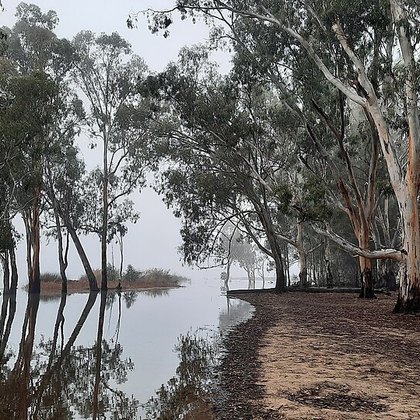
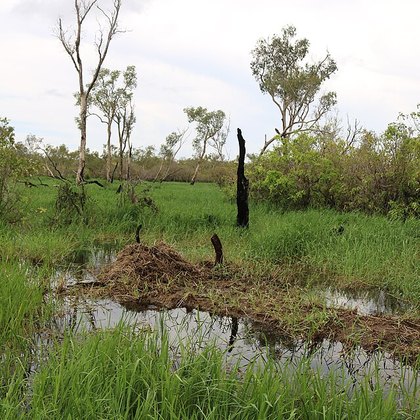
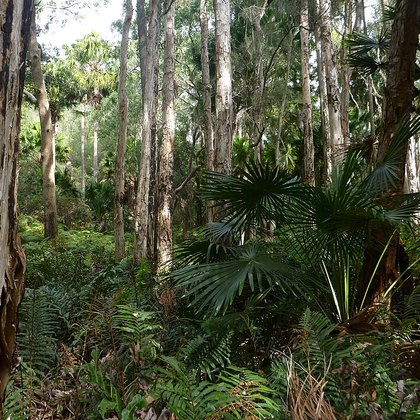
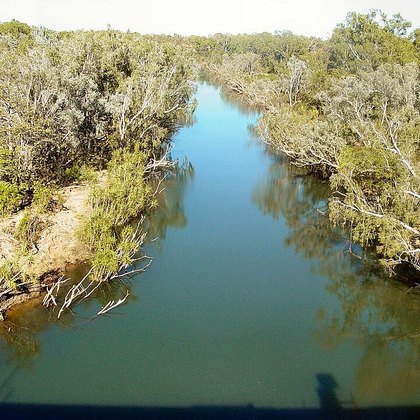
Shallow fresh lakes, lagoons and billabongs (cut-off river channel that flows only at high water) with a closed carpet of floating leaves — waterlily, lotus, and where it grows, water hyacinth. It needs that carpet: it walks, feeds and nests on it, and where the carpet breaks up it goes. Reservoirs, old river arms and the edges of paperbark swamps count as well, provided the water is still. Fast-flowing water, deep open lake and salt or brackish water it does not use.
Where the bird is most often found, arranged by main group and formation.
Range and movements
From the Kimberley in Western Australia along the tropical north coast through the Northern Territory and Queensland to northeastern New South Wales, and beyond the guide into New Guinea, the Moluccas, Sulawesi, the Lesser Sundas and southeastern Borneo. Within Australia it is resident where water stands and a wanderer where it dries: after a wet season birds appear well south of the usual range, into inland New South Wales. Along the southern edge numbers have fallen with the loss of coastal lagoons. It does not reach New Zealand.
- Resident
- dark = core range, pale = thinly spread
Where and when to look
Stand at a lagoon with a closed lily carpet early in the morning and look not for the bird but for the movement of the leaves: a pad that tilts without wind gives it away before you see it. In the breeding season do not count the chicks but watch the male's gait — if he walks stiffly and wide, there are young under his wings with only their legs showing. From August to April the chances of breeding behaviour in the north are highest.
Conservation
Least Concern (LC), with a wide range and, in the tropical north, a bird on every suitable lake. Along the southern edge of the range, in southeastern Queensland and northeastern New South Wales, it has gone locally as coastal swamps were drained and the floating leaves disappeared. Turbidity caused by carp and stock, and the drawing down of lagoons, are the threats that matter locally.
Scientific name
Irediparra gallinacea | (Temminck, 1828)
Temminck described the species in 1828 as Parra gallinacea, in the old catch-all genus of the jacanas; because it was later moved, author and year stand in parentheses. The genus Irediparra was introduced by Mathews in 1911 and joins the name of the British zoologist Tom Iredale to that old Parra. gallinacea means 'like a fowl', after the red forehead wattle, which recalls a rooster's comb. The type locality is Menado on Celebes, present-day Manado on Sulawesi.