All species › Waders, gulls and terns › Plovers and lapwings › Common Ringed Plover
Common Ringed Plover | Charadrius hiaticula
Bontbekplevier | Chorlitejo grande
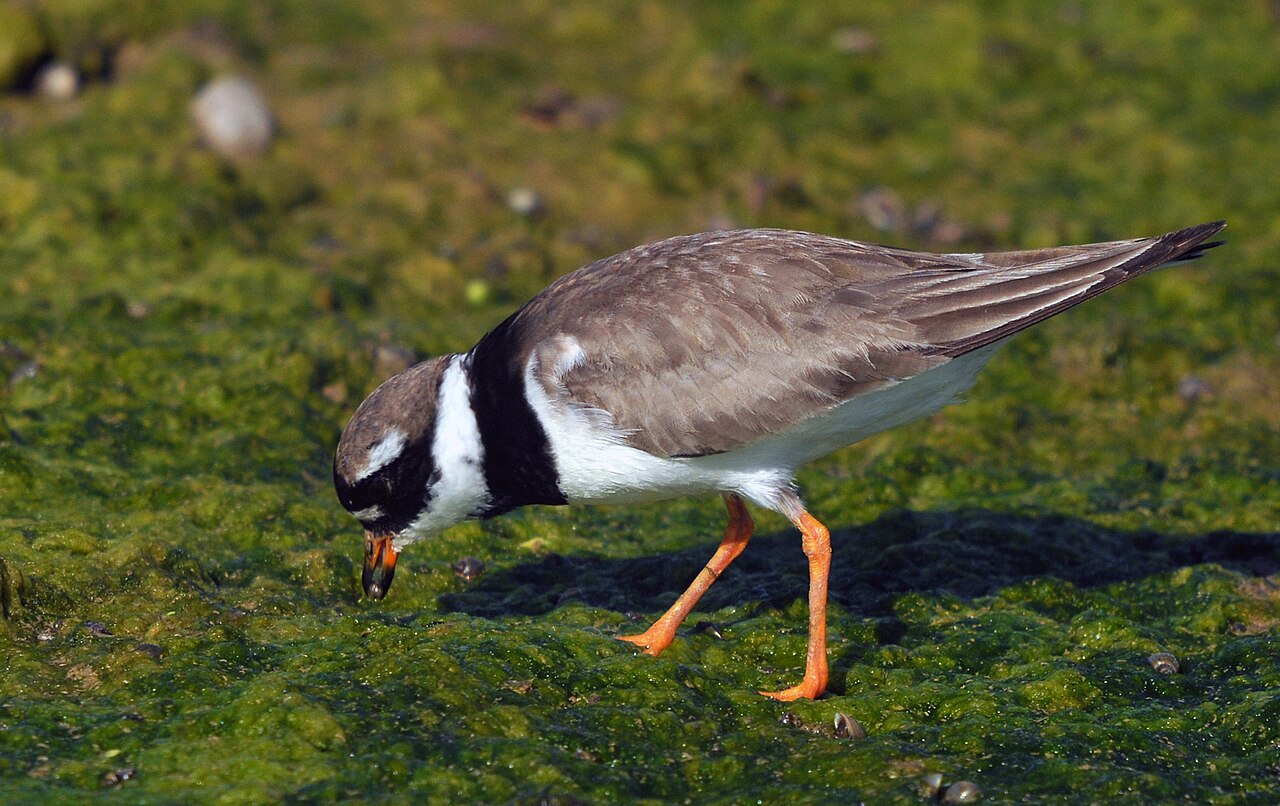
The Common Ringed Plover is the northern hemisphere's ringed plover that almost never reaches this part of the world: a short, thickset wader with a crisp black breast band, a black mask over a white forehead, and in spring an orange bill with a black tip on orange legs. It runs across the mud in short bursts, stops dead, picks and runs on. In Australia and New Zealand it is one of the rarest shorebirds there is.
Voice
The flight call is a soft, plaintive and slightly rising two-note whistle, too-lee or poo-eep, which carries far across mudflats and is usually the first thing an observer notices. In alarm it becomes shorter and harder, a repeated chip. On the breeding grounds the male sings a rolling, undulating tee-wee-a tee-wee-a over his territory, but that is not to be heard outside the Arctic.
Recording: Stanislas Wroza — CC BY-NC-SA 4.0 · Karigasniemi, Finland · xeno-canto
Identification
A small, compact plover of seventeen to a little over nineteen centimetres, grey-brown above and clean white below, with one broad, complete black band across the breast. The head is patterned black and white: a white forehead, a black bar above it, and a black mask running through the eye. The bill is short and blunt and in breeding plumage bright orange with a black tip; the legs are orange to orange-yellow and at range that is the most useful mark. In winter plumage everything fades: the breast band turns brown and is often broken in the middle, the bill is nearly all dark with at most a dull orange base, and the legs go dull yellow. In flight a clear white wing bar shows.
Confusion species
Semipalmated Plover (Charadrius semipalmatus) is the sibling species and the real problem: slightly smaller, with a shorter, blunter bill, a narrower breast band, a smaller white forehead patch and yellower legs, and with a complete bright yellow orbital ring that this species lacks. The call decides it, a sharp rising chu-weet against the soft, plaintive too-lee here; the webbing between all three front toes of the American bird is proof in theory but is rarely visible in the field. Double-banded Plover (Anarhynchus bicinctus) has two bands in breeding plumage and dull greenish to yellowish legs in every plumage. Red-capped Plover (Anarhynchus ruficapillus) is smaller and paler, has black legs and never a complete breast band. Kentish Plover (Anarhynchus alexandrinus) shows only black patches at the sides of the breast and has dark legs. Siberian Sand Plover (Anarhynchus mongolus) is bulkier, has an all-black bill, lacks the white collar on the hindneck and has grey-black legs.
Habitat
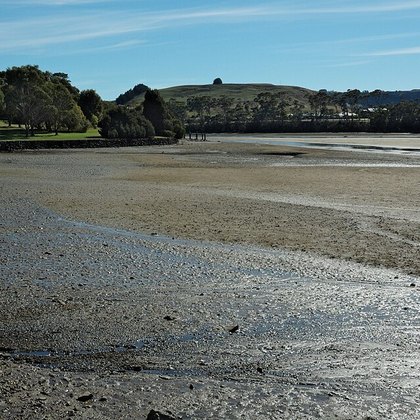
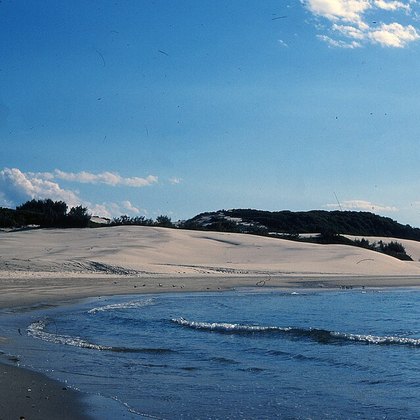
Tidal flats, mud and the sandy margins of estuaries and coastal lagoons, where it works the open mud for ragworms and small crustaceans. It also uses sandy beaches, settling ponds and the muddy edges of saltworks and sewage farms. It avoids tall vegetation and wants a clear view across flat ground.
Where the bird is most often found, arranged by main group and formation.
Range and movements
Within the map window of this guide it is a very rare vagrant, with a few accepted records scattered along the northern and north-western coasts of Australia and a handful from New Zealand. The flyways explain it: the bulk of the species moves from northern Europe, Greenland and Siberia to Africa and western Europe, and the East Asian-Australasian Flyway by which almost every other Palearctic wader arrives here is barely used by this plover. Records usually fall in the Australian summer, between November and March, among the common coastal species.
- Breeding (summer)
- dark = core range, pale = thinly spread
Where and when to look
To find it you have to work through the common birds: settle down at a high-tide roost among Red-capped and Greater Sand Plovers and look for a bird with orange legs and a complete black breast band. Listen as much as you look, because the soft two-note whistle gives it away before the plumage does. Always photograph head and legs: without an image of the orbital ring, the bill base and the leg colour a claim cannot be assessed.
Conservation
Least Concern (LC), with a range covering the whole northern hemisphere and a world population estimated in the hundreds of thousands. It breeds in the far north, on gravel and saltmarsh, and so depends on a climate zone that is changing fast; in parts of north-western Europe breeding numbers are falling through disturbance of beaches and loss of open saltmarsh edges. For Australia and New Zealand it is far too rare to pose a conservation question of its own.
Scientific name
Charadrius hiaticula | Linnaeus, 1758
Linnaeus described the species in 1758 in the tenth edition of his Systema Naturae as Charadrius hiaticula, and it has stayed in that genus, so author and year carry no parentheses. He gave the provenance as 'Europe and America'; the type locality was later restricted to Sweden. Charadrius is a Late Latin bird name going back to Greek kharadrios, a bird of ravines and gullies. hiaticula is Latin for 'dweller in a cleft', from hiatus, 'gap', and colere, 'to inhabit' — a reference to the nest, a scrape among the pebbles.