All species › Waders, gulls and terns › Sandpipers and allies › Common Greenshank
Common Greenshank | Tringa nebularia
Groenpootruiter | Archibebe claro
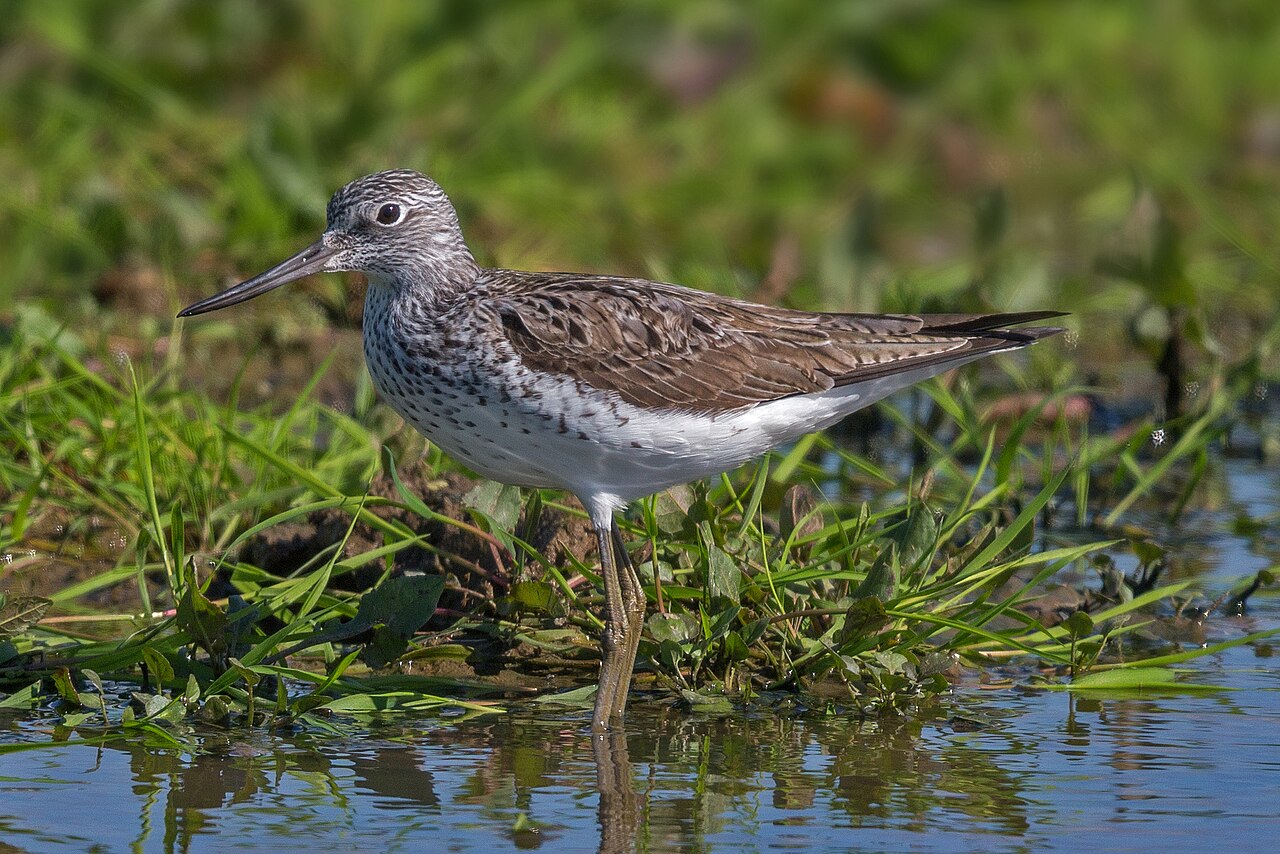
The Common Greenshank is the largest and by far the commonest shank of this region: a pale grey, slender wader of over thirty centimetres, with long yellow-green legs and a heavy, slightly upturned bill. It stands as readily on a tidal flat by the sea as on a drying claypan (shallow clay basin that holds water for a time after rain) far inland, and almost always gives itself away with its clear three-note whistle before it is seen.
Voice
The standard call is a clear, far-carrying whistle of three even, slightly falling notes: tew-tew-tew, nearly always on take-off and often before the observer has picked the bird up. It is a full, round sound, clearly lower and broader than the sharp high yip of Marsh Sandpiper. Feeding birds give soft, clipped contact notes, and in a disturbed flock the whistle swells into an uneven chorus.
Recording: Noé Ferrari — CC BY 4.0 · Arrondissement d'Abbeville (near Abbeville), Somme, Hauts-de-France, France · xeno-canto
Identification
A large, long-legged shank of thirty to thirty-five centimetres, grey-brown above with pale feather edges, white below, the head and neck finely streaked. The bill is heavy and about five centimetres long, blackish towards the tip and grey-green towards the base, and rises slightly along its length — that upward set is the best mark in profile. The legs are long and light yellow-green to blue-green, never orange or yellow. In flight the wing is plain dark with no wingbar, and a sharp white wedge runs from the rump well up the back; the toes project only slightly beyond the tail. Breeding birds add black streaking on breast and flanks.
Confusion species
Marsh Sandpiper (Tringa stagnatilis) carries the same white wedge up the back and the same green legs, but is a third smaller and far more delicate, with a dead-straight needle-fine bill instead of a heavy upturned one, and legs that trail well beyond the tail in flight. Nordmann's Greenshank (Tringa guttifer) is nearly as large and also shows the white wedge, but its legs are strikingly short and dull yellow and barely reach past the tail, its bicoloured bill is thicker at the base, and it has webbing between the front toes. Common Redshank (Tringa totanus) has orange-red legs and a red bill base, and shows broad white trailing edges to both wings that the greenshank entirely lacks. Grey-tailed Tattler (Tringa brevipes) is plain grey, short-legged and shows no white at all on back or rump.
Habitat
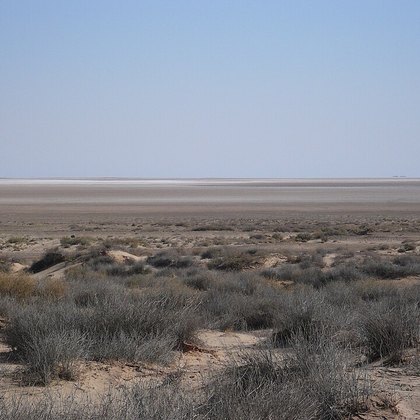
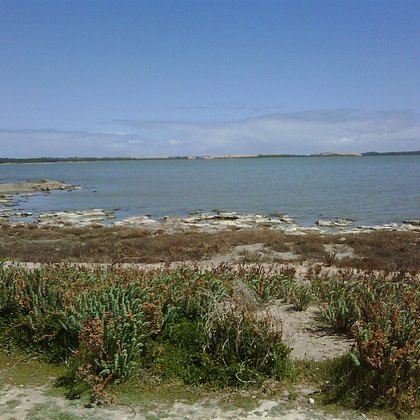
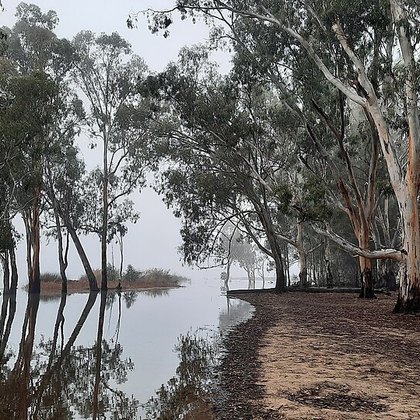
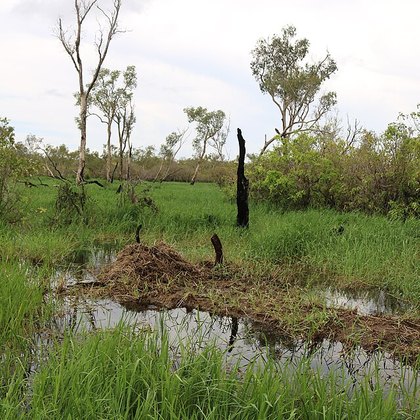
Salt and fresh alike, and in that the broadest of all the shanks here: intertidal mud and sandflats of estuaries, mangrove creeks, saltworks ponds and coastal saltmarsh, and inland the margins of lakes and reservoirs, claypans that fill after rain, rice fields, sewage ponds and stock dams. It feeds walking in shallow water, picking from the surface and at times dashing after small fish in short sprints.
Where the bird is most often found, arranged by main group and formation.

Range and movements
Common and widespread across the whole of Australia, on every coast and far inland — it is much the most frequently reported Tringa in this guide. Birds arrive between August and November, then hold fairly closely to one site, and leave in March and April. It reaches New Zealand only rarely: up to six a year were counted in the late 1980s, then came a gap, and between 2004 and 2020 there were about eight mainland records plus a few on the outlying islands. On Norfolk Island it is a scarce visitor.
- Resident
- Breeding (summer)
- dark = core range, pale = thinly spread
Where and when to look
Let your ears do the work: the clear tew-tew-tew on take-off is the fastest identification tool there is on a big flat, and it often comes before you have found the bird. Then look at the bill in profile — the slight upward curve separates it at once from the dead-straight Marsh Sandpiper — and on birds flying over, watch the back, where the white wedge runs up to a point between the shoulders.
Conservation
Least Concern (LC): the species breeds across an enormous belt from Scotland to Kamchatka and the world population is large. On the East Asian-Australasian Flyway the picture is less calm than those letters suggest, because this bird too depends on the outward journey on the tidal flats around the Yellow Sea, much of which has been reclaimed. That it uses both coast and interior here makes it less vulnerable than the strictly tidal waders: if one estuary fails it can shift to an inland claypan.
Scientific name
Tringa nebularia | (Gunnerus, 1767)
Gunnerus described the species in 1767 as Scolopax nebularia; because of the later move to Tringa, author and year stand in parentheses. The epithet comes from Latin nebula, 'mist', after the damp marshland in which the bird breeds; the type locality lies in the Trondheim district of Norway. The genus name Tringa was introduced by Linnaeus in 1758 and goes back through Neo-Latin to Greek trungas, a thrush-sized, white-rumped, tail-bobbing wading bird mentioned by Aristotle. The English name, like the Dutch, points to the colour of the legs.