All species › Passerines › Whipbirds and wedgebills › Chirruping Wedgebill
Chirruping Wedgebill | Psophodes cristatus
Struikraltimalia | Zordala picocuña oriental
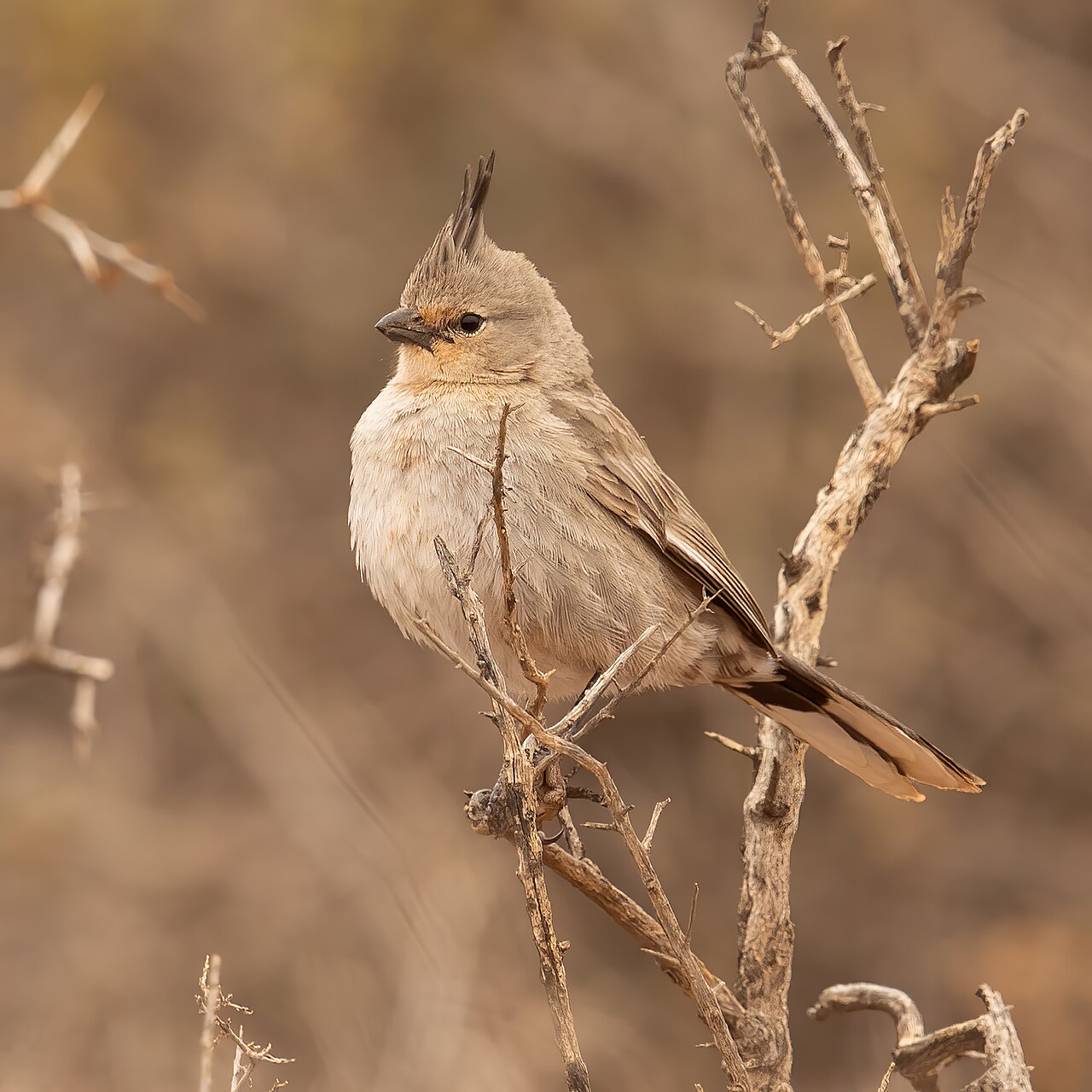
The Chirruping Wedgebill is the wedgebill of the eastern dry interior, from north-eastern South Australia to western New South Wales. It is a plain greyish brown bird with a pointed crest and a long tail, living in low saltbush (salt-tolerant dwarf shrubland of saline plains) and lignum scrub along dry creeks. Its counterpart, the Chiming Wedgebill (Psophodes occidentalis), lies further west; the two can be separated by song alone.
Voice
The only reliable key. The song is a short, fast, stuttering series of four or five notes rendered in Australia as did-ya-get-drunk: brisk, rather thin and chirruping, without melody and without a falling cadence. That is precisely the opposite of the Chiming Wedgebill, which delivers a sweet, chiming series running down like a falling scale. This species too sings for hours on end, through the full midday sun and sometimes at night, and a pair often sings in duet. In the low scrub of the plains the song is usually the first and often the only sign that the bird is there.
Recording: Martin Cake — CC BY-NC-SA 4.0 · Murnpeowie, South Australia, Australia · xeno-canto
Identification
Nineteen to twenty-one centimetres, much of it the long, slim tail. The plumage is plain greyish brown, a little darker above, paler below, with fine, faint dark streaking on throat and breast that is just visible in good light. The narrow, pointed crest stands upright and gives the silhouette its characteristic shape. The tail is dark with narrow white tips, the bill short, black and wedge-shaped. The bird keeps low, runs across open ground between two bushes and flies short and low, with fast wingbeats.
Confusion species
Chiming Wedgebill (Psophodes occidentalis) is the mirror species and the real identification problem: on appearance the two cannot be separated with certainty in the field. This species is reported to be a little more finely streaked below and to have a slightly shorter tail, but that cannot be made to hold on a moving bird, and both characters need light and time the scrub seldom grants. Song decides, and range helps: this species lives in the eastern interior — north-eastern South Australia, south-western Queensland and western New South Wales — and the Chiming Wedgebill in the west and centre. Western Whipbird (Psophodes nigrogularis) belongs to the same genus but is olive-green with a black throat and lives in dense southern scrub. Without a heard song, a wedgebill in the border country remains an unsettled record.
Habitat
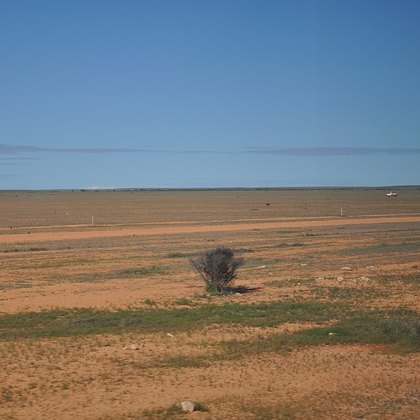
Low, open scrub of the dry plains: saltbush and bluebush (blue-grey salt-tolerant shrubland of the semi-arid interior) flats with scattered bushes, lignum and nitre bush (salt-tolerant shrub, Nitraria billardierei) along creek beds and around claypans (shallow clay basin that holds water for a time after rain), canegrass (tall, wiry tussock grass of periodically wet basins) in shallow basins, and the scrubby margins of gibber (stony desert with a pavement of polished stones) plains. Unlike the Chiming Wedgebill, which prefers taller acacia scrub, this species manages with vegetation under two metres as long as there is cover to dive into. It forages on foot over open ground, on insects and seeds, staying close to a bush. It lives in pairs or small parties and builds an open cup nest low in a shrub.
Where the bird is most often found, arranged by main group and formation.

Range and movements
The eastern dry interior: from north-eastern South Australia — the Lake Eyre basin and the Strzelecki country — north-east to south-western Queensland and south to western New South Wales. Within that it is locally common in the right vegetation and absent from bare plains. It is sedentary, but numbers move with the rain and the state of the scrub; after good years it is more widely spread than after a run of dry ones. To the west its range meets that of the Chiming Wedgebill.
- Resident
- dark = core range, pale = thinly spread
Where and when to look
Listen first, look afterwards, and always record what you heard. Drive past saltbush flats with lignum along the creeks at sunrise or, just as well, in the middle of the day, and stop where you hear the stuttering did-ya-get-drunk: that is the record, and without the song the observation is unusable in the border country. The bird itself often shows briefly on top of a bush or running over open ground between two thickets. Do not try to make the streaking difference from the Chiming Wedgebill in the field — it costs time and yields no certainty.
Conservation
Least Concern (LC). The species is locally common within its range and that range lies in thinly settled grazing country that has barely been cleared. What touches it is the loss of the low shrub layer: saltbush and bluebush eaten out by sheep, rabbits and goats, and the loss of lignum where creeks are dammed or no longer get their water. Where the scrub comes back after a run of wet years, the bird comes back with it. Feral cats are a factor in places where cover has gone.
Scientific name
Psophodes cristatus | (Gould, 1838)
Gould described the species in 1838 as Sphenostoma cristatum, from material in New South Wales; the specific name is Latin for crested, after the pointed crest. The genus Sphenostoma — Greek for wedge-mouth, after the wedge-shaped bill, and the source of the English name wedgebill — was later merged into Psophodes, which is formed from Greek psophos (sound) and -odes (resembling); hence author and year stand in parentheses. The English name Chirruping Wedgebill cites the chirruping quality of the song against the chiming of the western species; the Dutch name cites the scrub the bird lives in.