All species › Passerines › Australasian babblers › Chestnut-crowned Babbler
Chestnut-crowned Babbler | Pomatostomus ruficeps
Roodkruinbabbelaar | Gárrulo coronirrufo
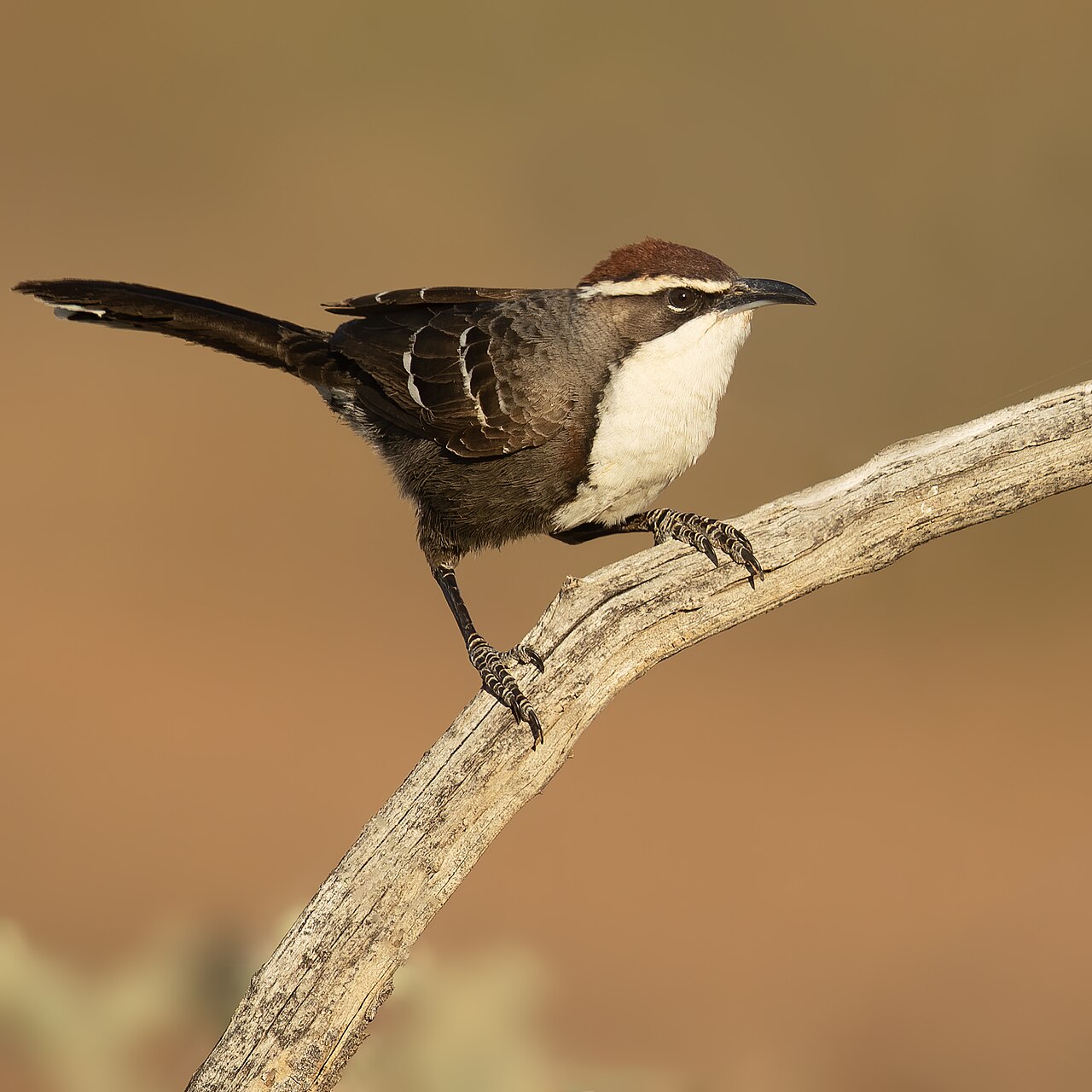
The Chestnut-crowned Babbler is the babbler of the dry south-eastern interior, from the Flinders Ranges to western New South Wales. It is dark brown with a warm chestnut crown, a white eyebrow and — the decisive mark — two white wing bars. It lives in the largest and noisiest parties of any Australian babbler and is one of the best-studied cooperative breeders in the world.
Voice
An unbroken chatter from many throats at once: short twittering notes, grating rattles and plaintive, cat-like mewing; the larger the party, the fuller the sound. There is no clear song in it and no fixed structure: it is talk, and it runs on as long as the group is feeding. In alarm it turns into a sharp collective rattle at which every bird shoots into the same bush. The sound carries far in open scrub and is almost always the first sign that a party is present.
Recording: Richard White — CC BY-NC-SA 4.0 · Hattah, Mildura Rural City, Victoria, Australia · xeno-canto
Identification
Twenty-one to twenty-three centimetres and nearly sixty grams. The crown is warm chestnut and stands out against a narrow white eyebrow and a dark eye-stripe. The upperparts are dark greyish brown, throat and breast white, belly greyish brown. Two clear white bars cross the folded wing — no other Australian babbler has them, and the mark holds at a distance and in flight. The bill is long and downcurved, the tail long and broadly white-tipped.
Confusion species
The two white wing bars separate this species from every other babbler; if they show, the identification is settled. White-browed Babbler (Pomatostomus superciliosus) overlaps broadly with it in the south, but has a dark rather than chestnut crown, no wing bars, and is smaller and lighter in build. Hall's Babbler (Pomatostomus halli) also has a dark crown, lacks the wing bars, carries a sharply cut white bib and lives further to the north-east, in the mulga (acacia scrub of the dry interior, dominated by Acacia aneura) of south-western Queensland. Grey-crowned Babbler (Pomatostomus temporalis) is bulkier, has a grey crown with a pale central stripe and shows a large rufous wing panel instead of two narrow bars. A babbler with a rusty cap and a barred wing in saltbush (salt-tolerant dwarf shrubland of saline plains) or mulga of the south-eastern interior is this species.
Habitat
Dry interior country with a woody shrub layer: saltbush and bluebush (blue-grey salt-tolerant shrubland of the semi-arid interior) plains with scattered trees, mulga and other acacia scrub, belah and mallee (low, multi-stemmed eucalypt scrub of dry southern Australia) stands, and lignum along creeks. It needs shrubs or low trees to build its nests in and open ground to forage on, and avoids both closed forest and bare grassland. Parties are large — often ten to fifteen birds, sometimes more — and breed cooperatively, a group sometimes splitting into several breeding units during the season that rejoin afterwards. The large domed stick nests double as communal roosts, which saves warmth on cold inland winter nights.
Where the bird is most often found, arranged by main group and formation.


Range and movements
The dry south-eastern interior: from the Flinders Ranges and north-eastern South Australia east to south-western Queensland, western New South Wales and north-western Victoria. It is sedentary, but parties shift their ground somewhat with the rain and may crowd onto the better patches in dry years. Around Fowlers Gap in western New South Wales sits a population followed for decades that has yielded most of what is known about cooperative breeding in this species.
- Resident
- dark = core range, pale = thinly spread
Where and when to look
Watch the wing, not the head. The chestnut crown simply looks dark in strong light or at range, but the two white wing bars stay visible even as a party crosses a road one bird after another. Look for the birds in saltbush plains with scattered acacias, and note the conspicuous ball-shaped stick nests in the bushes: several standing together in one territory almost certainly means a party is about, even when you hear nothing at that moment.
Conservation
Least Concern (LC). The species is common over most of its range and benefits locally from stock watering points. Where it declines it is the loss of the shrub layer: clearing of mulga and belah for pasture and the eating out of saltbush by sheep, rabbits and goats, which removes the nest sites. Because a group needs helpers to breed successfully, the loss of a few birds from a small party counts for more than it would in a species that lives in pairs.
Scientific name
Pomatostomus ruficeps | (Hartlaub, 1852)
Hartlaub described the species in 1852 as Pomatorhinus ruficeps, from material near Adelaide; because it now stands in Pomatostomus, author and year are in parentheses. The specific name is Latin: rufus (reddish) and ceps (headed), after the chestnut crown, and the Dutch and English names both say exactly the same. Pomatostomus is formed from Greek poma (lid) and stoma (mouth), after the build of the bill. Despite the name, the Australasian babblers are not related to the babblers of Asia and Africa; they form a family of their own, Pomatostomidae, confined to Australia and New Guinea.