All species › Parrots › Old World parrots › Australian Ringneck
Australian Ringneck | Barnardius zonarius
Port Lincoln-parkiet | Loro de Port Lincoln
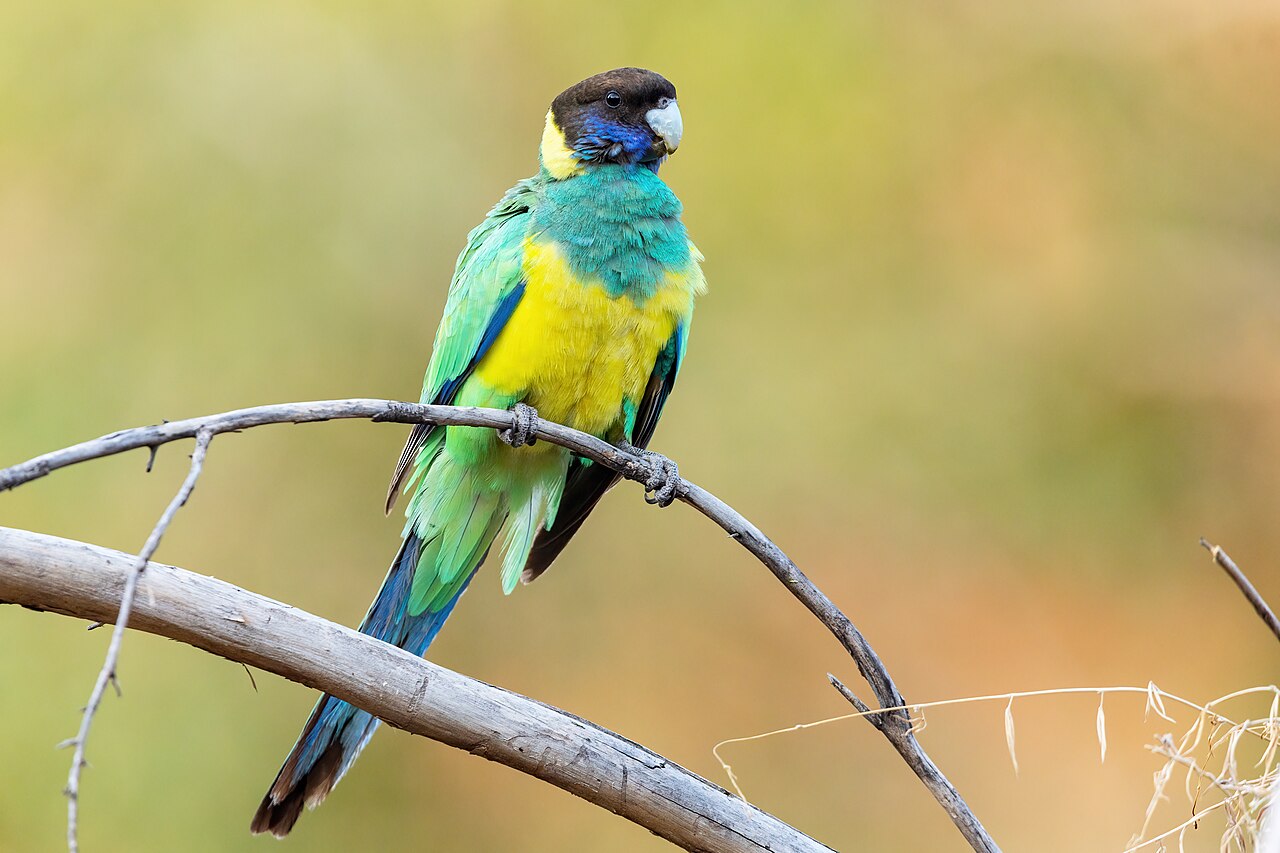
The Australian Ringneck is the big green parrot of the dry Australian interior, in four forms that look so unalike that they were long held to be separate species. What they share is a bright yellow band across the hindneck — the ring of the English name — and a long, broad tail. The two western forms have a black head, the two eastern ones a green head.
Voice
The usual call is a full, bell-like kwink-kwink-kwink-kwink or kling-kling that carries half a kilometre across dry woodland and is mostly given in flight. Beyond that comes soft chatter between birds feeding together and a shrill alarm at a passing hawk. The south-western form has a contact call that sounds like twenty-eight, which is what Australians call it.
Recording: Raymond Bosman — CC BY-NC-SA 4.0 · Jarrahdale, Australia · xeno-canto
Identification
A heavy, long-tailed parrot averaging well over thirty-five centimetres, far bigger and plainer than any rosella: the back is an even green to blue-green with no scalloping. All forms carry a crisp yellow band across the hindneck. The Port Lincoln form has a dull black head, blue-green throat and breast and a yellow belly; the south-western form matches it but has a green belly and a bold crimson frontal band. The Mallee form instead has a bright green crown and nape with a blue cheek, a deep blackish-blue back, a red frontal band and an orange-yellow belly band; the Cloncurry form is pale green throughout, without a red band and with a broad, even pale yellow belly band. The flight is swift and strongly undulating.
Confusion species
All four rosellas in this guide have a mantle scalloped black and colour, and the ringneck does not — that is the quickest separation. In the south-west Western Rosella (Platycercus icterotis) is the neighbour: much smaller, with a yellow cheek patch and a scalloped back, and no yellow collar. In north-western Queensland the pale Cloncurry form meets Northern Rosella (Platycercus venustus), which has a black crown and finely scalloped yellow underparts. Red-capped Parrot (Purpureicephalus spurius) of the south-west has a purple-red crown and a long pointed bill. Red-winged Parrot (Aprosmictus erythropterus) is also green but carries a large red wing panel and lacks the collar.
Habitat
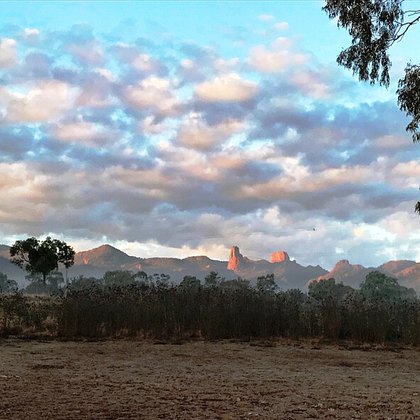
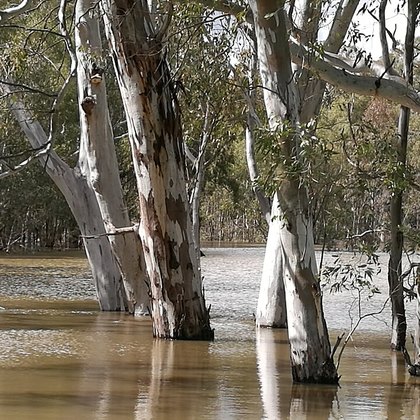
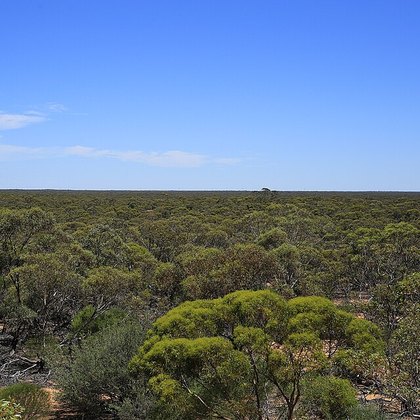
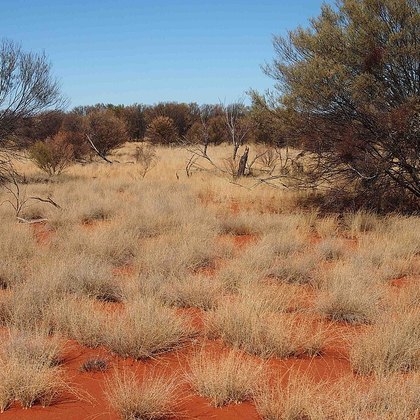
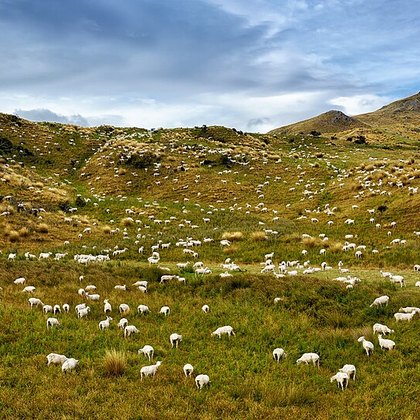
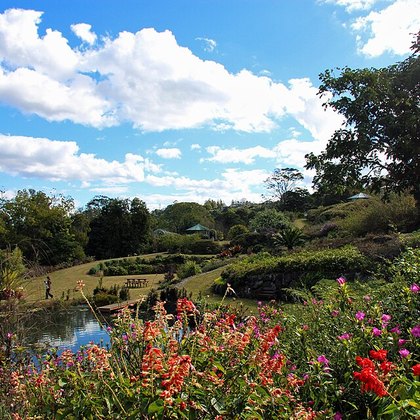
Eucalypt woodland and the lines of trees along creeks are the core, and around them mallee (low, multi-stemmed eucalypt scrub of dry southern Australia), mulga (acacia scrub of the dry interior, dominated by Acacia aneura) and other acacia scrub, lightly timbered plains and, in the south-west, true marri and jarrah forest. It adapts well: crop margins, grazing land with scattered trees, roadsides, parks and gardens are all used, and in Perth and Kalgoorlie it is an ordinary town bird. It feeds mainly on the ground — seed, with fruit, blossom, nectar and insects besides — in the morning and late afternoon, and nests in tree hollows.
Where the bird is most often found, arranged by main group and formation.
Range and movements
Endemic to Australia and spread across almost the whole arid and semi-arid interior. The Port Lincoln group holds the central and western arid zone, from the Eyre Peninsula in South Australia across the Nullarbor to all of Western Australia; the Mallee group occupies the arid Northern Territory, north-western Queensland and inland eastern Australia. It is absent from the eastern seaboard and the far tropical north, and does not occur in New Zealand; birds around Sydney and the New South Wales Central Coast are escaped cage birds.
- Resident
- dark = core range, pale = thinly spread
Where and when to look
Drive an inland creek line of old river red gums and stop at every stand of trees: the birds sit quietly in the crown until they go off on their bell-like kwink-kwink, when the yellow collar and the long tail show at once. On every bird check whether the belly is yellow or green and whether there is a red frontal band — that fixes the form. In Perth a city park is enough.
Conservation
Least Concern (LC). The range is huge, the species occurs in nearly every dry landscape type, and it has gained from stock watering points put in across the pastoral country. There is local pressure: in Western Australia the south-western form is losing nest hollows to introduced Rainbow Lorikeets, and in orchards and on grain the bird is controlled as a pest. Road casualties are numerous on inland highways, because it picks up spilt grain along the verge. The species is listed on CITES Appendix II.
Scientific name
Barnardius zonarius | (Shaw, 1805)
Shaw described the species in 1805 as Psittacus zonarius, in The Naturalist's Miscellany alongside a plate by Nodder; because it was later moved to another genus, author and year stand in parentheses. zonarius means 'girdled', after the yellow hindneck band. The genus Barnardius was introduced by Bonaparte in 1854 and honours Edward Barnard, the British colonial agent-general for the Australian colonies and a collector. The type locality is Memory Cove near Port Lincoln on the Eyre Peninsula in South Australia, where Robert Brown took the specimen during Flinders' voyage in the Investigator; that is the place name carried by the Dutch guide name. Four subspecies are recognised: zonarius, semitorquatus, barnardi and macgillivrayi.