All species › Waders, gulls and terns › Sandpipers and allies › Asian Dowitcher
Asian Dowitcher | Limnodromus semipalmatus
Aziatische grijze snip | Agujeta asiática
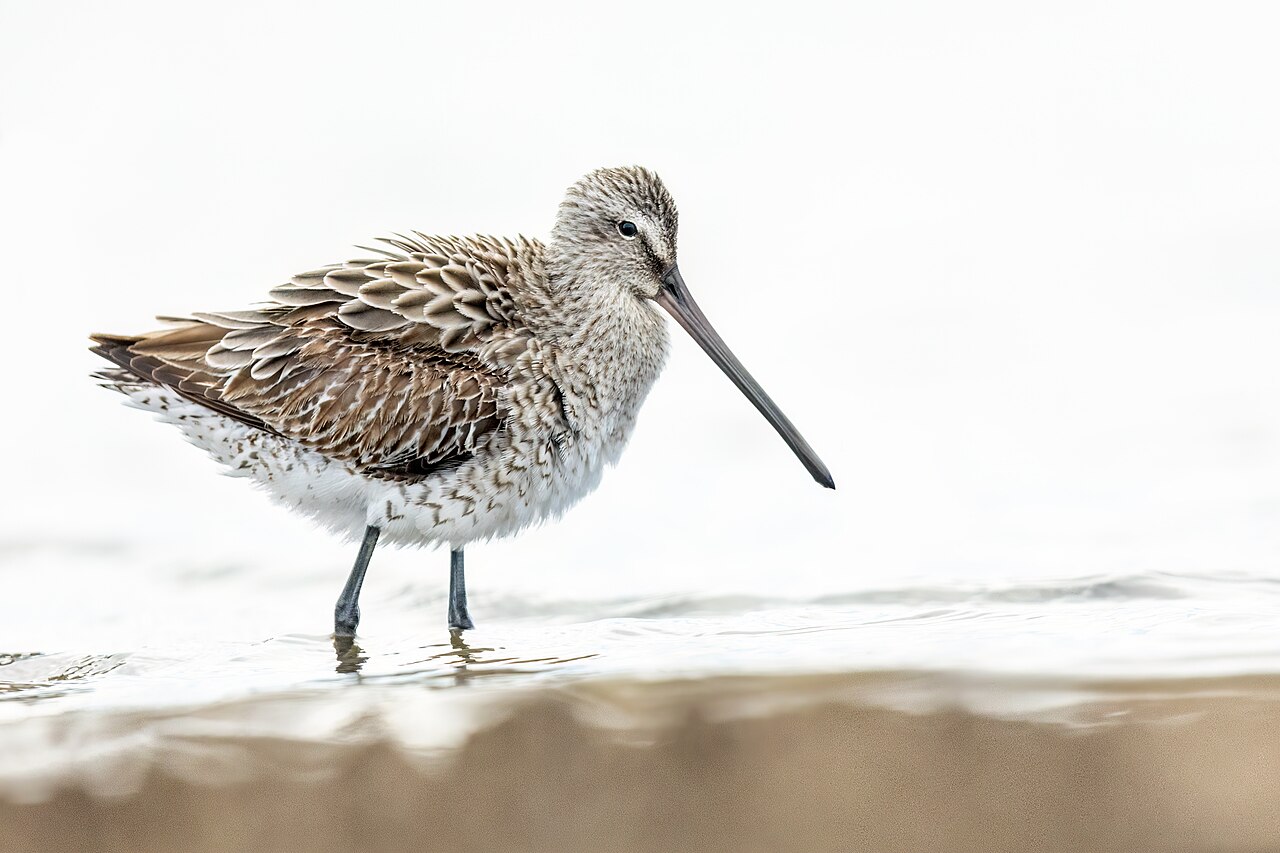
The Asian Dowitcher is a godwit-like wader that stands among thousands of Bar-tailed Godwits on the flats of northwestern Australia and gives itself away by one feature: a dead-straight, wholly black bill, thick at the base and blunt at the tip, like that of a giant snipe. It feeds with fast vertical jabs, the head going up and down like a sewing machine. For Australia it is a scarce visitor, centred between Broome and Port Hedland.
Voice
On the flats it is usually silent; the sound that betrays it is a soft, yelping and slightly plaintive chowp or kee-owp, given in flight or as a small party lifts, clearly different from the harder three-syllable calls of the godwits. A short rolling chatter sometimes passes between birds. Anyone who knows the call often picks it out of a mixed wader flock by ear before the eye finds it.
Recording: Sébastien Provost - Birding Mont-Saint-Michel — CC BY-NC-SA 4.0 · Oldzeyte, Ulziit, Övörkhangai, Mongolia · xeno-canto
Identification
A medium-large wader of thirty-three to thirty-six centimetres with a long neck and long legs, a wingspan of about fifty-nine centimetres and a weight of a hundred and eighty to a hundred and ninety grams. The bill decides it: straight, snipe-like, heavy at the base and blunt at the tip, and grey-black along its whole length, without the pink or orange base every godwit has; legs and feet are grey-black too. The female is larger and longer-billed. In non-breeding plumage it is drab grey with a dark crown running forward as a cap over the forehead, a white supercilium and a dark loral stripe that is broad at the bill base and fades behind the eye. In breeding plumage it is heavily streaked black and chestnut with brick-red underparts. In flight there is no white wingbar, and the pale lower back and rump contrast with a finely barred tail.
Confusion species
Bar-tailed Godwit (Limosa lapponica) is the species it stands among: larger and longer-legged, with a slightly upturned bill with a pink base and a paler, streaked plumage, and a calmer, more grazing way of probing. Black-tailed Godwit (Limosa limosa) is ruled out by the broad white wingbar and black tail band in flight, both of which the dowitcher lacks, and it too has a pink bill base. Great Knot (Calidris tenuirostris) shares the flats and the sewing-machine action but is shorter in neck and leg, with a shorter bill that droops a little at the tip. The American dowitchers of the same genus do not occur here, so any dowitcher in this region is this species.
Habitat
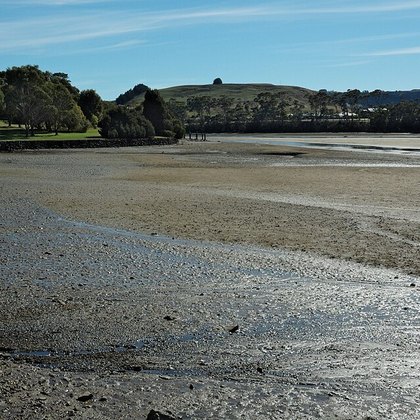
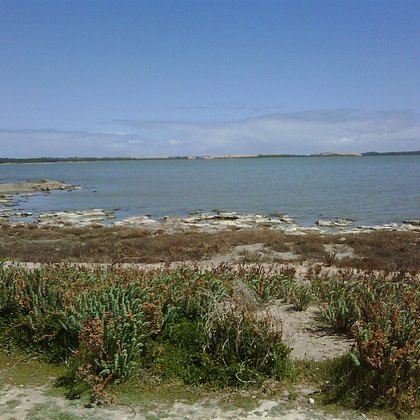
Broad intertidal mudflat in sheltered bays and estuaries, where it works the softest mud on the falling tide. At high water it gathers at roosts close by: saltmarsh with samphire (low, succulent saltmarsh shrubland on tidal mud), the bunds and ponds of saltworks, shallow lagoons and sandbars at the edge of the flats. Fresh inland water it hardly uses in this region; here it is a coastal bird, and the mud must be soft, because its blunt bill is built to drive deep and fast.
Where the bird is most often found, arranged by main group and formation.

Range and movements
Within the map window it is a regular visitor only on the north coast of Australia, and above all between Broome and Port Hedland in Western Australia: Roebuck Bay holds some four hundred birds in a good year and the Port Hedland saltworks up to a hundred and twenty-five. Beyond that the tidal wetlands at Port McArthur in the Gulf of Carpentaria are a fixed site. Elsewhere along the northern and eastern coast, as far as New South Wales, records are scattered. In all, an estimated six to eight hundred mature birds visit Australia out of a world population of about fourteen thousand. In New Zealand it is a great rarity.
- Resident
- dark = core range, pale = thinly spread
Where and when to look
Go to the Roebuck Bay roosts on a rising tide in November or December and look through the godwit flocks for the bird with the all-black bill; that one colour carries a hundred metres and is more reliable than any plumage mark. Then watch the feeding action: the fast vertical sewing-machine jabs with the body barely moving are characteristic. Note as well the dark cap and the broad loral stripe at the bill base, which give the face a sterner look in winter plumage than any godwit has.
Conservation
Near Threatened (NT), with a world population of about fourteen thousand birds, which is little for a wader with so wide a flyway. In Australia numbers look stable or slightly rising, and virtually all the threats lie outside the map window, halfway along the route. Around the Yellow Sea, where it must lay on fat, tidal flat is being reclaimed fast for aquaculture and industry, introduced cordgrass is spreading, and pollution from households, industry, fish farming, oil and pesticides comes together; hunting is added on top. Sediment is also being lost because the feeding rivers are dammed, and sea level rise squeezes what flats remain. In New South Wales the species was listed as vulnerable at state level in 2024.
Scientific name
Limnodromus semipalmatus | (Blyth, 1848)
Edward Blyth described the bird in 1848 as Macrorhamphus semipalmatus, from a specimen near Calcutta; because of the later move to another genus, author and year stand in parentheses. The epithet semipalmatus means 'half-webbed' and refers to the small webs between the toes. The genus name Limnodromus is built from Greek limne, 'marsh', and dromos, 'runner'. The Dutch name follows the American dowitchers of the same genus; the English name goes back to a word from the hunters' vocabulary of northeastern North America.