All species › Ericales › New World pitcher plant family › Sarracenia rosea
Sarracenia rosea
Roze trompetbekerplant
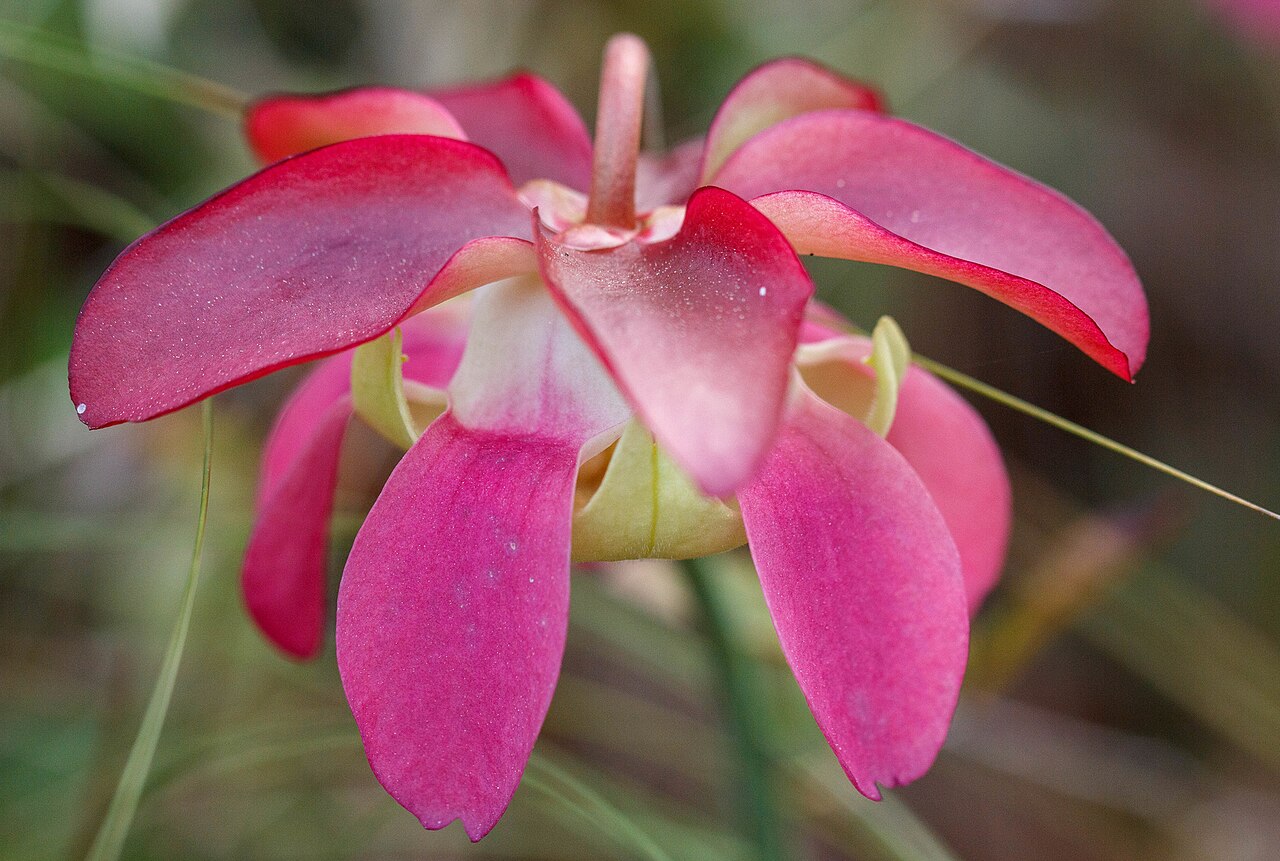
A quarter of a century ago this was simply the southern Sarracenia purpurea. In 1999 it was described as a species of its own, and anyone who sees the two in flower side by side understands why: where the northerner is dark purple-red, this one is pink, its petals hanging like a skirt over the style disc.
Identification
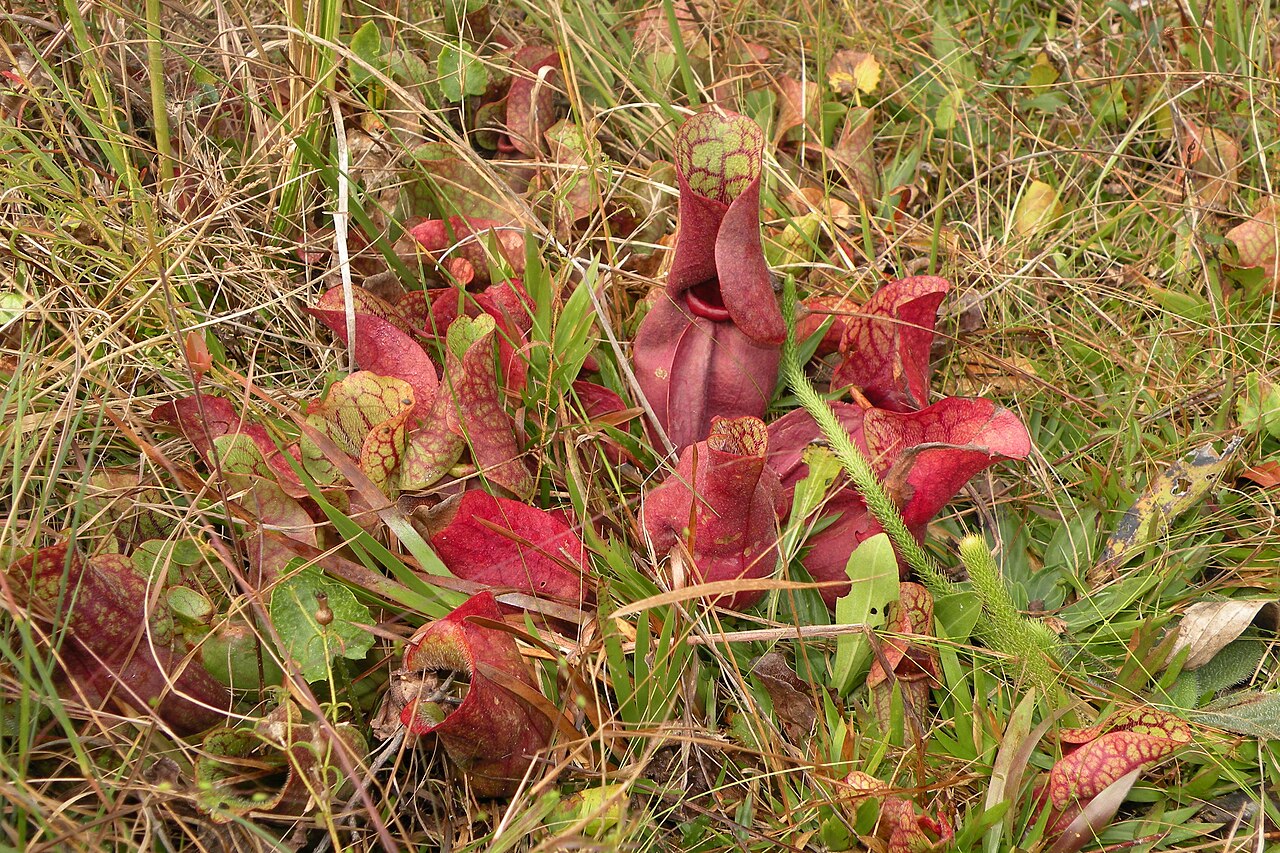
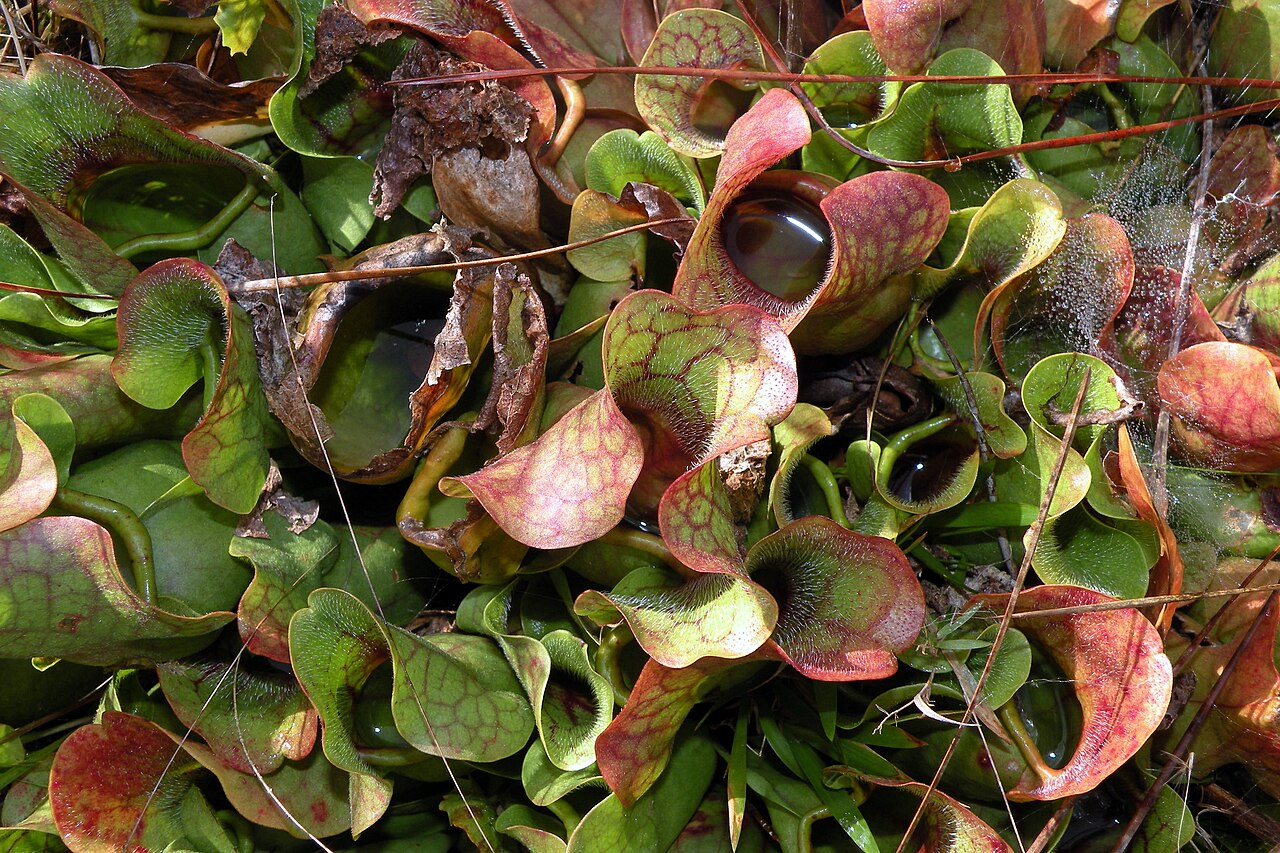
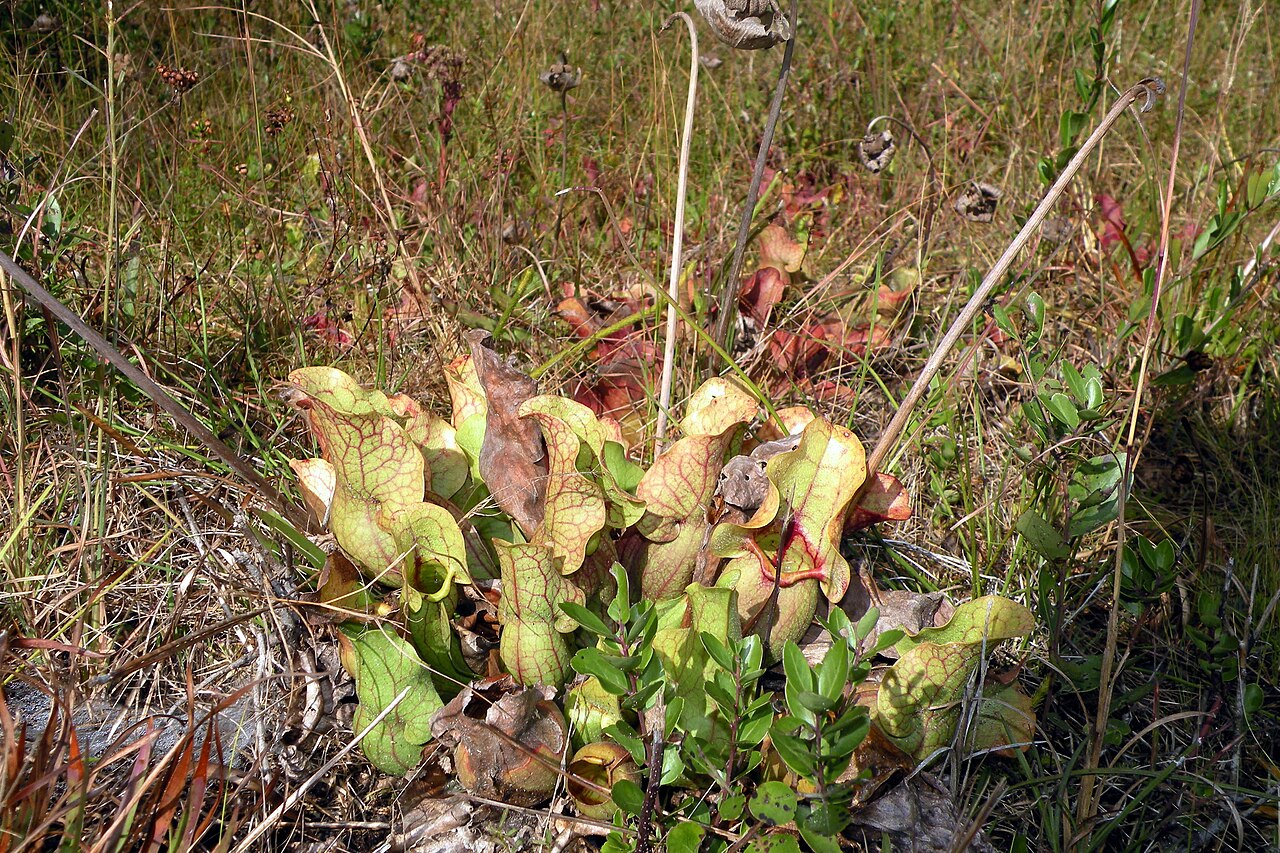
A decumbent rosette of thick, bellied pitchers 6 to 28 cm long and 2 to 4 cm across, with a broad wing. They stand half full of rainwater, because the lid rises upright behind the mouth rather than over it. In this species that lid is conspicuously broad, strongly undulate at the margin and often pinched at the base. The pitcher is green with red veins, flushing deeper red in full sun. In early spring a single nodding flower stands on a bare scape: pink to rose-red, with broad spatulate petals shorter and far wider than those of S. purpurea.
Similar species
Everything turns on telling it from S. purpurea, of which it was a variety until 1999 (var. burkii). Three things help in the field: flower colour (pink to rose-red against dark purple-red), petal shape (broad and spatulate, shorter than the sepals, against narrow and longer) and the lid (broad, strongly undulate, pinched at the base against narrower and flatter). Geography helps too: S. rosea occurs only on the Gulf coast, where S. purpurea in its southern guise scarcely reaches. This guide follows POWO, which accepts S. rosea as a species; older books and many photo captions still call it S. purpurea subsp. venosa var. burkii. S. psittacina, often growing with it, lies flatter and has a closed globular hood.
The trap and how it works
As in its northern sister the trap is a rain barrel. The pitcher fills with water, the rim offers nectar and no grip, and the downward-pointing hairs of the inner wall allow no way back. The plant does only part of the digesting itself: the water holds a community of mosquito larvae, mites and bacteria that break the prey down, and the plant absorbs what is released. Because the pitchers lie low, the catch is mostly walking animals — ants, beetles, spiders — and far less flying insect life than in the upright species. In high water the rosette is sometimes submerged for weeks; the pitchers are none the worse for it.
Habitat and ecology
Wet savanna and wet flatwoods of the Gulf coastal plain, seepage slopes on sand, and the margins of depression marshes and sinkhole ponds. Acid, wet, nutrient-poor ground with sphagnum and sedges, in full sun. Like the other pitcher plants of this coast it depends on regular fire: without it the shrub layer closes and the plant is gone within a few years.
Distribution and elevation
Endemic to the coastal plain of the Gulf of Mexico: southern Alabama, the Panhandle and northern Florida, southern Georgia and south-eastern Mississippi. That makes it one of the smaller ranges in the genus, and it coincides almost exactly with the country of S. leucophylla and S. psittacina. Outside that area it is nowhere naturalised.
- Recorded (one-degree cells)
Forms and variation
The most striking wild form is var. luteola, an anthocyanin-free plant with yellow flowers and yellow-green pitchers without any red, known from a few sites in the Florida Panhandle. Beyond that the variation in pitcher colour is wide but not divisible into forms. More useful in the field are the natural hybrids: with S. leucophylla it gives S. × mitchelliana, with S. psittacina S. × courtii, with S. flava a plant that goes under S. × catesbaei. Where three or four species grow mixed together such crosses can outnumber the parents. A plant with intermediate characters — half upright, lid half over the mouth — is nearly always a hybrid and not an aberrant species.
Where and when to see it
March and April, when the pink flowers rise above the grass and last year's growth has not yet burnt away. Look in wet savannas and along the margins of depression marshes on the Gulf coastal plain, preferably on recently burnt ground: the grass is then low and the rosettes visible. The pitchers lie in the moss and are hard to spot outside the flowering season. Do not leave the trail on soaked peat — you will crush rosettes without ever seeing them.
Conservation status
The species has not been evaluated for the Red List, so a global assessment is lacking, which is no surprise for a species described only in 1999. What is known: its habitat, the wet savanna of the Gulf coastal plain, has largely vanished in a century through drainage, pine planting and the absence of fire, and the sites that remain are fragmented. Poaching for the trade affects the whole genus. As a Sarracenia it falls under CITES Appendix II.
Scientific name
Sarracenia rosea | Naczi, F.W. Case & R.B. Case, 1999
Robert F. C. Naczi, Frederick W. Case and Roberta B. Case described the species in 1999 in the journal Sida, based on populations previously treated as a variety of Sarracenia purpurea. The type locality lies near Theodore, Alabama, on the Gulf Coast. The species epithet rosea is Latin for 'pink' and refers to the colour of the flowers; the authors deliberately chose a new epithet over the existing varietal name burkii, to avoid confusion and capture the flower colour directly in the name.
World Checklist of Vascular Plants (WCVP), via Plants of the World Online (POWO), Royal Botanic Gardens, Kew.
Natural hybrids of this genus
These ten species can cross with one another. See the nineteen named natural hybrids of Sarracenia, with photographs where available.