All species › Lamiales › Bladderwort family › Pinguicula vallis-regiae
Pinguicula vallis-regiae
The Camosciara, deep in the Abruzzo national park, is an amphitheatre of limestone walls and waterfalls inhabited by bears and chamois. There, on the wet rock, grows Pinguicula vallis-regiae, a butterwort named after the valley in which it was found and occurring nowhere outside that area.


Identification
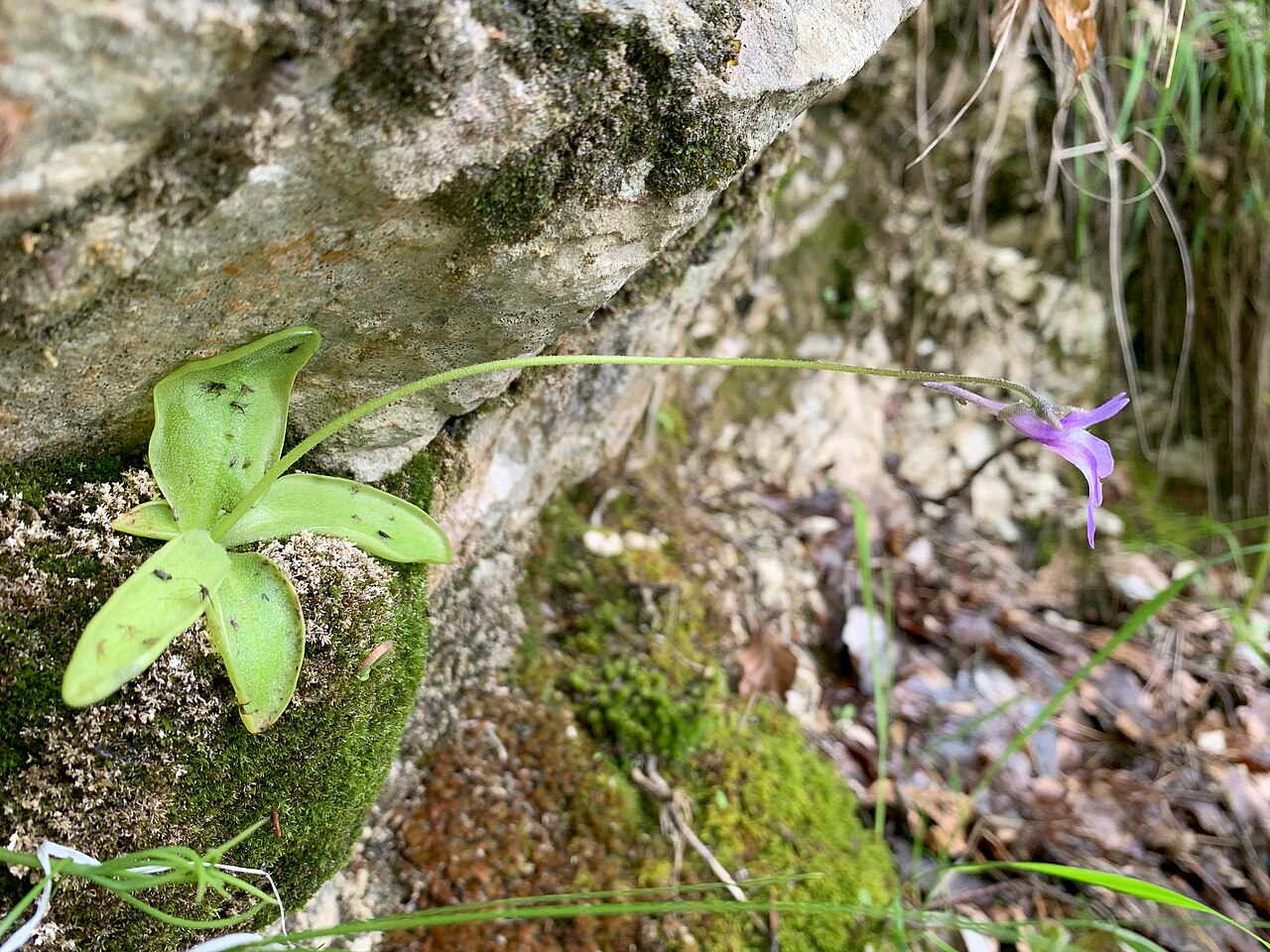
A flat rosette of entire, oblong-ovate leaves, yellow-green, greasy to the touch and with margins curled upward; on a vertical wall they hang obliquely. Glabrous scapes rise from the centre, each with one two-lipped flower, with a two-lobed upper lip, a three-lobed lower lip with throat markings and a spur behind. Reliable measurements for plant, corolla and spur could not be traced to a checkable source for this guide and are therefore not given. Erect capsules ripen after flowering; the plant overwinters as a winter bud.
Similar species
Central Italy holds several closely related butterworts side by side, and identification rests on flower and seed characters rather than first impressions. The same Apennines hold, among others, Pinguicula fiorii from the Majella massif and several locally described subspecies of P. vulgaris from the mountains of Lazio and Abruzzo. Each sits on its own limestone massif, separated by broad dry valleys. For the field-guide reader the most usable rule is therefore: record precisely which massif you are standing on, and only then compare.
The trap and how it works
A flypaper trap on soaked limestone. The leaf bears stalked glands with a sticky, glistening droplet and, between them, sessile glands that deliver digestive enzymes only once prey is lying on them. The catch consists of mosquitoes, midges, gnats and springtails living in the humid air along the waterfalls and wet walls. After a catch the leaf margin rolls slowly over the prey so the digestive fluid stands in a shallow dish. On a steep, constantly flushed face that is essential, because the rock supplies no nutrients at all.
Habitat and ecology
Wet limestone rock in a mountain amphitheatre: dripping faces, the spray zone of waterfalls, seepage between boulders and the wet margins of spring-fed streams. The plant roots in crevices and in moss cushions directly on the rock, generally on north-facing shaded sections the summer sun never reaches. The Apennines are strongly karstic, so precipitation vanishes underground and returns to the surface only at the emergence points; at those points, and nowhere else, this plant grows.
Distribution and elevation
The Camosciara area and its surroundings in Abruzzo, central Italy, within the national park of Abruzzo, Lazio and Molise. The range is small and confined to a few wet faces in that massif. Our own species list gives only 'Italy' for this taxon; for a plant with so narrowly bounded a distribution that is uselessly coarse. That virtually the whole range falls inside a national park is a considerable advantage for its protection.
- Recorded (one-degree cells)
Forms and variation
No wild varieties are recognised. The variation noticeable in the field concerns plant size and flowering and follows the wetness and shelter of the site. The taxonomy of the central Italian butterworts has moved considerably in recent years: molecular work on the Italian species has rearranged the relationships and shows that the Apennine species are not all each other's closest relatives, however similar they look and however much they share a mountain range.
Where and when to see it
May and June, when the mountain streams are high and the walls still dripping everywhere. Look for the dark wet bands on the pale limestone and the spray zone beside the waterfalls; the rosettes often sit above eye level in a crevice or on a moss cushion. Keep to the waymarked routes — this is the core zone of a national park with bears and strict access rules — and use binoculars. Photograph flower, leaf and fruit and record the site; for these recently described Apennine species that is the most useful contribution.
Conservation status
The species has not been assessed for the global Red List; there is no international category and CITES does not apply. What is known: an endemic of one massif, with a small number of sites all dependent on a steady water supply. Lying inside a national park is a major advantage, since building, reclamation and abstraction are restrained there. The remaining risks are climatic — drier summers and shorter snow seasons reduce spring discharge — and human, in the form of trampling and the removal of plants by collectors.
Scientific name
Pinguicula vallis-regiae | Conti & Peruzzi, 2006
Described by Fabio Conti and Lorenzo Peruzzi in 2006, in Annales Botanici Fennici 43(5): 329. The species occurs in the upper Sangro valley, in Abruzzo, Italy (including near Civitella Alfedena). The name "vallis-regiae" means "of the royal valley" and refers to "Vallis Regia", the medieval name for the upper Sangro valley.
World Checklist of Vascular Plants (WCVP), via Plants of the World Online (POWO), Royal Botanic Gardens, Kew.