All species › Lamiales › Bladderwort family › Pinguicula pilosa
Pinguicula pilosa
A pale violet-flowered butterwort from a small remote mountain range in southern Tamaulipas — country that has only recently come into botanical view and has yielded several new species in a short time. Pinguicula pilosa was described in 2004 and owes its name to its hairiness; it is a species with a pronounced winter flowering, at its best in the coolest months of the year.
Identification
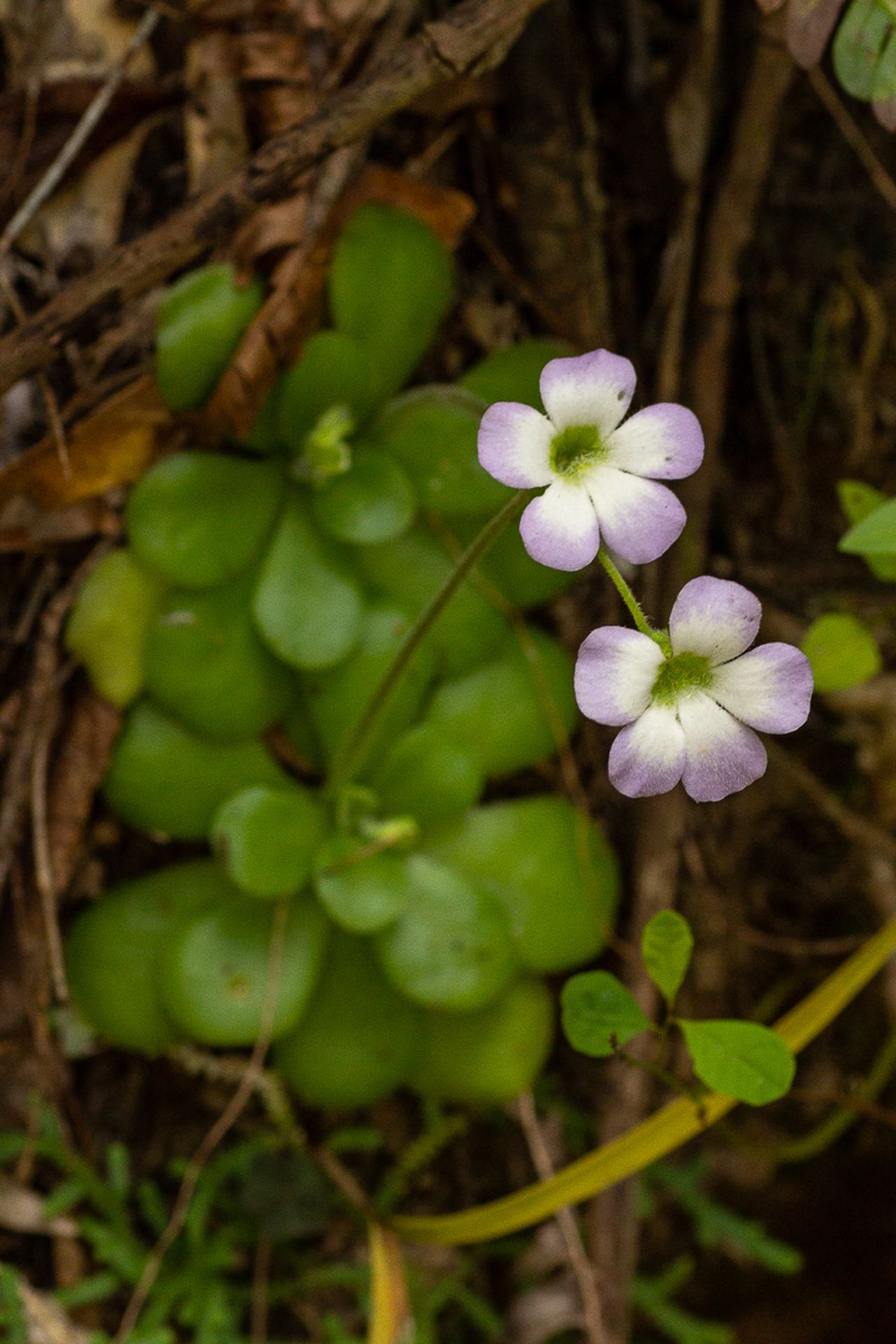
The winter rosette counts 12 to 18 thick, oblanceolate leaves 10 to 20 mm long and 6 to 12 mm wide. The summer rosette consists of 8 to 12 broader leaves 25 to 40 mm long and 20 to 30 mm wide, with a rounded tip and a slightly involute margin, covered with the characteristic glandular droplets. There are one to three erect, pale purple-tinged scapes (35)70 to 90 mm tall. The flower measures (16)22 to 25 mm including the spur and is pale violet with a white centre and a greenish yellow throat. The spur is curved and set at roughly a right angle to the corolla tube — exactly the character that separates the species from its nearest counterpart. Flowering runs from January to March, sometimes into April.
Similar species
The protologue sets the species against Pinguicula agnata, from which it differs in leaf shape, scapes and floral characters. For the field observer, however, Pinguicula ibarrae of Hidalgo is the key comparison: that is larger in all its parts, with summer leaves 35 to 95 mm against 25 to 40 mm here, and it has a straight spur set at a shallow angle of 130 to 160 degrees to the tube, whereas the spur of P. pilosa is curved and nearly perpendicular. The two also occur in different states. A side view of the flower settles the case.
The trap and how it works
The broad summer leaves carry the usual two-part glandular coating: stalked glands with a clear sticky droplet and sessile glands that release digestive enzymes only once prey is lying on the leaf. The slightly involute leaf margin is functional here — it holds the digestive fluid in a shallow dish instead of letting it run off the edge. In the humid mountain forest of southern Tamaulipas the catch consists of small two-winged flies, psyllids and winged ants. That the plant flowers and is active precisely in the cooler months means it exploits an insect supply many other plants do not then use.
Habitat and ecology
A small, remote mountain range in southern Tamaulipas. The species grows there in humid montane forest, on shaded wet rock faces and banks where water seeps down the rock (R1), under a canopy that keeps humidity high (B1). For a more precise habitat statement — rock type, elevation above sea level — we could find no testable source; the elevation field on the fact card has therefore been left empty. The highlands of southern Tamaulipas are a northern outlier of the cloud-forest zone, with humid north-facing and dry south-facing slopes close together.
Distribution and elevation
Endemic to the Mexican state of Tamaulipas, in a small and remote massif in the south of the state — in agreement with the entry in our species list. The protologue stresses the isolation of that range, which probably explains how a conspicuous species could remain undescribed until 2004. The known range is small. Southern Tamaulipas has meanwhile been recognised as butterwort country — P. laxifolia occurs here too — so further work in the surrounding mountains may yield both new sites and new species.
- Recorded (one-degree cells)
Forms and variation
No wild varieties have been described. The species is known from a limited area and there is no comparative material from differing environments on which a division into forms could rest. The recorded variation concerns scape length, which is notably wide — thirty-five to ninety millimetres — and flower size from sixteen to twenty-five millimetres; both probably track light and site quality. Clones circulate in the plant trade under this name with added designations; they are not wild forms and have no place in this guide. No natural hybrids are reported.
Where and when to see it
January to March is the window: the species flowers then, and it is also the pleasantest time to walk in southern Tamaulipas. Search shaded wet faces and banks in humid mountain forest, along streams and cuttings. The pale violet flowers with their white centre stand on seven- to nine-centimetre scapes and show well against dark rock; the rosettes are green and merge into the moss. When photographing, mind the spur: always take a side view, because its curvature and its angle to the tube are the identification character here.
Conservation status
The species has not been assessed for the global IUCN Red List and is not listed in CITES. What is known: a species described in 2004 with a small range in one remote mountain chain. Remoteness is its chief protection — the area is hard to reach and has been comparatively spared logging and conversion. Against that, a small range without reserve status has no buffer: one road, one large-scale felling or one targeted collecting trip can hit a substantial part of the population. Mexican butterworts that become known in the growers' world almost always attract collecting pressure as well. Without an assessment there is no category, and without population data the trend cannot be estimated.
Scientific name
Pinguicula pilosa | Luhrs, Studnicka & Gluch, 2004
Described by Holger Lührs, Jiří Studnička and Oliver Gluch in 2004, in Carnivorous Plant Newsletter 33: 43. The species occurs in Mexico; the precise type locality could not be established with certainty. The name "pilosa" is Latin for "hairy" and refers to this species' hairy plant parts.
World Checklist of Vascular Plants (WCVP), via Plants of the World Online (POWO), Royal Botanic Gardens, Kew.