All species › Lamiales › Bladderwort family › Pinguicula ombrophila
Pinguicula ombrophila
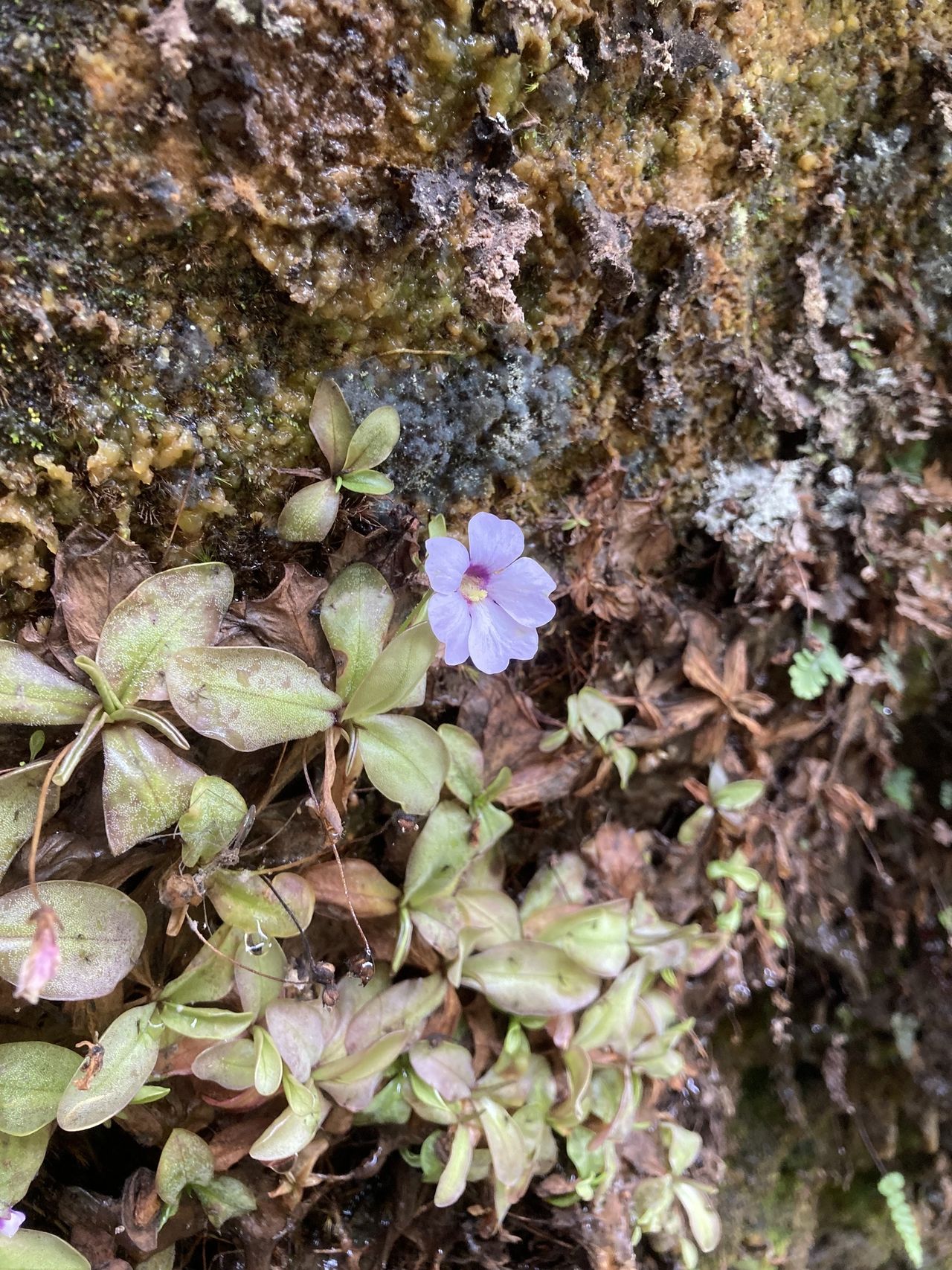
The name means 'rain-loving', and it is no exaggeration: Pinguicula ombrophila grows on a near-vertical rock face in the saturated páramo of southern Ecuador, at two thousand nine hundred metres, where mist and rain alternate almost daily. The species was described in 2023 and is known from one site holding about fifteen mature plants — one of the smallest known world populations in this book.
Identification
A butterwort rosette of the ordinary kind, pressed flat against wet stone: entire, sticky leaves with an upper surface full of glandular droplets, and slender scapes from the centre each carrying one two-lipped, spurred flower. Together with P. jimburensis the species was split from the broad concept of Pinguicula calyptrata, on floral characters set out in the original description. This guide therefore enters no measurements: the dependable figures sit in that one 2023 paper, and for a species known from fifteen plants an estimated number is worse than none.
Similar species
Pinguicula calyptrata occurs in the same altitudinal band of the Ecuadorian Andes and is the species this one was confused with until recently; the distinction lies in the structure of the flower. P. jimburensis, the second new species from the same study, grows five hundred metres higher beside a highland lagoon rather than on a rock face, which in the field is distinction enough. Further south, in Peru and Bolivia, occurs P. involuta, with a strongly inrolled leaf margin and a curved spur. In practice, for all of these, the locality is the most usable character.
The trap and how it works
A flypaper trap tuned to a vertical wall under constant rain. The stalked glands carry a tenacious droplet that neither washes off nor dries in the humid air; the sessile glands beneath act only when prey is lying there. That the margin rolls over a catch is decisive on a steep face: without that hollow the digestive fluid would run straight off. The supply consists of small flies and springtails hanging in the lee of the wall. The rock gives the plant nothing else — no soil, no humus, only water running over it — so virtually all nutrition has to come from what is caught.
Habitat and ecology
A near-vertical rock face in saturated páramo at about two thousand nine hundred metres (R1), surrounded by open, wet ground above the treeline (R5). It rains much and often, and when it does not, fog hangs. The plant draws its moisture from the waterlogged páramo soil above the face and from the rain itself; the epithet refers directly to that. On such a wall there is no competition from taller plants, but no buffer either: should the face dry out for a few weeks, nothing carries the plants through.
Distribution and elevation
Known from one site in southern Ecuador, in the Amotape-Huancabamba zone of the Andes, and therefore endemic to Ecuador. About fifteen mature plants have been counted. The site lies inside a protected area. The Amotape-Huancabamba zone is the low break in the Andean chain between Ecuador and Peru, known for an unusually high number of species with tiny ranges; this one stands at the extreme end of that. Whether comparable faces on the Peruvian side hold plants has not been investigated.
- Recorded (one-degree cells)
Forms and variation
No wild varieties are recognised; with fifteen known mature plants there is no material for that either. What matters historically is that until 2023 these plants were filed under P. calyptrata, and that the describing authors note further differences in the remaining Ecuadorian material that do not fit inside one species. There is a real chance that more species will yet be distinguished in this corner of the Andes. No natural hybrids have been described.
Where and when to see it
Do not go looking for this species. Fifteen mature plants on one wall cannot bear visitor pressure, and collecting here could end the species. Anyone walking the southern Ecuadorian páramo can still take away the right search image for butterworts in general: wet, steep rock faces with water running over them permanently, moss and liverwort in the crevices and open, unvegetated patches between. Photographing and reporting the locality to a herbarium is the only responsible response to a find here.
Conservation status
The species has not been assessed for the global IUCN Red List and is not in CITES, so there is no international category. What is known is nevertheless very precise: one known site, about fifteen mature plants, and a habitat entirely dependent on persistent rain and fog. The describing authors point out that the species lies inside a protected area but that protection does nothing against a fog belt rising with warming. At these numbers any chance event — a rockfall, a dry spell, a collector — is a real threat to the whole species. The absence of a formal category here follows from the recent description, not from uncertainty about the risk.
Scientific name
Pinguicula ombrophila | Pérez, Tobar & Henning, 2023
Described by Álvaro J. Pérez, Tobar and Tilo Henning in 2023, in PhytoKeys 222: 153–171, in the same article as Pinguicula jimburensis. The species occurs in southern Ecuador; the precise type locality could not be established with certainty (accessible sources only gave the general region). The name likely derives from the Greek ombros (rain) and philos (loving), "rain-loving" — fitting the wet, rain-rich habitat in which the species grows, although this explanation was not explicitly confirmed in an accessible source.
World Checklist of Vascular Plants (WCVP), via Plants of the World Online (POWO), Royal Botanic Gardens, Kew.