All species › Lamiales › Bladderwort family › Pinguicula oblongiloba
Pinguicula oblongiloba
A large-leaved butterwort of the western Mexican highlands, which spends the dry season as a bud underground and reappears only with the rains. Pinguicula oblongiloba carries one of the older names in the genus — De Candolle described it in 1844 — and owes that name to the oblong lobes of its corolla.
Identification
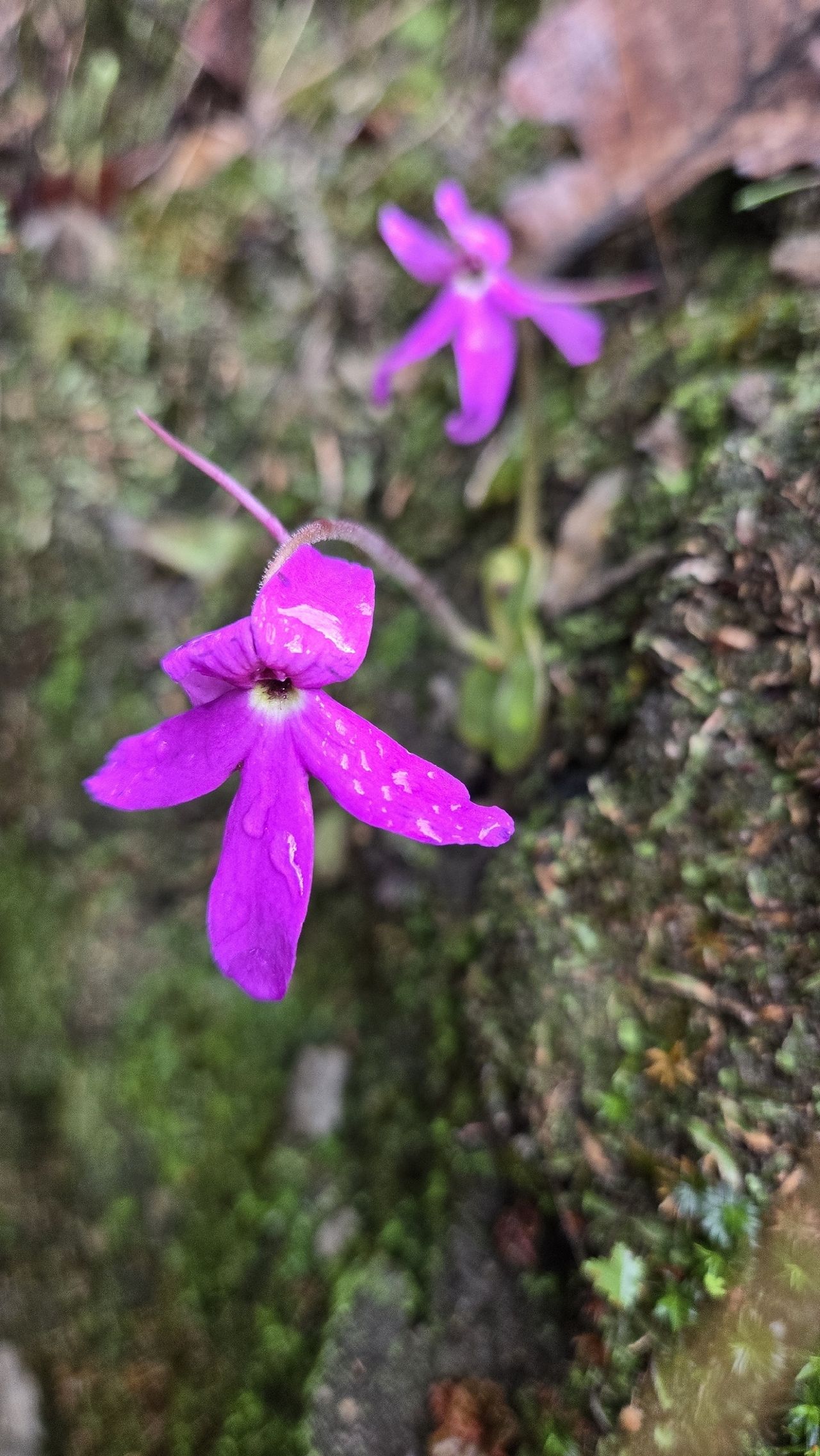
In the dry season nothing shows above ground: the plant sits as a substrate-covered winter rosette or bud just below the surface. In the rains a rosette of large, elliptic to almost round leaves unfolds, with a clearly set-off petiole, spread flat and sticky. The flower is violet-purple and deeply two-lipped, with oblong lobes and a very short, broadly funnel-shaped corolla tube; the spur is longer than tube and lips together. The literature gives flowers for the species of roughly two and a half to ten centimetres including the spur, a wide spread probably reflecting the broad concept of the species in older sources. The winter rosette lies so low and is so thoroughly covered with grit and litter that in the field it is often entirely hidden; the plant marks its presence again only when the first summer leaves push through the litter. That makes the species practically unfindable in the dry half of the year.
Similar species
The closest relative is Pinguicula macrophylla, likewise with large leaves on a set-off petiole and a long spur; that species occurs further east, in the central highlands. P. moranensis is commoner and has a different leaf shape. Because the group was broadly conceived in older literature and the names were used interchangeably, identification from photographs is unreliable; certainty needs locality and flower measurements together. Recently described western species have moreover split material out of this group.
The trap and how it works
A flypaper trap that exists for only part of the year. The large flat summer leaves carry stalked glands with a sticky droplet and sessile glands releasing digestive enzymes as soon as prey lies on them; the margin rolls slowly inward so the fluid stays in a shallow bowl. Because the leaf is broad and the plant lies low in woodland vegetation, the catch consists mainly of small flies, ants and other crawling matter from the litter layer. Outside the rainy season, as an underground bud, the plant catches nothing. In this species the catching season coincides entirely with flowering and seed set, which means the return from a few months' catching goes straight into the underground bud and into the seed. Anyone examining a leaf in October sees that account: the surface is then covered with dark remains.
Habitat and ecology
Rocky mountain slopes and open spots in pine and oak woodland of the western highlands, on calcareous to neutral soil with a thin humus layer (B5, R2). Records from Michoacán place the species around twenty-five hundred metres, far above the valleys; the climate is cool, with winter frost and a marked summer rainy season. The plant grows not on cliff rock but in moss, grit and humus among boulders and at the foot of trees. The underground bud makes it resistant to forest fires and to months without rain.
Distribution and elevation
Endemic to Mexico, with sites in the western and central highlands: Michoacán, with records from Jalisco, Aguascalientes and adjoining states. Our species list says only 'Mexico', which is defensible given the unclear species limits; the published populations lie in the west of the country. These are isolated mountain populations in different massifs, separated by hot valleys where the species is absent.
- Recorded (quarter-degree cells)
Forms and variation
No wild varieties are distinguished. The most conspicuous variation is flower size, which is given a very wide range in the literature; that probably follows from the name having been applied in older sources to plants from various populations and related species. Within one population variation is limited to leaf size and the saturation of the flower colour, both related to exposure and the amount of summer rain. Recent work in western Mexico has described parts of this complex as separate species, which will sharpen the limits further.
Where and when to see it
Go in the rainy season, July to September, because that is when the plant exists at all: in the dry months it sits underground and there is nothing to look for. Walk slopes in pine and oak woodland looking for the large glossy leaves among moss and litter; they are more conspicuous than the flower. Search in the lee of boulders and where the soil stays damp through the rains. Do not dig for the bud, and leave the litter in place: the plant sits just below the surface.
Conservation status
Not assessed for the global IUCN Red List and not listed in CITES. Remarkably little is known of this species for a taxon named as long ago as 1844: there has been hardly any recent targeted fieldwork, the species limits are in flux, and population data are lacking. The setting speaks for itself: pine and oak woodland in western Mexico is under pressure from logging, grazing and fire. Until it is settled which populations belong to this species, no meaningful assessment can be made — that is the first step here.
Scientific name
Pinguicula oblongiloba | de Candolle, 1844
Described by Alphonse de Candolle in 1844, in Prodromus 8: 27. The species occurs in Mexico; the precise type locality could not be established with certainty. The name derives from the Latin oblongus (oblong) and lobus (lobe), likely referring to the shape of the corolla lobes.
World Checklist of Vascular Plants (WCVP), via Plants of the World Online (POWO), Royal Botanic Gardens, Kew.