All species › Lamiales › Bladderwort family › Pinguicula michoacana
Pinguicula michoacana
A large-flowered butterwort with a spur of two to three centimetres, growing at a single place in Michoacán: on calcium carbonate deposits formed on basalt rocks where water seeps out, in the middle of tropical deciduous forest. Pinguicula michoacana was described in 2018 and is a textbook micro-endemic — a species whose entire known range lies within one municipality.
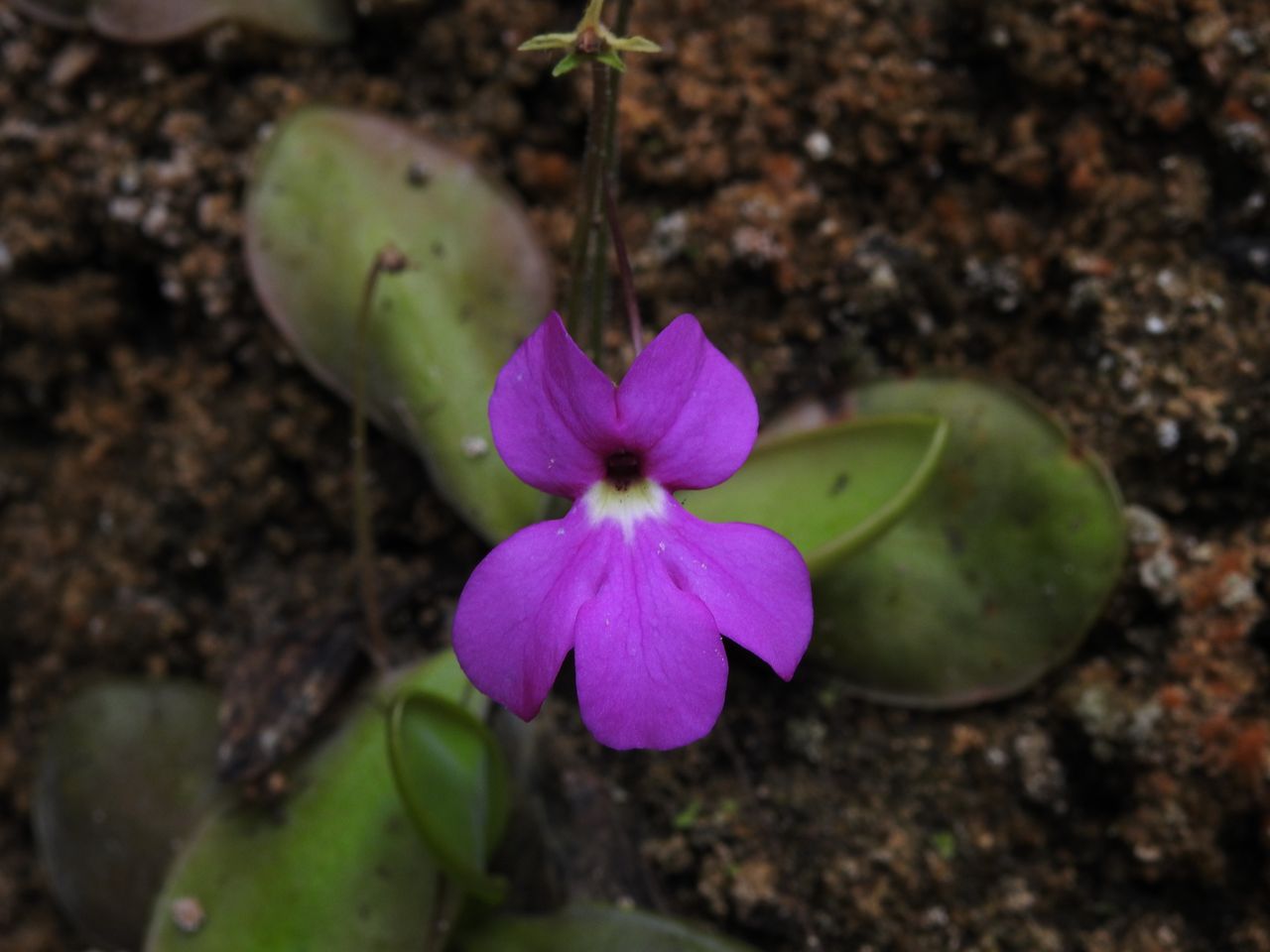
Identification
The winter rosette is hypogeal and compact, 4 to 25(30) mm long and (5)10 to 15 mm wide, built from 20 to 40 thick leaves; the outer ones are 15 to 25(30) mm long and 3 to 5(7) mm wide, with a long-acuminate tip and a glabrous margin. During the rains it produces a summer rosette of only 2 to 8 thin, petiolate leaves, obovate-elliptic to suborbicular, (15)20 to 60 mm long and 10 to 50 mm wide. There are 1 to 4(6) scapes (40)50 to 120(150) mm tall. The flower is pink to purple and deeply two-lipped, with an upper lip 8 to 15 mm and a lower lip 8 to 20(25) mm, and measures 35 to 45(50) mm including the spur; that spur is cylindric-subulate, purple and (15)20 to 30 mm long. Flowering runs from late March to September.
Similar species
The protologue compares the species with Pinguicula oblongiloba. Three characters separate them. First the number of winter leaves: 20 to 40 in P. michoacana against 60 to 86 in P. oblongiloba. Second the margin of those leaves: glabrous with a long-acuminate tip in our species, ciliate in the other. And third, P. michoacana lacks the layer of old dried summer leaves that clothes the winter rosette of P. oblongiloba. From other large-flowered species of section Orcheosanthus it is chiefly distinguished by its habitat and its isolated position.
The trap and how it works
The few broad summer leaves do all the work. They carry stalked glands with a viscous clear droplet and, among them, sessile glands that release digestive enzymes only once prey makes contact; the leaf margin then bends over the catch. Having only two to eight trapping leaves makes each leaf matter: in tropical deciduous forest the insect supply is strongly concentrated in the rains, and the plant has packed its entire above-ground life into that window. Outside the rains there is no leaf, no gland and no catch — only the underground winter bud.
Habitat and ecology
Calcium carbonate concretions on basaltic igneous rock with seeping water, in tropical deciduous forest at about 1800 m. That is an unusual combination: a damp, lime-rich microsite in the middle of a landscape that dries out completely for most of the year (D4). The plant sits exactly where water emerges from the basalt and deposits lime as it evaporates, building a porous, permanently damp crust (R1). Such spots are rare and small — sometimes no more than a few square metres — which explains why the species is a micro-endemic.
Distribution and elevation
Endemic to the municipality of Jiquilpan in the Mexican state of Michoacán, in agreement with our species list. It concerns one known area at about 1800 m; the protologue explicitly calls the species a micro-endemic. That is no exception in western Mexico: the relief of the Trans-Mexican Volcanic Belt produces countless small, hydrologically peculiar spots, each able to hold its own species. Outside Jiquilpan the species has not been found, and given its specific substrate requirements a wide distribution is unlikely.
- Recorded (one-degree cells)
Forms and variation
No wild varieties are recognised. In a species known from one area and one altitude there is simply no basis for them. Variation within the population, however, is considerable: summer leaves range from fifteen to sixty millimetres, scapes from four to fifteen centimetres and the spur from fifteen to thirty millimetres — a spread that shows how strongly growing conditions differ from spot to spot, even within a single lime deposit. That internal variation is one more reason not to identify Mexican butterworts on a single measurement. No natural hybrids are reported.
Where and when to see it
Go during the rains, from June to August: outside that window nothing of the plant is visible above ground. Search the dry deciduous woodland around Jiquilpan for the damp places on rock where water emerges and a pale, porous lime crust has formed — precisely the contrasting spots in an otherwise parched landscape. The large pink to purple flowers on their long scapes show from ten metres away and are the best guide. Do not touch the lime crust or climb over it: it is brittle and the rosettes root shallowly in it.
Conservation status
The species has not been assessed for the global IUCN Red List and is not listed in CITES. What is known is the profile of an extremely vulnerable species: a micro-endemic, described in 2018, tied to a rare and small-scale habitat type within a single municipality. Lime deposits at seepage points are sensitive to any change in the water regime — a capped spring, a well, an altered drainage — and the surrounding dry deciduous forest of western Michoacán has been much reduced by farming and cattle. Add to that the near certainty that a large-flowered, newly described Mexican butterwort attracts the attention of collectors. A formal assessment is missing, but the profile points to very little room to spare.
Scientific name
Pinguicula michoacana | Zamudio & Juarez, 2018
Described by Sergio Zamudio and H.D. Juárez in 2018. The species occurs in the Mexican state of Michoacán, within the Trans-Mexican Volcanic Belt. The name refers to the Mexican state of Michoacán, where the species occurs.
World Checklist of Vascular Plants (WCVP), via Plants of the World Online (POWO), Royal Botanic Gardens, Kew.