All species › Lamiales › Bladderwort family › Pinguicula lilacina
Pinguicula lilacina
An annual carnivore — an exception within this genus. Pinguicula lilacina germinates with the rains, grows into a modest rosette, flowers, sets seed and disappears again; the dry season is bridged not by the plant but by the seed. It is moreover one of the few Mexican butterworts that continues far into Central America, and so is not endemic.
Identification
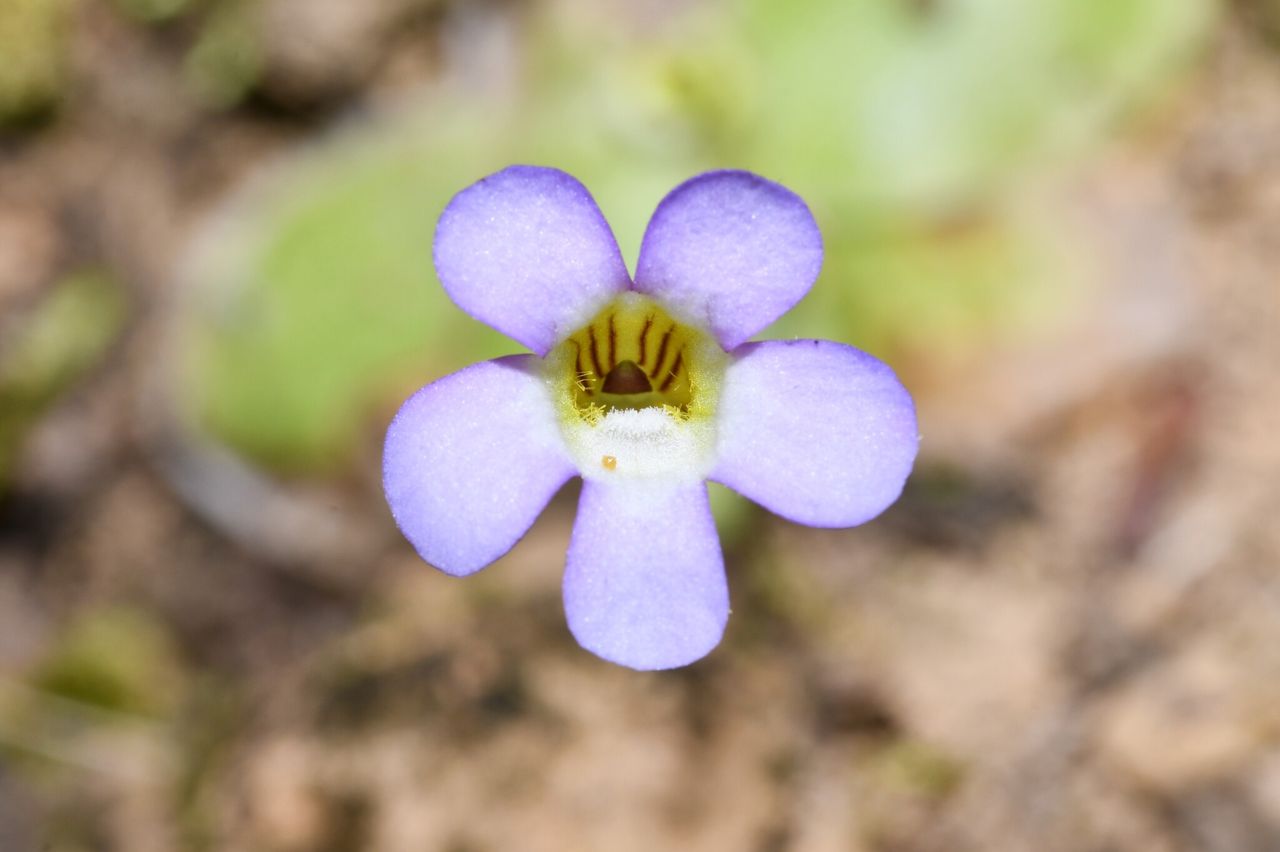
A flat rosette of five to fifteen rounded-ovate to obovate leaves with a cuneate base, 15 to 45 mm long and 9 to 23 mm wide, light green and sticky. The plant forms no winter rosette and no bud: there is only one leaf type. One to nine very slender, filiform scapes 3.5 to 17 cm tall rise from the centre. The flowers are small, 8 to 17 mm including the spur, lilac to whitish lilac, pale blue or almost white, with a yellow mark in the throat; the corolla lobes are 4 to 5 mm long. The spur is short and blunt, roughly 1.5 to 4 mm. A flowering plant with several thin scapes at once is characteristic in the field. The capsules are small and ripen fast; the dust-fine seed is released within weeks of flowering and forms the seed bank from which the next generation comes. A population therefore consists, for most of the year, entirely of seed in the soil.
Similar species
The annual habit and the absence of a winter rosette separate the species from virtually all its Mexican relatives. The most confusing species is Pinguicula takakii, also small and annual, but growing on gypsum soil while P. lilacina grows on rocky, usually non-gypsum ground. P. sharpii from Chiapas is annual too, but has a far smaller, mostly white flower with a spur of at most two and a half millimetres. With larger perennial butterworts that form a winter bud there is no need to hesitate.
The trap and how it works
A flypaper trap that has to last only one season. The leaf surface carries stalked glands with a sticky droplet and sessile glands releasing enzymes as soon as prey makes contact; the margin rolls in slightly to hold the fluid. Because the plant completes its whole life cycle within a few months, the nutritional gain from insects is especially direct here: what is caught goes almost immediately into flowering and seed set rather than into a reserve for next year. Prey is small: midges, small flies and springtails.
Habitat and ecology
Rocky places, banks and woodland edges in oak woodland, pine-oak woodland and montane cloud forest, in a subhumid to humid climate (B5, R2). The species also occurs on seasonally dry, shallow ground where the vegetation dies back completely in the dry season (D4). It avoids heavy closed soils and grows by preference where the soil layer is thin and competition therefore stays low: on gravel, among boulders, on road cuttings and at the foot of rock faces. Its elevation range is broad, from about seven hundred to twenty-four hundred metres.
Distribution and elevation
The widest distribution of any species in this group. P. lilacina occurs across much of Mexico — including Oaxaca, Guerrero, Veracruz, Querétaro, San Luis Potosí, Nuevo León, Tamaulipas, Sinaloa and Chihuahua — and continues into Guatemala, with records reported as far as Honduras. Our species list names Oaxaca and Chiapas; that is too narrow, since the published distribution reaches much further north and beyond Mexico. The species is therefore not endemic.
- Recorded (quarter-degree cells)
Forms and variation
Flower colour varies greatly within and between populations, from clear lilac through pale blue to nearly white, and the number of scapes per plant differs widely too. No wild varieties are distinguished; the variation relates mainly to site and growing season, since a plant that catches well in a wet year produces more and larger flowers. Being annual and lacking vegetative propagation, the species never forms the clonal cushions so conspicuous in its relatives: every plant stands on its own. For a species with so large a range it is striking how little geographical structure that variation has: plants from Chihuahua and from Guatemala differ no more from one another than plants within a single population. That fits an annual with dust-fine, widely dispersed seed.
Where and when to see it
Flowering falls outside the summer rains, roughly October to April, which makes the species a welcome exception for anyone travelling in the dry season. Search road cuttings, the foot of rocks and open spots in oak woodland, and look for the thin scapes with pale lilac flowers — they catch the eye sooner than the rosette. Get low; the rosette is small and lost entirely among moss and litter. A place where the species stood last year may be empty this year: the seed bank decides where the plants come up.
Conservation status
Not assessed for the global IUCN Red List, and not listed in CITES. What is known gives little cause for concern at species level: the distribution is very wide, from northern Mexico into Central America, and the species prefers disturbed, shallow places such as road cuttings, where it benefits from human works rather than suffering from them. Locally it can disappear when a bank is stabilised or a woodland edge closes over. The annual habit makes counting awkward: an empty year says little as long as the seed bank is intact.
Scientific name
Pinguicula lilacina | Chamisso & Schlechtendal, 1830
Described by Diederich Franz Leonhard von Schlechtendal and Adelbert von Chamisso in 1830, in Linnaea 5: 94. The species occurs in the states of Nayarit and Veracruz, in the Trans-Mexican Volcanic Belt, in pine-oak forest and cloud forest. The name "lilacina" (lilac-coloured) refers to the flower colour, which is lilac or white.
World Checklist of Vascular Plants (WCVP), via Plants of the World Online (POWO), Royal Botanic Gardens, Kew.