All species › Lamiales › Bladderwort family › Pinguicula jaraguana
Pinguicula jaraguana
Pinguicula jaraguana carries the name of the Jaragua, a stream in the Sierra de Moa in the far east of Cuba, and beyond that catchment and its neighbours the species does not go. It is a white-flowered butterwort of the serpentine scrub — the low, hard shrubland Cuba calls charrascal — where it stays permanently wet along the streams and where the soil holds so much nickel and magnesium that most plants cannot tolerate it.
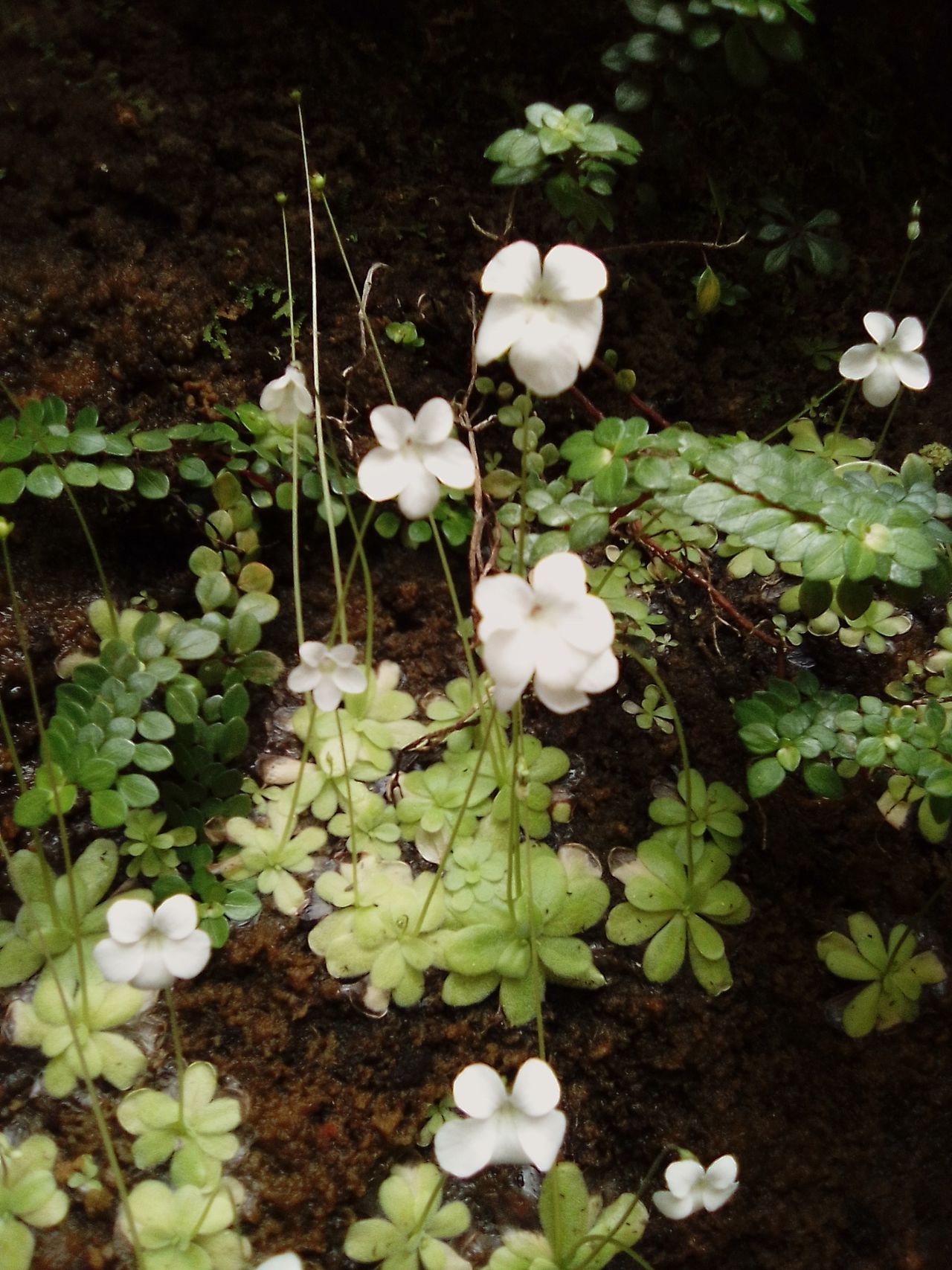
Identification
A flat rosette of entire, fleshy leaves whose margins are rolled upward, with a dense glandular coat that makes the blade look wet. Slender scapes rise from the centre, each with a single white flower that measures ten to thirteen millimetres including the spur. The seeds are strikingly small for the genus, six to seven tenths of a millimetre with the appendage. This combination — a white flower of modest size, an inrolled leaf margin, a rosette larger than that of the recently described neighbouring species — is what distinguishes the plant in the literature.
Similar species
The awkward relative is Pinguicula panfetiae, described in 2025 from the same hill country: it has smaller rosettes with erect, obovate leaves whose margins are not inrolled, and smaller flowers of at most ten to thirteen millimetres. P. albida of western Cuba is also white-flowered but grows hundreds of kilometres away in lowland savanna. P. moaensis, in turn, shares the serpentine streams. In short: in this company situation and flower size are the usable clues, and photographs of flower and leaf margin are indispensable.
The trap and how it works
The trapping principle is that of the genus: stalked glands supply a sticky droplet, sessile glands the digestive enzymes, and the leaf skin reabsorbs what has been digested. In this species the naturally inrolled margin gives extra help in holding the digestive fluid; what in many butterworts is a temporary movement is here already part of the leaf's shape. Along a stream in the scrub the prey supply is generous: midges and gnats swarm over running water, and the rosettes lie exactly at the level where those insects settle.
Habitat and ecology
The labels are brief but clear: charrascos a orillas de arroyos sobre serpentina — serpentine scrub along stream banks. These are permanently damp strips beside mountain streams in a landscape of low, hard shrubland on ultramafic rock. Such soils are heavy in metals and poor in nitrogen, phosphorus and calcium; the vegetation stays low and open, and the company consists of species found nowhere else. For a carnivorous plant this is ideal ground: water in abundance, minerals only from the air. The charrascal itself is low enough to let sunlight reach the stream banks, and that matters to a butterwort: too much shade and the plant goes, too much sun and the glandular coat dries out. The narrow strip between those extremes is exactly where the rosettes lie.
Distribution and elevation
Endemic to Cuba and confined to the Moa massif in Holguín and Guantánamo provinces: the cuchillas de Moa, the Mina Mercedita area, La Melba and the headwaters of the río Jiguaní, with the Jaragua stream as its namesake. Labelled finds lie around six hundred to six hundred and fifty metres. That is a small range inside one of the botanically richest areas in the Caribbean, and at the same time an area holding the island's largest nickel mines.
- Recorded (one-degree cells)
Forms and variation
No wild subspecies or varieties are recognised. What the recent literature does show is that what was long treated as one white-flowered species in fact covers several closely related ones: the description of P. panfetiae in 2025 brought the number of Cuban butterworts to fifteen and took precisely this species as its main comparison. It is therefore quite possible that some of the variation fieldworkers see within P. jaraguana rests on relatives not yet described.
Where and when to see it
Search along streams in the low serpentine scrub, on the permanently wet bank strip and on seeping places where water runs over bare rock. The best period runs from late spring into early summer, when most eastern Cuban butterworts flower. Get low and look into the light; the rosette is small and the scrub is full of leaves that look much the same from above. Almost the whole area lies in protected land or on mining ground — go with a guide and with permission. Take time to record the flower properly: in this group of species the length of the flower including spur is decisive, and that can only be measured reliably from a sharp side-on photograph with a scale beside it.
Conservation status
The species has not been assessed for the global IUCN Red List and is not listed in CITES. What is known: an eastern Cuban endemic of a handful of serpentine stream valleys, in the same altitudinal belt as the nickel workings. Any intervention in the water regime of such a stream — excavation, road building, sediment load — hits the population directly, and the species of this soil type have nowhere else to go. Recent descriptions from the same area were published with preliminary assessments in the highest threat categories; that this species still has no category is therefore largely a matter of time and manpower.
Scientific name
Pinguicula jaraguana | Casper, 2003
Described by Siegfried Jost Casper in 2003, in the article "Two new Pinguicula species (Lentibulariaceae) from East Cuba", Haussknechtia 9: 141–155. The plant had already been collected in 1976 by Helga Dietrich, but was then mistakenly identified as Pinguicula albida; H. Lippold had also informally noted the plant in the late 1960s. The type locality lies in the valley of the Jaragua and Jiguani rivulets, in the Cuchillas de Moa mountain range in Holguín Province, eastern Cuba. The species epithet refers directly to the type locality: the valley of the Jaragua rivulet.
World Checklist of Vascular Plants (WCVP), via Plants of the World Online (POWO), Royal Botanic Gardens, Kew.