All species › Lamiales › Bladderwort family › Pinguicula gracilis
Pinguicula gracilis
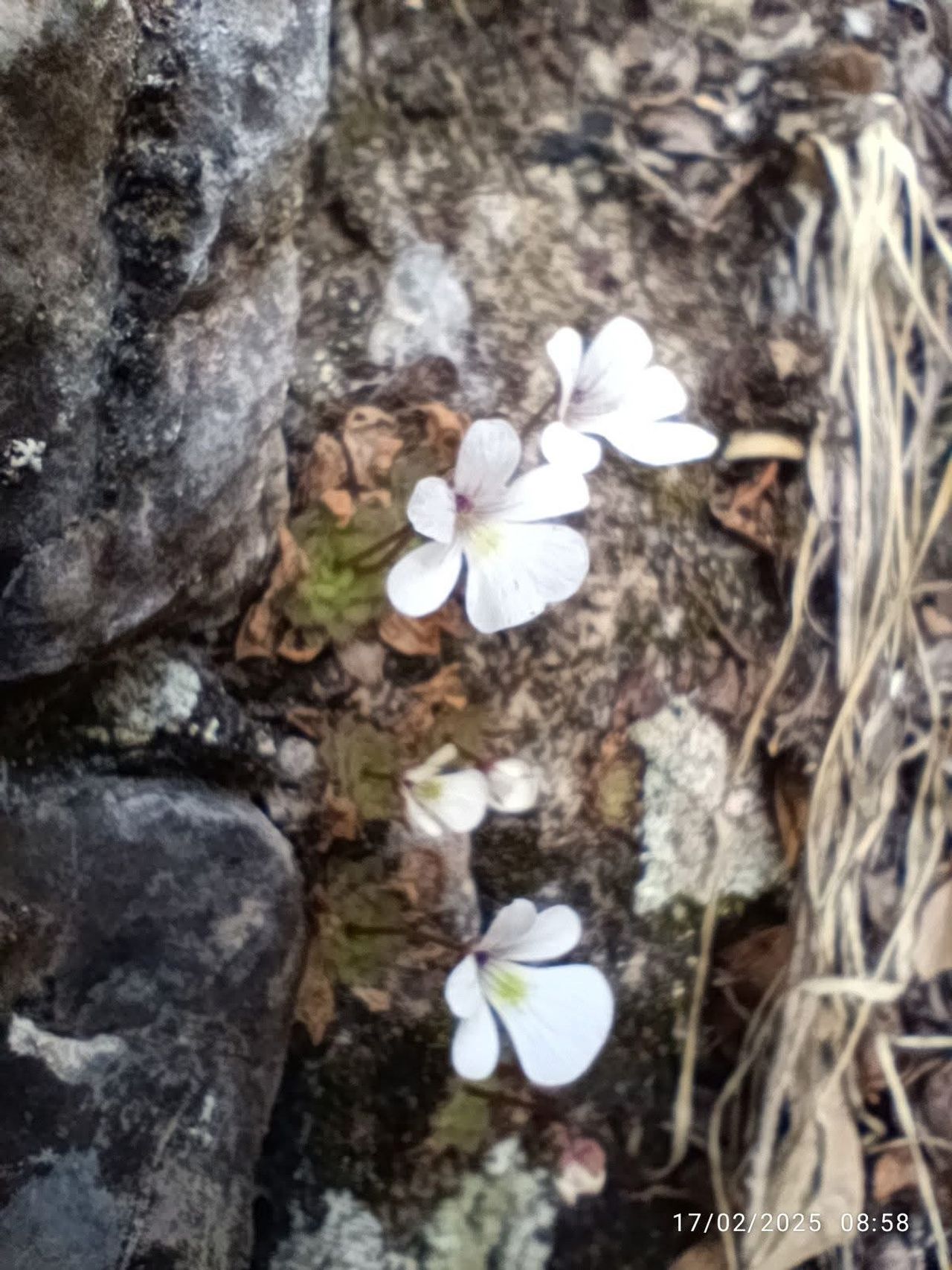
A small slender butterwort of the limestone rocks above Monterrey, with a white flower in which purple markings point the way to the throat. Pinguicula gracilis was described by Zamudio in 1988, together with a second new species, and is known from Cerro de las Mitras and its surroundings — a mountain bordering a city of millions.
Identification
Two rosette forms. The winter rosette consists of leaflets 3 to 12 mm long and 1.5 to 4 mm wide, fleshy and with few glands; the summer rosette of slightly broader, flatter leaves 8 to 16 mm long and 4 to 10 mm wide with a thin glandular coating. The scapes reach 18 to 57 mm, slender and erect. The flower measures 10 to 19 mm including the spur and is white, with purple streaks or blotches in the throat and at the base of the veins. The spur is cylindrical, 3 to 6.5 mm long and only half to one millimetre thick. The flowers come from the winter rosette and appear in the cool season. The name refers to the slender build of the whole plant: thin scapes, a narrow spur barely a millimetre thick, and a rosette that never has the squat fleshy look of the gypsum-dwelling relatives. After flowering small capsules remain on the scapes.
Similar species
North-eastern Mexico holds more small white-flowered butterworts. Pinguicula immaculata, from the gypsum slopes near Rayones and Galeana, has an unmarked white flower with only a yellow-green throat mark and lacks the purple venation. P. rotundiflora has a pale lilac to pink flower with broad rounded lobes. P. lilacina is annual and has a yellow throat mark. The combination of white corolla, purple markings in the throat and a very slender spur of a few millimetres is the most useful for P. gracilis.
The trap and how it works
A flypaper trap on a small leaf, with a clear seasonal rhythm. The summer leaves carry stalked glands with a sticky droplet and, between them, sessile glands releasing digestive enzymes as soon as prey lies on them; the margin bends slightly inward so the fluid stays. The winter rosette is fleshy and nearly glandless and serves to see the plant through the dry cool months — the very months in which it flowers. The catch is small: springtails, mites, small midges and flies from the moss and fern layer on the rock.
Habitat and ecology
Steep limestone rocks beneath oaks on the northern slope of Cerro de las Mitras, and higher up in moss cushions under stands of cypress; also within oak groves lower on the mountain (R2, B5). Elevation runs from about a thousand to eighteen hundred metres, so the species covers a considerable gradient from warm dry oak woodland at the bottom to cooler, damper forest above. The plants root in moss, grit and crevices rather than true soil, and depend on shade and on moisture lingering in the rock. On a mountain that shifts from warm oak woodland below to cool cypress stands above, the character of the site shifts too: lower down it is about shade and rock moisture, higher up about moss holding the mist. The same species therefore lives under two fairly different moisture regimes.
Distribution and elevation
Endemic to Mexico and known from Nuevo León, municipality of Monterrey, with Cerro de las Mitras as the classic locality. Our species list says only 'Mexico'; the literature places the species in that limited area of the Sierra Madre Oriental. That a carnivorous plant was described only in 1988 on a mountain bordering one of Mexico's largest cities says mostly how inconspicuous such species are — and how much remains to be found in the steep, barely passable north faces.
- Recorded (one-degree cells)
Forms and variation
No wild varieties are distinguished. Variation within the species concerns mainly flower size, running from one to nearly two centimetres, and how far the purple markings in the throat are developed: in some plants a clear striping, in others no more than a hint. Plants at the higher, cooler sites have more generous summer rosettes than those on the warm lower slopes. No natural hybrids have been published.
Where and when to see it
Flowering falls in winter, which in north-eastern Mexico is the pleasantest season for walking. Search the northern slope, on shaded limestone rocks beneath oaks and in moss cushions; higher on the mountain, under the cypresses, the plants are larger. The white flower with its purple markings stands on a slender scape above the rosette and is the only thing visible from half a metre away. Sit down and work small areas; keep off the moss cushions, as they peel from the rock the moment you lean on them.
Conservation status
Not assessed for the global IUCN Red List and not listed in CITES. The known range is small and lies right beside a fast-growing city of millions, which explains the obvious pressures: limestone quarrying at the foot of the mountain, urban expansion, hiking and climbing, and fires in the oak woodland. Against that, the steepest north faces are hard to reach and therefore fairly well protected. There are no published population figures; an assessment would be particularly useful here, given the setting.
Scientific name
Pinguicula gracilis | Zamudio, 1988
Described by Sergio Zamudio in 1988. The type area lies in the mountains near Monterrey, in the Mexican state of Nuevo León, on vertical, north-facing limestone cliffs in oak and cypress forest between 1000 and 1800 metres elevation. The species name gracilis is Latin for "slender, graceful" and refers to the plant's delicate build.
World Checklist of Vascular Plants (WCVP), via Plants of the World Online (POWO), Royal Botanic Gardens, Kew.