All species › Lamiales › Bladderwort family › Pinguicula casperi
Pinguicula casperi
A butterwort of the open oak and pine-oak woods of the Sierra Madre Occidental, named for the German Pinguicula specialist Siegfried Jost Casper. Pinguicula casperi keeps the rhythm of the Mexican year: through the dry months it lies hidden underground as a bulb-like bud, and as soon as the first rains fall it unfolds a rosette of broad sticky leaves and comes into flower within weeks.
Identification
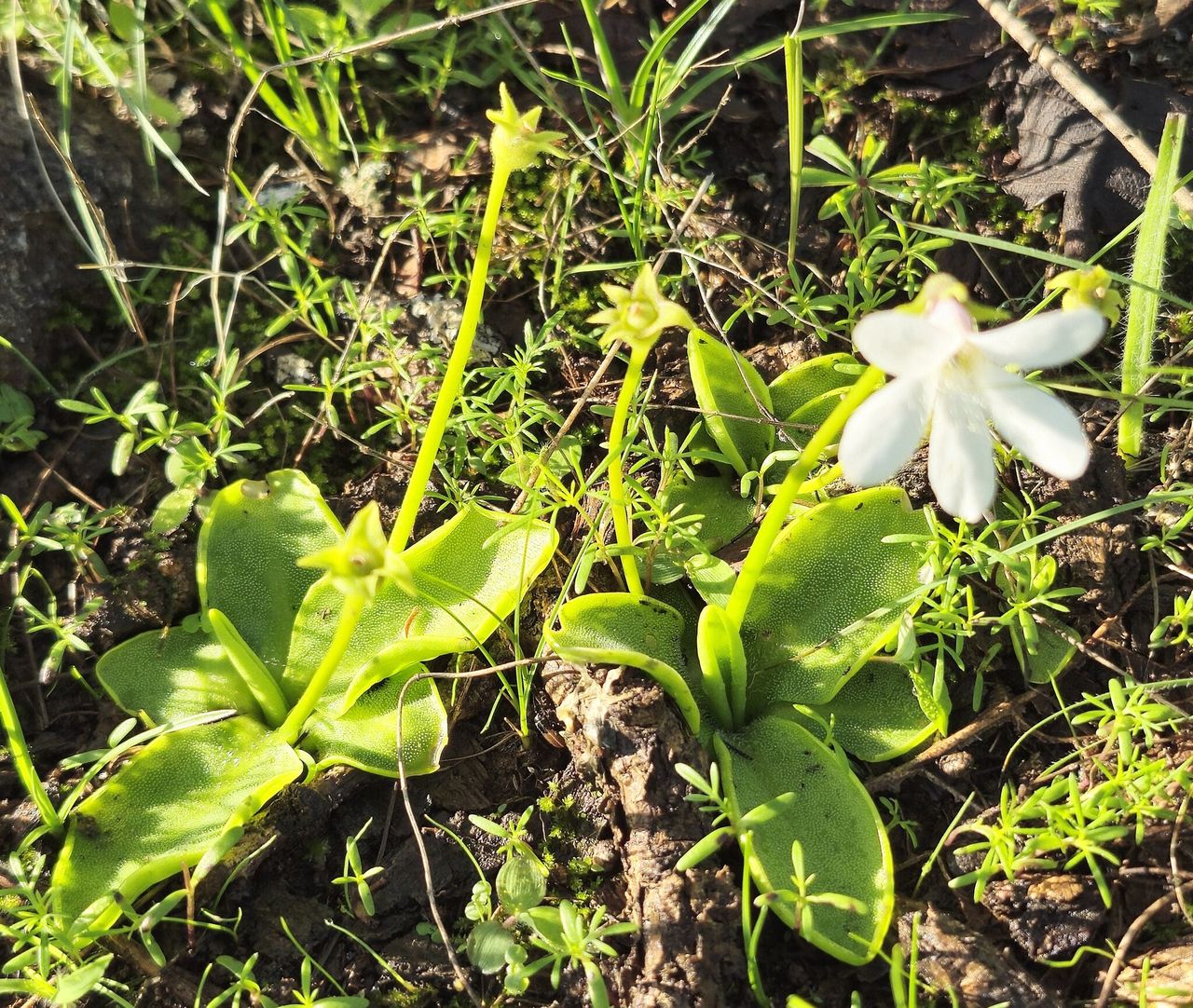
The winter rosette is hypogeal, a compact bulb-like bud 10 to 25(30) mm across built from 20 to 50 thick fleshy leaves; the outer ones are 14 to 27(30) mm long and (1)5 to 16(20) mm wide, with an acuminate tip and ciliate margins. During the rains it produces a summer rosette of only 4 to 6 thin, petiolate leaves, ovate-elliptic and 15 to 60 mm long by 11 to 40 mm wide — markedly broader than in related species. There are 2 to 6 scapes 40 to 135(150) mm tall. The flower is white to faintly lilac, 16 to 25(30) mm including the spur, with nearly equal lobes 8.5 to 13.5(15) mm long and a short, almost cylindrical tube 5 to 8 mm long; the spur is green and short, 2 to 4 mm. Flowering runs from June to August.
Similar species
The comparison drawn by the protologue itself is with Pinguicula parvifolia. Two things separate them: the summer leaves of P. casperi are far broader (15 to 60 by 11 to 40 mm against 15 to 50 by 7 to 15 mm), and its calyx lobes enlarge as the fruit ripens and come to overlap, which they do not in P. parvifolia. That last point is a welcome field character, because it remains visible after flowering. Large-flowered long-spurred species of section Orcheosanthus are ruled out at once: the spur here is barely four millimetres and green.
The trap and how it works
The broad summer leaves do the catching. They carry stalked glands with a clear sticky droplet and, between them, sessile glands that release digestive enzymes only once prey is lying on them; over the following hours the leaf margin bends slightly across the catch so the fluid stays put. That the plant emerges exactly at the start of the rains is no accident: in the Mexican mountains that is the moment when insect numbers explode, with swarms of midges, hoverflies and flying ants. During the dry months the plant does not feed — the underground bud has no glands and is purely a survival organ.
Habitat and ecology
Open oak and pine-oak woodland with elements of tropical deciduous forest, between 1300 and 2722 m. The soil is regosol over extrusive igneous rock: a thin, loose layer of weathered material on volcanic bedrock, saturated during the rains and bone dry in the dry season (D4). The plants grow among grass and litter in clearings and along woodland edges (B5), often on small slopes where water runs off at the surface after rain (R1). The underground winter bud is the answer to that extreme seasonal swing: while the soil is hot and dry there is nothing to see above ground.
Distribution and elevation
Endemic to western and north-western Mexico, known from the states of Durango and Jalisco. Our finding differs here from the guide's species list, which gives Nuevo León: the original description names Durango and Jalisco only, on the western side of the country, well over a thousand kilometres from Nuevo León. The altitudinal span is remarkable for a Mexican butterwort — from 1300 to nearly 2750 m — which suggests the species is not tied to one mountain belt and that further populations probably lie between the known sites in the still poorly explored Sierra Madre Occidental.
- Recorded (one-degree cells)
Forms and variation
No wild varieties are recognised. Variation within the species is nonetheless considerable, and it goes with the wide altitudinal span: plants from the lowest sites stay smaller and flower earlier than those at nearly 2700 m, and flower colour runs from pure white to pale lilac. Such differences are readily visible but have not been named as separate forms, and until comparative work has been done along the whole gradient that is the sensible line. No natural hybrids are reported.
Where and when to see it
July is the best moment: the rains have then been under way for some weeks, the rosettes are full-grown and the scapes are up. Search open oak and pine-oak woodland on the western slopes of the Sierra Madre Occidental, where the grass cover is thin and bare loose soil shows through — a closed sward rules the species out. The white flowers on ten- to fifteen-centimetre scapes show from a few metres away; the rosette itself lies flat and vanishes against the litter. Outside the rains there is no point looking: the whole plant is then underground.
Conservation status
The species has not been assessed for the global IUCN Red List and is not listed in CITES. What is known is limited: a species described in 2018, recorded from two states, with a wide altitudinal range but an unknown number of populations. Its habitat — open, seasonally dry oak and pine woodland — is under pressure in this part of Mexico from logging, grazing, fire and conversion to farmland, and the underground winter bud offers only limited protection against that: a plant invisible in the dry season is simply taken along by any soil work. Without a formal assessment any statement about trend is guesswork, and that lack of data is the real problem here.
Scientific name
Pinguicula casperi | Juarez & Zamudio, 2018
Described by Hilda Dalila Juárez and Sergio Zamudio in 2018, in Phytoneuron 2018-14: 1–20. The type area lies in Mezquital municipality, in the Mexican state of Durango. The species name casperi honours the German taxonomist Siegfried Jost Casper, who devoted decades to studying the genus Pinguicula worldwide.
World Checklist of Vascular Plants (WCVP), via Plants of the World Online (POWO), Royal Botanic Gardens, Kew.