All species › Lamiales › Bladderwort family › Pinguicula bissei
Pinguicula bissei
Pinguicula bissei is one of those Cuban butterworts described only recently and found only if you know exactly where to go: along the banks of the Báez river in the far east of the island, in the hills behind Baracoa. The species is named for Johannes Bisse, the German botanist who with Cuban colleagues mapped the flora of eastern Cuba for decades, and whose collections underlie almost every recent butterwort description from this region.
Identification
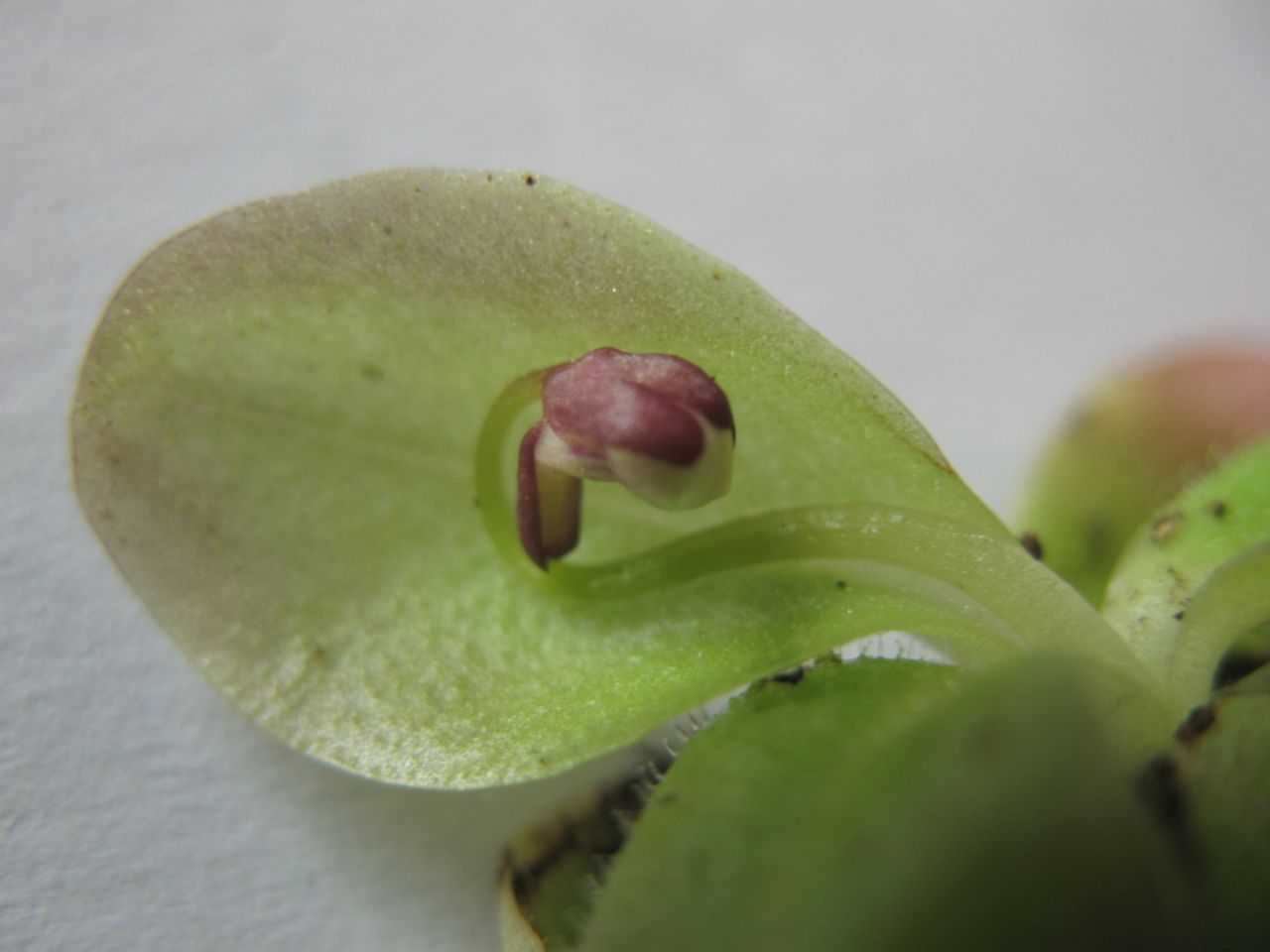
A small, flat rosette of entire, fleshy leaves whose upper surface is densely set with stalked glands; in raking light the leaf looks wet while feeling dry. From the centre rise slender, glandular-hairy scapes, each with a single two-lipped flower with a spur behind, the standard architecture of the genus. The plant grows pressed against damp, vegetated rock and bank soil, so it lies literally in the horizontal plane — you look down onto the rosette. Out of flower it is mainly the glistening glandular coat that betrays it.
Similar species
The identification problem in eastern Cuba is not the genus but the species: several closely related butterworts grow within a short distance of each other, and the differences lie in flower measurements and seed details you cannot see in the field. Pinguicula baezensis comes from the same river bank and can only be separated with the descriptions in hand. P. benedicta has been discussed in the literature as possibly the same species. Practical advice for the field: record the locality precisely, photograph flower, spur and leaf from the side, and leave the name to whoever has the descriptions.
The trap and how it works
As a flypaper trap the species works like any butterwort. The leaf carries two gland types: stalked ones bearing a clear sticky droplet, and sessile ones that release digestive enzymes only once prey is actually lying on them. Small insects landing on the leaf, or blown onto it, stick fast; the more they struggle the more glands they touch. In broader-leaved rosettes like these the leaf margin slowly rolls towards the prey, so the digestive fluid pools in a shallow dish. In a stream valley the supply is generous: midges, craneflies and other small fliers that swarm over running water.
Habitat and ecology
The known habitat is a mountain river bank: permanently moist, shaded to half-shaded rock and earth faces that spray and seepage never allow to dry. That is the classic niche of the Cuban butterworts — a narrow strip beside the water where the substrate is constantly rinsed and too little remains for ordinary herbs. Labelled material comes from about one hundred and fifty-five metres, so from the low hills and not from the high cloud forest. The surrounding landscape is that of the Moa–Baracoa massif, with its nutrient-poor, metal-rich soils. Such a bank strip is also a dynamic place: every downpour shifts sand and stone, washes plants away and exposes bare ground elsewhere. Species that persist there live as a shifting mosaic rather than as a fixed population.
Distribution and elevation
Endemic to Cuba and, as far as known, restricted to Guantánamo province, Baracoa municipality: the banks of the Báez between Camarones and Mina Amores. Recent Cuban species-monitoring data place the species inside Alejandro de Humboldt National Park, one of the best protected areas in the Caribbean. The range is therefore measured in a few river kilometres — the kind of distribution that in this genus on Cuba is the rule rather than the exception.
- Recorded (one-degree cells)
Forms and variation
No wild subspecies or varieties are recognised. In a species known only from a short stretch of river there is little room for geographical variation either: what varies is size with situation, with larger rosettes on permanently wet shaded ground and smaller ones where the substrate dries briefly in the dry months. The main open question is not one of form but of taxonomy: the boundary against a few closely related Cuban butterworts has not been settled in every respect. What makes the work difficult is that the flowers are small and fade quickly, while flower measurements carry the distinction. For the guide that means using the name with reservation and treating every well-dated, well-photographed find as a building block towards a definitive arrangement.
Where and when to see it
Search the river itself rather than the slopes above it: the strip the water reaches at high flow, where moss and liverwort stay green all year. Get low and look into the light, so the droplets catch. The best chance of flowering plants is in spring, when most eastern Cuban butterworts bloom. The area lies inside a national park; go with a guide and with permission, and leave the plants standing — collecting here is both pointless and damaging.
Conservation status
The species has not been assessed for the global IUCN Red List and is not listed in CITES. What is known is enough to be careful: an endemic known only from a short stretch of river bank in eastern Cuba, an area measurable in hectares. That the known site falls inside a national park is the main favourable factor; the unfavourable ones are mining and deforestation in the wider region and the sensitivity of such bank populations to changes in run-off and to exceptional floods. The absence of a category mostly means nobody has yet opened the file.
Scientific name
Pinguicula bissei | Casper, 2004
Described by Siegfried Jost Casper in 2004, in Wulfenia 11: 1–13. The type area lies in eastern Cuba, in Guantánamo Province, in the Alturas de Baracoa near Camarones, on the banks of the Río Báez. The species name bissei honours the German botanist Johannes Bisse, who in 1966 initiated the German-Cuban collaboration to study the flora of Cuba.
World Checklist of Vascular Plants (WCVP), via Plants of the World Online (POWO), Royal Botanic Gardens, Kew.