All species › Caryophyllales › Tropical pitcher plant family › Nepenthes undulatifolia
Nepenthes undulatifolia
A small mountain species from south-eastern Sulawesi, named for its wavy leaf margins: undulatifolia means 'with undulate leaves'. It was described in 2011 by Joachim Nerz, Andreas Wistuba, U. Zimmermann, Ch'ien Lee, Pirade and Ramadhanil Pitopang, in the same volume in which Nepenthes nigra was published. It is known only from the province of South-East Sulawesi, a part of the island far less explored botanically than the centre.
Identification
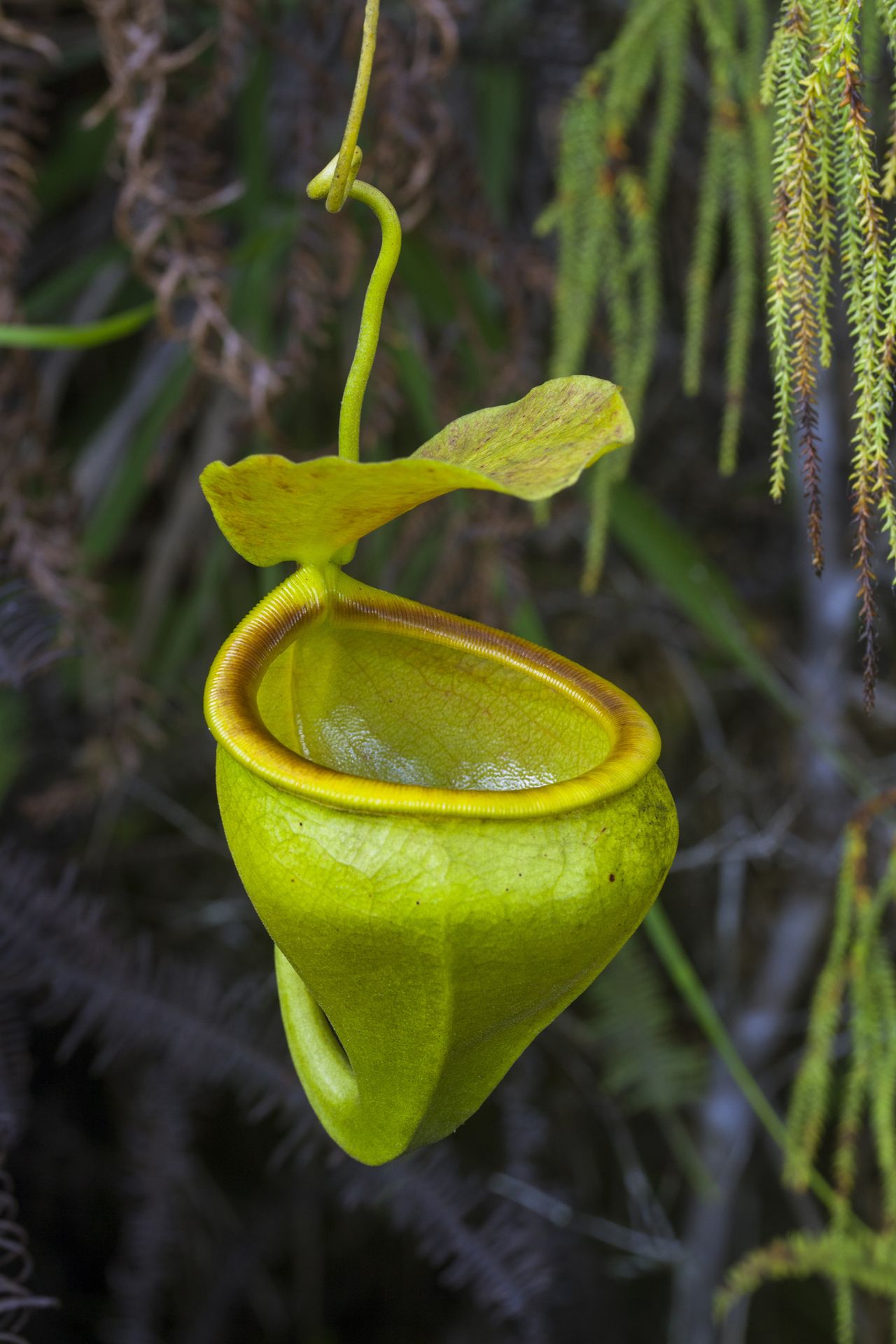
A climber to about three metres, growing on the ground or as an epiphyte. The climbing stems are obtusely three-angled and twisted, to 6 mm thick. The best character lies in the leaves of the short shoots: sessile, oblong to spathulate, 12 to 15 cm long and up to 5.3 cm wide, with an undulating blade and a minutely wavy margin. The lower pitchers are small and urn-shaped to slightly ovate, 5 to 9.5 cm tall, with two fringed wings and a strikingly broad peristome up to 2 cm. The upper pitchers are broadly funnel-shaped and contracted just below the mouth, 7 to 9 cm tall and about 6 cm wide, without wings but with two prominent ridges. The tendrils of the climbing stems are coiled once or twice halfway along. The difference between lower and upper pitchers is linked to growth stage: young plants and rosettes form lower pitchers, and only when the stem begins to climb do upper pitchers appear, their tendrils often coiling around a support.
Similar species
Wavy leaf margins also occur in some plants of Nepenthes maxima on Sulawesi, but that species has much longer, narrowly funnel-shaped upper pitchers with a narrow peristome. N. undulatifolia has short, broad pitchers with a broad peristome. The species is placed in section Tentaculatae, with among others N. tentaculata, N. hamata, N. nigra and N. glabrata; from these relatives it differs in its wavy leaves and broad peristome.
The trap and how it works
Small, stout pitfalls with a broad peristome. The lower pitchers, with their fringed wings, stand in moss or on the ground and take mainly walking animals; the upper pitchers hang on coiled tendrils in the vegetation. The broad peristome with its nectar glands turns slippery when wet, so insects seeking nectar there slide into the pitcher. Nectar glands also lie under the lid, and digestive fluid stands at the bottom. No prey study has been published. Work on other species of the genus has shown that the peristome works by 'aquaplaning': a thin film of water on the finely ribbed surface makes it so slippery that the adhesive pads of insect feet can no longer grip. The trap therefore works best when it is damp, which in cloud forest is almost always the case.
Habitat and ecology
Mossy forest and open landslips on steep ridges, at around 1800 m (B1, B5). On such ridges dense moss in the cloud forest alternates with bare, open places where slopes have slipped away; the species makes use of both. The consulted sources give no details of the substrate. For a pitcher plant such a habitat is favourable: the constant humidity keeps the pitchers filled and the peristome slippery, while the poor soil supplies little nitrogen and phosphorus, so that the extra nutrition from prey is a real advantage.
Distribution and elevation
Endemic to Sulawesi and known only from the province of South-East Sulawesi. This agrees with 'Sulawesi, south-east' in the guide's own species list. Since the mountains of the south-eastern peninsula are little explored, the real range is probably larger than now known. Sulawesi lies east of Wallace's Line, in the transition zone between the Asian and Australian floras and faunas, and holds far fewer pitcher plants than Borneo; all the more striking, then, that a large share of the island's species is endemic.
- Recorded (one-degree cells)
Forms and variation
No varieties or wild forms have been described. The degree of leaf undulation varies between plants. No natural hybrids were found in the literature for this guide. Like all pitcher plants the species is dioecious: there are male and female plants, and both must be in flower for seed to set. The small, inconspicuous flowers are borne in racemes or panicles and are pollinated by insects; the seeds are light and dispersed by wind.
Where and when to see it
The mountains of South-East Sulawesi are little visited and reachable on treks of several days with local guides. At around 1800 m on steep ridges, in the moss and along open landslips, search for small, broad pitchers and rosettes with wavy leaves; those leaves are often the most conspicuous feature from a distance.
Conservation status
There is no IUCN assessment of this species (Not Evaluated). What is known: the species is recorded from one province only, and in the published description from a limited area. South-East Sulawesi, like other parts of the island, is seeing expanding mining and clearance, although it is not known whether these affect the sites. As a member of Nepenthes it is listed in CITES Appendix II.
Scientific name
Nepenthes undulatifolia | Nerz, Wistuba, Zimmermann, Lee, Pirade & Pitopang, 2011
Described by Nerz, Wistuba, U. Zimmermann, Chi.C. Lee, Pirade & Pitopang in 2011 — not in a scientific journal, but in S.R. McPherson's book "New Nepenthes: Volume One" (Redfern Natural History Productions), p. 492-505. South East Sulawesi, around 1800 m elevation; precise coordinates are not known. From the Latin undulatus ("wavy") and folium ("leaf") — refers to the wavy leaf margin.
World Checklist of Vascular Plants (WCVP), via Plants of the World Online (POWO), Royal Botanic Gardens, Kew.