All species › Caryophyllales › Tropical pitcher plant family › Nepenthes reinwardtiana
Nepenthes reinwardtiana
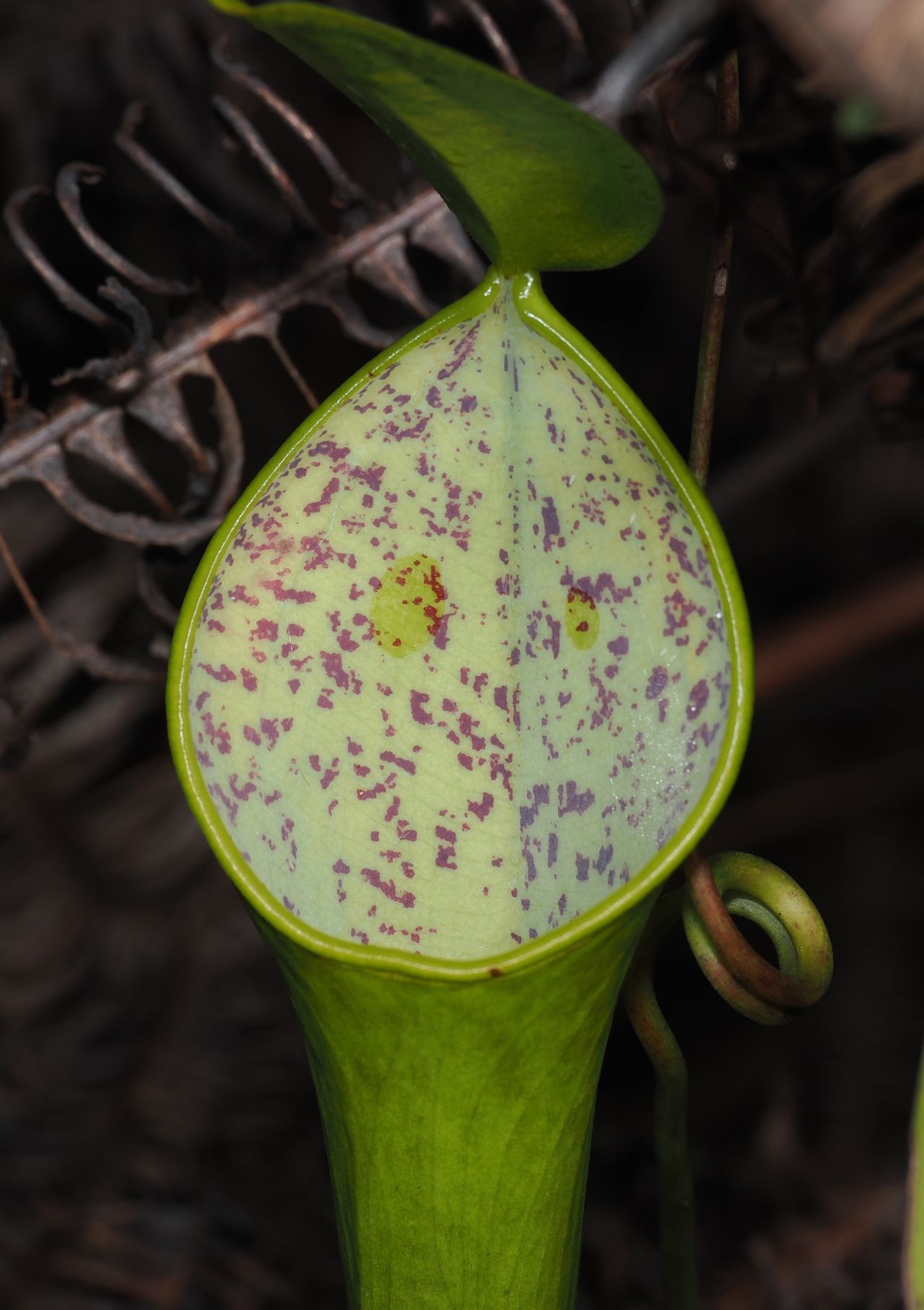
The pitcher plant with 'eyes'. On the inside of the upper pitchers of Nepenthes reinwardtiana there are usually two dark spots, sharply outlined against the bluish, waxy wall, and by that feature the species can almost always be recognised in the field. Friedrich Anton Wilhelm Miquel described it in 1852 and named it after Caspar Georg Carl Reinwardt, founder of the Botanic Gardens at Buitenzorg (Bogor). Unlike most species in this group it is no narrow mountain endemic: it occurs on Sumatra and Borneo, from peat-swamp forest at sea level to ridges above 2000 m.
Identification
A shrub or climber of 2 to 8 m, sometimes to 20 m, terrestrial or epiphytic, with a triangular stem 3 to 7.5 mm thick, two of whose angles are sometimes narrowly winged. The leaves are papery, sessile, narrowly elliptic to oblong, 11 to 25 cm long and 1 to 3 cm wide (sometimes 4.5 cm), with one to three longitudinal veins on each side; the whole plant is glabrous. Lower pitchers are ellipsoid to almost cylindrical, to 11 cm tall and 4 cm wide, with fringed wings and a rounded, scarcely ribbed peristome of 0.5 to 1 mm. Upper pitchers are 9 to 19.5 cm long, rarely to 31 cm, 3 to 5 cm wide at the base, constricted at the middle and widening again to the mouth; the inner wall is bluish and waxy, usually with two (rarely none, one or three) dark eye-spots just below the peristome. Colour is light green, sometimes flushed or spotted red; the flowers are reddish black.
Similar species
Often confused with Nepenthes gracilis, which grows in the same places in the lowlands of Sumatra and Borneo. That species has four to six pairs of longitudinal veins instead of one to three, teeth on the inside of the peristome instead of glandular pits, a cordate instead of truncate lid base, and lacks the eye-spots. N. tobaica and N. murudensis have been regarded as relatives in the past but differ clearly in pitcher shape and peristome. Molecular work places N. reinwardtiana next to N. macrovulgaris, a species of ultramafic soil on Borneo.
The trap and how it works
The upper pitchers are funnel-shaped with a strikingly bluish, waxy inner wall. That wax layer is so smooth that insects find no grip on it, and it forms the background against which the eye-spots stand out so strongly. What the spots are for has not been resolved; they lie where insects following the nectar of the peristome look into the pitcher. The peristome itself is narrow and almost unribbed, with glandular pits along the inner edge; the lid bears numerous small nectar glands. Prey ends up in a digestive fluid in the bottom of the pitcher.
Habitat and ecology
Remarkably broad: lowland peat-swamp forest (B4), heath forest and ridges on sandstone or limestone (B3), more rarely cloud forest (B1), and sometimes ultramafic soil (R3), from sea level to 1450 m and locally to 2100 m. The species often grows epiphytically and also occurs in secondary vegetation. According to Cheek & Jebb (2001), red pitchers are known only from plants on ultramafic ground, sandy heath soil or podzol, where the plant is most exposed to light and nutrient poverty.
Distribution and elevation
Sumatra and Borneo, with the smaller islands around them: Bangka, the Natuna Islands, Nias and Siberut. Old records from the Malay Peninsula and Singapore are regarded as erroneous. Within Sumatra and Borneo the species is widespread but not common everywhere; its altitudinal range runs from 0 to 2100 m. The world checklist gives Borneo and Sumatra.
- Recorded (quarter-degree cells)
Forms and variation
One variety has been described, N. reinwardtiana var. samarindaensis J.H.Adam & Wilcock (1993), from East Kalimantan; whether it can be separated as a distinct variety is not generally accepted. There is also a green and a red colour form, the red apparently tied to the poorest soils. The number of eye-spots varies: some populations have one, three or none. Natural hybrids are reported with nine other species, including N. albomarginata, N. ampullaria, N. fusca, N. gymnamphora and N. tobaica.
Where and when to see it
Thanks to its broad ecology the species can be found in many places: in lowland peat-swamp forest and on heath soil with open, low vegetation, but also on sandstone ridges in the interior of Borneo. Look into the upper pitchers: the two dark spots against the blue wall are the surest feature and separate it at once from N. gracilis. In peat-swamp forest boots or wading shoes are no luxury; on ridges the plant often grows epiphytically, so the pitchers hang above eye level.
Conservation status
Assessed on the Red List as Least Concern: the range covers two large islands and a string of smaller ones, the altitudinal span is exceptionally wide and the species tolerates secondary vegetation. As a member of the genus it is listed in CITES Appendix II. Lowland populations suffer from the conversion of peat-swamp and heath forest to plantations and from peat fires; mountain and epiphytic populations are less vulnerable.
Scientific name
Nepenthes reinwardtiana | Miquel, 1852
Nepenthes reinwardtiana was described in 1852 by Friedrich Anton Wilhelm Miquel. The species is native to Borneo and Sumatra, plus several smaller surrounding islands (Bangka, Natuna, Nias and Siberut); a precise type locality could not be established with certainty. The specific epithet honours Caspar Georg Carl Reinwardt, the same botanist who himself described N. gymnamphora and N. maxima (golf 23/26) in 1824 — here honoured in turn by another author.
World Checklist of Vascular Plants (WCVP), via Plants of the World Online (POWO), Royal Botanic Gardens, Kew.