All species › Caryophyllales › Tropical pitcher plant family › Nepenthes palawanensis
Nepenthes palawanensis
Palawan, the long narrow island in the west of the Philippines, has a pitcher plant of its own on almost every high summit. Nepenthes palawanensis is one of them: a robust, squat plant with enormous pitchers, known only from the bare summit of a single mountain in the south-central part of the island. It was described in 2010 by an international team around Stewart McPherson, shortly after the much-publicised description of Nepenthes attenboroughii from another Palawan mountain. The name simply refers to the island, to which the species is endemic.
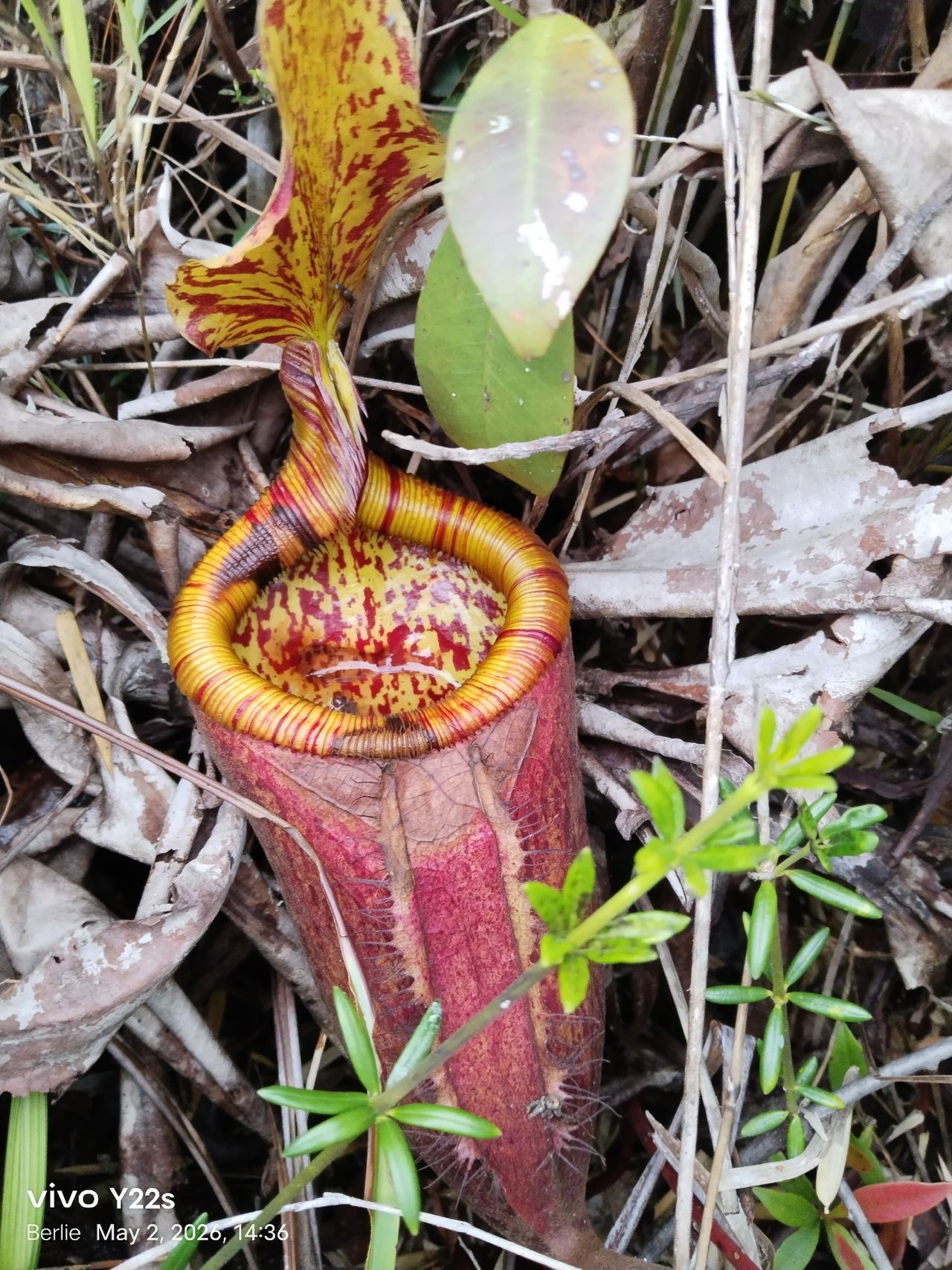
Identification
Not a climber in the usual sense but an erect to sprawling, unbranched shrub up to about a metre tall, with an exceptionally thick stem of 2.5 to 3.5 cm. The leaves are large and leathery, elliptic to oblong, 20 to 45 cm long and 6 to 15 cm wide, with a blunt or notched tip and a base clasping the stem; the tendrils reach 60 cm and are not coiled. The leaf is green, with dark red to purple on the midrib. The pitchers are large: up to 34 cm tall and 13 cm wide, funnel-shaped to cylindrical, with an oblique mouth up to 14 cm wide. The peristome is cylindrical to flattened, up to 24 mm wide, with ribs up to three millimetres high. The lid is elliptic, up to 14 cm long. Colour varies: green to red and purple mottled with purple-black bands on the peristome, or wholly orange-red outside and yellow-green inside with dark purple blotches. Upper pitchers are unknown from the type locality.
Similar species
On Palawan each high mountain stands more or less alone, and the large pitcher plants of the island's summits are mostly each confined to one mountain or massif. Closest in size and habit is Nepenthes attenboroughii, which grows on another massif in central Palawan; both form squat, upright plants with very large pitchers in open summit vegetation. Since the two do not occur on the same mountain, the locality is in practice the first identification character. The common lowland species of Palawan, Nepenthes philippinensis, with its narrow leaves and small pitchers, cannot be confused with it.
The trap and how it works
A pitfall trap on a large scale. With a mouth up to 14 cm wide and a peristome up to 24 mm, set with ribs as much as three millimetres high, this species has one of the broadest catching rims of any Philippine pitcher plant. Such large pitchers can catch and hold fairly large animals, and in related giant species small vertebrates have been found in them now and then; for this species that has not been documented. The spur behind the lid is stout, up to 14 mm long. The pitchers stand at the foot of the plant on or just above the ground, and catch mainly walking and crawling animals. Nothing has been published on the prey of this species.
Habitat and ecology
Exposed upper montane scrub on the summit and summit ridge, above 1100 m (B6). The species is absent from the montane forest on the slopes and grows only in sunny places where the vegetation stays below a metre. Such open summit vegetation on poor soil is typical of the peaks of Palawan and of many of the island's pitcher plants. The elevation field gives the range stated in the description.
Distribution and elevation
Endemic to Palawan, and known only from one summit in the south-central part of the island. Because the species is listed as Endangered on the Red List, this guide does not name the mountain. Its habitat covers only the summit and summit ridge above 1100 m, and is therefore very small.
- Recorded (one-degree cells)
Forms and variation
No varieties have been described, but pitcher colour varies clearly between plants: from green, red and purple mottled with dark peristome bands to entirely orange-red outside. Upper pitchers are unknown, presumably because in open scrub the plant rarely climbs. No natural hybrids have been reported.
Where and when to see it
For this species the rule is: look from a distance, or look at photographs. The habitat is small, the soil of open summit vegetation is fragile, and every newly trampled patch counts. Anyone visiting the mountain on an official expedition or guided trip will find the pitchers at the foot of the low shrubs on the summit ridge; stay on existing trails and take nothing. On Palawan, access to summits often requires permits from the provincial government and the indigenous communities concerned.
Conservation status
The Red List assesses the species as Endangered. Its habitat is limited to one small summit, and every loss to fire, trampling or collection weighs heavily. Large pitcher plants of Palawan have been the target of illegal collectors in the past. As a member of Nepenthes it is listed in CITES Appendix II, so international trade in wild plants requires a permit. Palawan as a whole enjoys protected status as a biosphere reserve, but that alone does not stop poaching.
Scientific name
Nepenthes palawanensis | McPherson, Cervancia, Lee, Jaunzems, Mey & Robinson, 2010
Nepenthes palawanensis was described in 2010 by Stewart McPherson, Alexander Cervancia, Ch'ien C. Lee, Ugis Jaunzems, François Sockhom Mey and Alastair Robinson, in "Nepenthes palawanensis (Nepenthaceae), a new pitcher plant species from Sultan Peak, Palawan Island, Philippines" (Carnivorous Plants and their Habitats, volume 2, pp. 1332-1339). The species was discovered in February 2010 by Jehson Cervancia and Stewart McPherson. Sultan Peak, Palawan island, Philippines, at 1,100-1,236 m elevation — the species' only known locality. The specific epithet derives from the island of Palawan, to which the species is endemic, with the Latin suffix "-ensis", meaning "from".
World Checklist of Vascular Plants (WCVP), via Plants of the World Online (POWO), Royal Botanic Gardens, Kew.