All species › Caryophyllales › Tropical pitcher plant family › Nepenthes izumiae
Nepenthes izumiae
A pitcher plant that lives almost entirely in the tree crowns. Nepenthes izumiae was found in July 2000 during the same expedition to the highlands north of Bukittinggi that produced N. jacquelineae. Clarke still listed it in his 2001 monograph as 'Nepenthes species B'; in 2003 Troy Davis, Charles Clarke and Rusjdi Tamin formally described it in Blumea, naming it after Izumi Davis, the first author's wife. It is a robust species with long, cylindrical lower pitchers, growing on mossy branches high in the cloud forest.
Identification
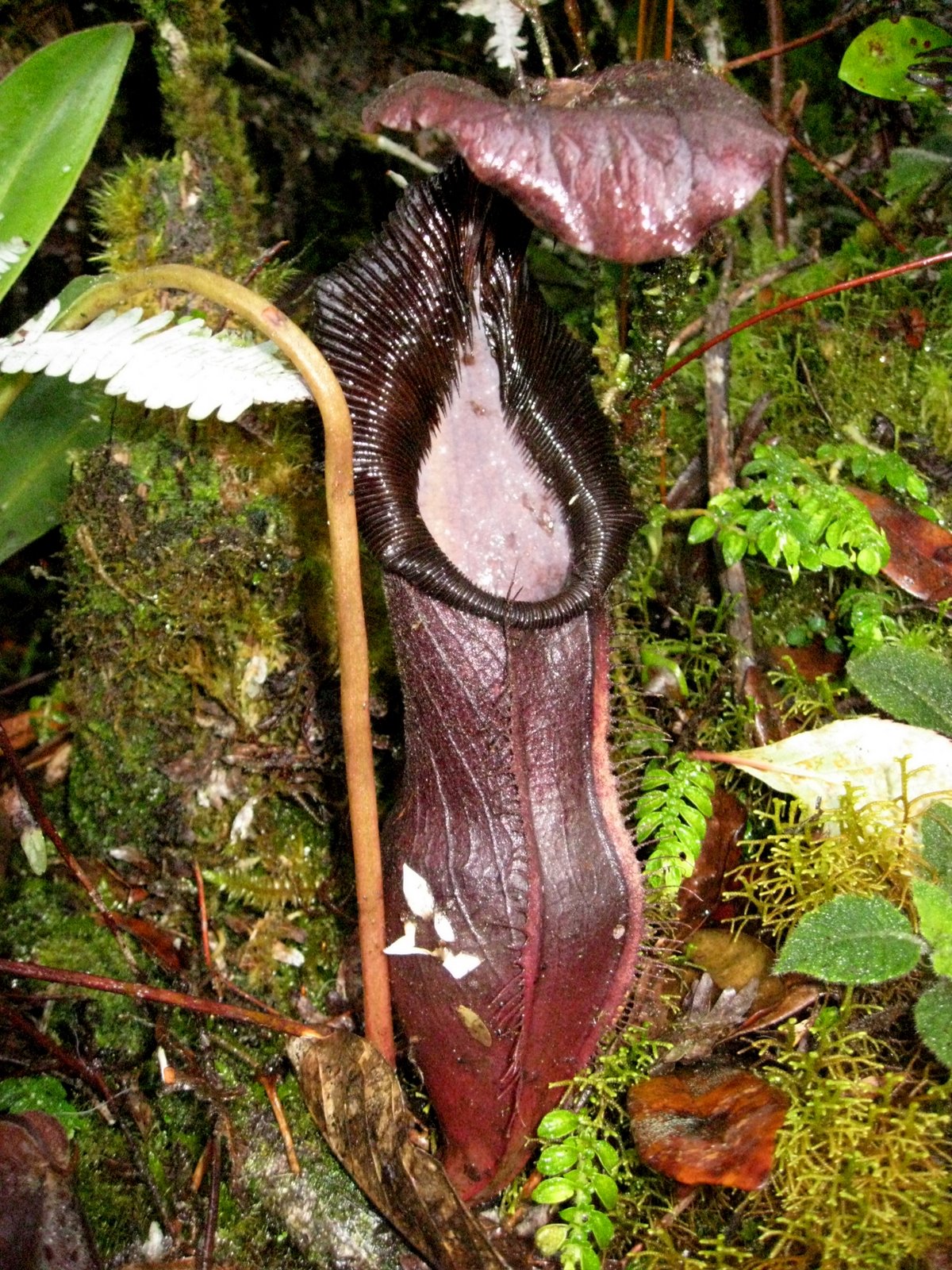
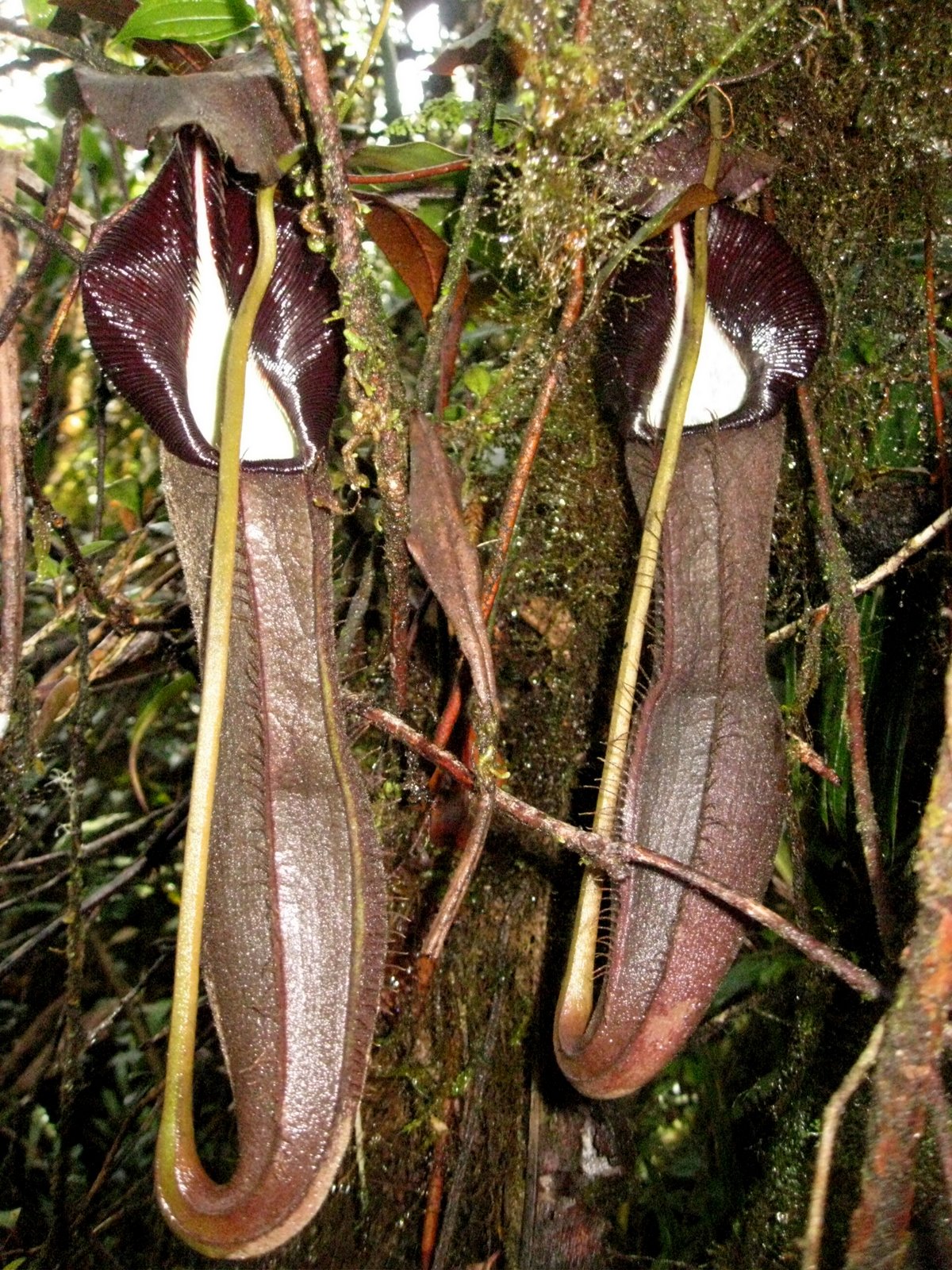
A climber with a round to angular stem up to 8 mm thick and internodes to 12 cm. Rosette leaves are strikingly large, broadly lanceolate to spathulate, to 25 cm long and 8 cm wide, sessile, with three longitudinal veins on each side; leaves of the climbing stem are smaller and ovate, to 20 cm long and 3 cm wide, with a rounded tip. The leaf margin carries persistent hairs. The lower pitchers are the ones most seen: to 30 cm tall and 6 cm wide, funnel-shaped below and cylindrical above, with fringed wings to 6 mm (fringe to 9 mm), a mouth to 6 cm, and a peristome up to 3 cm wide with pronounced, narrow teeth up to 1 cm long. The lid is round, to 8 cm across, often with a hook-shaped appendage or crest up to 1 cm on its underside. Upper pitchers are rarely formed: to 15 cm tall and 4 cm wide, with a narrow peristome to 8 mm.
Similar species
The closest relatives are Nepenthes lingulata and N. singalana. N. lingulata from North Sumatra has a triangular lid with a long, thread-like tongue on its underside, up to 4 cm, and narrower pitchers; N. izumiae has a round lid and at most a short crest. N. singalana has narrower blades without persistent marginal hairs, rarely a crest under the lid, and grows on the ground rather than epiphytically. N. bongso has more slender upper pitchers and grows much more often terrestrially.
The trap and how it works
The large lower pitchers, resting on mossy branches and among epiphytes, catch whatever crawls over the moss: ants and other arthropods of the tree crowns. An epiphytic pitcher sits in the middle of its own small world of moss, ferns and litter, where small animals are constantly on the move. The peristome teeth on the inner edge overhang the opening, and the broad, ribbed peristome turns slippery in the daily mist and rain. The crest under the lid carries nectar glands and draws insects to a spot above the mouth, so that a slip ends in the pitcher. A digestive fluid stands in the bottom.
Habitat and ecology
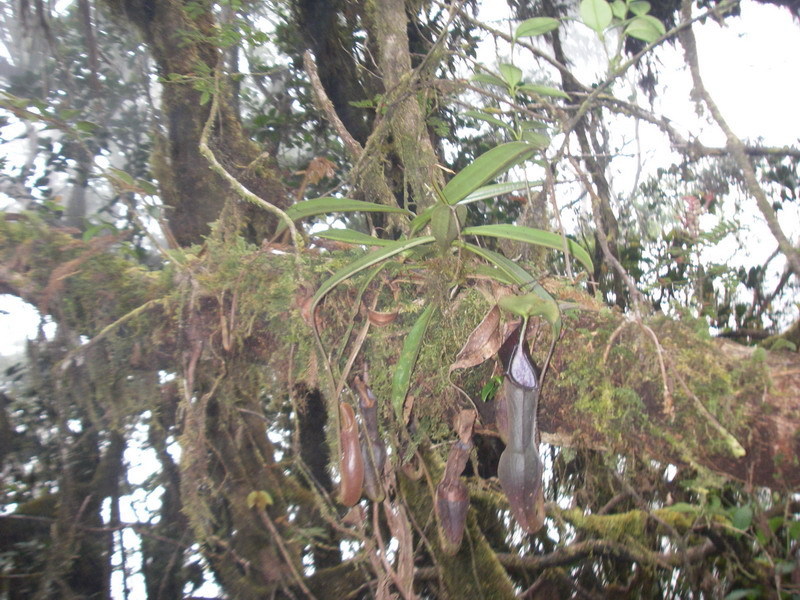
Moist, mossy upper montane cloud forest (B1) above 1700 m, with filtered light. The species grows almost exclusively as an epiphyte, on moss-covered branches and trunks, occasionally on the ground over a thick moss layer. The accompanying vegetation is dominated by ferns of the genera Dicranopteris and Dipteris. The recorded altitude is 1700 to 1900 m. For an epiphyte this is a favourable setting: the moss on the branches holds water, the air is almost saturated, and drying out, the greatest risk for plants without roots in the soil, hardly ever happens.
Distribution and elevation
Endemic to Sumatra, in the Barisan Mountains of West Sumatra, and known only from two peaks north of Bukittinggi. The authors deliberately withheld the exact locality to protect the populations from collectors. The world checklist gives Sumatra as its only area.
- Recorded (one-degree cells)
Forms and variation
No varieties or colour forms have been described. Natural hybrids are known with N. dubia, producing small, yellowish-green funnel pitchers, and with N. jacquelineae, with reddish pitchers in which the features of N. jacquelineae dominate. Both species grow in the same highlands.
Where and when to see it
The highlands north of Bukittinggi have no marked trails to the sites; go with a local guide. Look up at the mossy branches: the long lower pitchers lie there among moss and ferns, not on the forest floor. In the filtered light they are easily overlooked. The species is sensitive to collecting; share no location data.
Conservation status
Assessed on the Red List as Least Concern. The situation is nonetheless more fragile than that category suggests: the species is known from only two peaks, its populations lie outside national parks, and they are threatened by poaching and collecting, forest fires and clearance. As a member of the genus it is listed in CITES Appendix II.
Scientific name
Nepenthes izumiae | Davis, Clarke & Tamin, 2003
Nepenthes izumiae was described in 2003 by Charles Clarke, Troy Davis and Rusjdi Tamin, in "Nepenthes izumiae (Nepenthaceae): a new species from Sumatra" (Blumea 48(1): 179-182). The holotype (Clarke, Davis & Tamin 1309) was collected on 13 July 2000 in the Barisan Mountains, north of Bukittinggi, and is held at the Herbarium Universitas Andalas (ANDA), Padang, West Sumatra; the exact locality was deliberately withheld from the formal description for conservation reasons. The Barisan Mountains, north of Bukittinggi, West Sumatra; the precise locality has deliberately not been disclosed. The specific epithet honours Izumi Davis, wife of Troy Davis, one of the describing authors.
World Checklist of Vascular Plants (WCVP), via Plants of the World Online (POWO), Royal Botanic Gardens, Kew.